

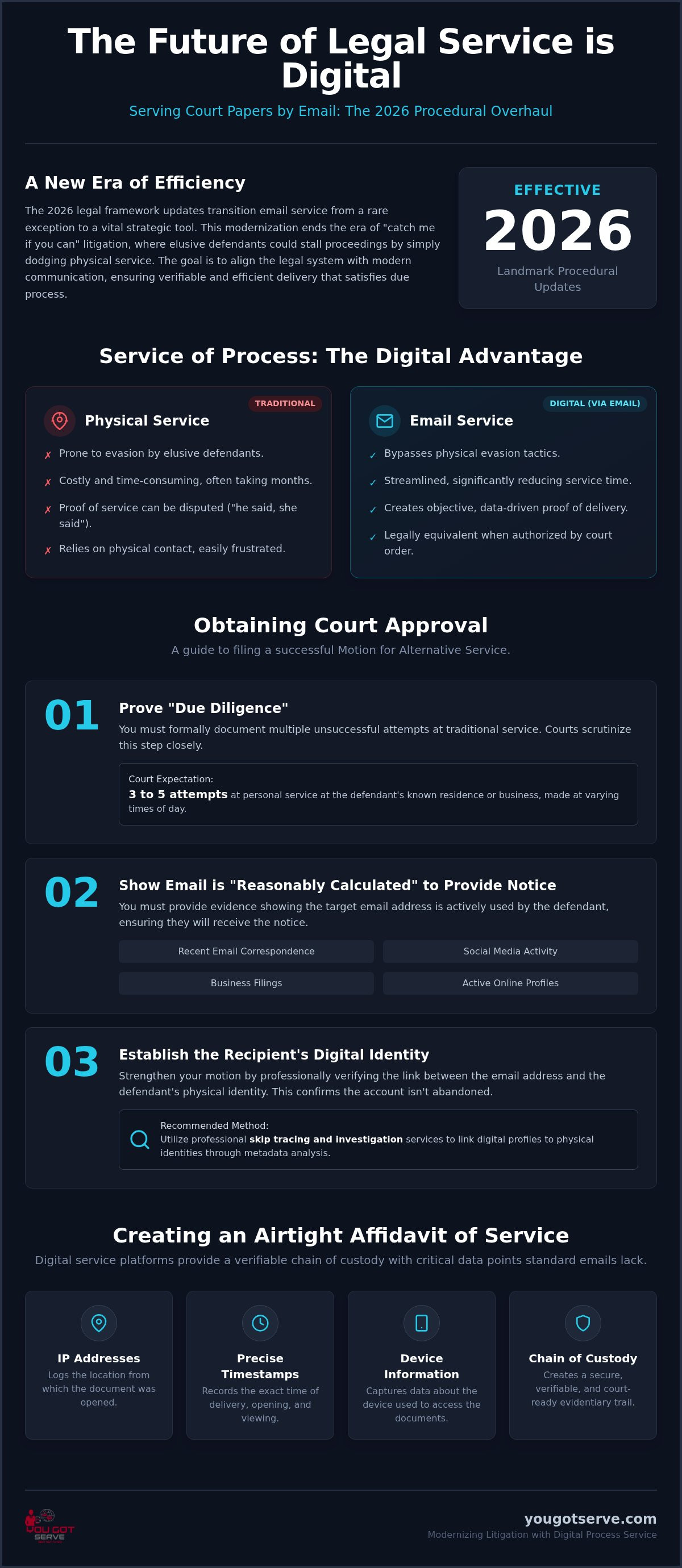
In 2026, the era of "catch me if you can" litigation is officially coming to an end. As jurisdictions nationwide implement landmark procedural updates this year, the ability to serve legal papers by email has transitioned from a rare exception to a vital strategic tool. You've likely felt the frustration of watching litigation stall because a defendant is dodging physical service, turning what should be a routine step into a costly, month-long ordeal. The legal system is finally aligning with modern communication, offering a streamlined path that prioritizes efficiency and verifiable delivery.
We understand that while the technology exists, the fear of a dismissed case due to improper service remains a significant hurdle. This guide provides the precise legal requirements and technical protocols needed to ensure your digital service survives rigorous judicial scrutiny. You'll learn how to navigate the 2026 statutory framework, secure the necessary court orders for alternative service, and utilize advanced tracking to obtain a court-ready proof of service that satisfies due process.
Key Takeaways
- Understand how 2026 procedural updates in major jurisdictions have established electronic delivery as a valid method for satisfying due process requirements.
- Master the specific "due diligence" criteria required to obtain a court order to serve legal papers by email when traditional methods are unsuccessful.
- Learn the technical protocols for document preparation and secure delivery that maintain a verifiable chain of custody for court-approved compliance.
- Identify the critical data points, including IP addresses and timestamps, that are essential for creating an airtight Affidavit of Electronic Service.
- Explore how automated digital platforms provide real-time verification and court-ready documentation to significantly reduce the time spent on the service phase.
The Legality of Serving Court Papers via Email
Electronic service of process is the formal delivery of legal documents through digital channels, primarily email or secure messaging portals. While traditional methods rely on physical contact, the modern judicial system recognizes that the primary objective of Service of process is to provide the defendant with actual notice of the proceedings. Under the Due Process clause, notification is the core requirement. If a plaintiff can demonstrate that digital delivery is reasonably calculated to reach the defendant, courts are increasingly receptive to this method.
It's vital to distinguish between "Service of Record" and "Initial Service of Process." In most jurisdictions, once a case is active, serving subsequent motions or discovery via email is the default. However, to serve legal papers by email for an initial summons, the requirements are stricter. As of January 1, 2026, statutes like California Code of Civil Procedure § 413.30 have formalized this process, allowing summons delivery via electronic technology after a showing of reasonable diligence. Courts are moving toward digital delivery because it eliminates the ability of elusive defendants to stall litigation by simply refusing to open their front door.
When is Email Service Legally Permitted?
Courts generally view email as a form of "Alternative Service." To utilize this, a plaintiff must file a Motion for Alternative Service. This requires proving "due diligence," showing that you've made multiple, unsuccessful attempts at physical delivery. Another common scenario involves contractual agreements. Many modern business contracts now include clauses where both parties pre-authorize the ability to serve legal papers by email to streamline potential litigation. This bypasses the need for a specific court order in many instances.
Common Misconceptions About Digital Service
A prevalent myth suggests that email service is somehow "lesser" than hand-delivery. In reality, when authorized by a court order or statute, digital service carries the same legal weight as a physical summons. However, simply hitting "send" on a standard Gmail account is rarely enough to satisfy a judge.
Standard read receipts are often insufficient for court standards because they can be easily blocked or spoofed. A secure legal delivery platform provides a verifiable chain of custody, capturing IP addresses, device IDs, and timestamps. This technical precision creates an evidentiary trail that a standard email cannot match. Unlike physical service, which can be disputed as a "he said, she said" scenario, digital platforms offer objective, data-driven proof of delivery.
Requirements for Motion for Alternative Service
Securing judicial authorization to serve legal papers by email is not an automatic right; it is a remedy granted when traditional methods prove futile. Most jurisdictions require a formal Motion for Alternative Service, supported by a declaration that establishes "due diligence." This means you must document specific, unsuccessful attempts to reach the defendant through personal service or substituted service at their known residence or place of business. In 2026, courts increasingly scrutinize these efforts, looking for at least three to five attempts at varying times of day before they consider digital alternatives.
Beyond proving that physical service failed, you must demonstrate that the proposed digital method is "reasonably calculated" to provide actual notice. This involves presenting evidence that the recipient actively uses the specific email address provided. For example, the New York Department of State provides Instructions for Electronic Service of Process that highlight how structured protocols ensure legal validity. Your motion should include exhibits such as recent email correspondence, social media activity, or business filings that list the address as a primary point of contact.
Establishing the Recipient's Digital Identity
Proving an email address belongs to a defendant requires more than just a guess. Investigative techniques, such as verifying the account through professional skip tracing and investigation services, add significant weight to your motion. These reports can link a digital profile to a physical identity through historical data and metadata analysis. If you can show the defendant recently replied to an inquiry from that address, the court is much more likely to approve the request, as it confirms the account isn't abandoned or unmonitored.
Drafting the Proposed Order
The proposed order must be precise to avoid future challenges to the service's validity. It should explicitly authorize the plaintiff to serve legal papers by email and define exactly what constitutes "complete" service. Specific language should include:
- The exact email address(es) to be used.
- A requirement for a specific subject line, such as "LEGAL RECAP: SUMMONS AND COMPLAINT ENCLOSED."
- A directive on whether a secondary delivery method, like SMS or social media messaging, is required as a backup.
- A clear timeline, stating that service is deemed complete a certain number of days after the email is sent, regardless of whether a reply is received.
Drafting this order with technical clarity ensures that the resulting proof of service meets the court's standards for a final judgment. Without these specific parameters, a defendant might later claim they never saw the message or that it was filtered into a spam folder, potentially vacating your hard-won court orders.
How to Serve Legal Papers by Email: A Step-by-Step Guide
Executing the technical side of service requires a shift from physical logistics to digital precision. Once you've obtained the necessary judicial authorization to serve legal papers by email, the focus turns to creating a verifiable audit trail. This process begins with meticulous document preparation and ends with a court-ready proof of service that eliminates any claim of non-receipt. Following a structured workflow ensures that the delivery is not only successful but also legally defensible.
Preparing the Digital Service Packet
Your first step is to convert all court documents into a non-editable PDF format. This ensures that the summons, complaint, and any supporting exhibits remain exactly as they were when filed with the court. Organize these files logically. While a single combined file is often easier to track, you must ensure the total size stays below 25MB. Larger packets risk being blocked by the recipient's mail server, which can invalidate the service attempt. It's also best practice to apply a digital timestamp to each document before transmission, locking the versioning and providing a clear baseline for the delivery timeline.
Executing the Delivery via YouGotServe
Utilizing a dedicated platform like YouGotServe bridges the gap between investigative data and formal delivery. After completing a skip trace to identify the most active digital contact, you can upload your prepared packet directly into the system. A professional subject line is not just a courtesy; it's a legal requirement. It must clearly state the nature of the communication, such as "OFFICIAL LEGAL SERVICE: Case Name and Number." This prevents the recipient from claiming they mistook the notification for marketing or spam. The platform handles the formal transmission, including mandatory legal notices in the body of the message. Unlike standard email, this system uses automated delivery reminders to prompt the recipient, increasing the likelihood of a documented interaction.
Chain of custody in digital delivery refers to the chronological documentation of every stage of the document's lifecycle, from transmission and receipt to the specific moment of recipient interaction. This level of detail is what allows you to serve legal papers by email with the same confidence as personal delivery. The system monitors for specific triggers, such as when the email is opened or when the attachments are downloaded. Once these interactions occur, the platform captures the recipient's IP address and device ID, providing the technical evidence required for your final declaration. This automated tracking culminates in the immediate generation of an Affidavit of Service, ensuring you have court-ready proof before the defendant has a chance to respond.
Ensuring Court-Ready Proof of Service and Verification
A standard affidavit signed by a notary is no longer sufficient for digital delivery in 2026. To successfully serve legal papers by email, your proof must be rooted in technical data that links the recipient to the document interaction. This evidence transforms a simple sent message into a legally binding event. The courts now look for a comprehensive audit trail that confirms both the delivery to the correct address and the recipient's opportunity to view the documents.
One of the most critical distinctions in digital service is the difference between "Actual Notice" and "Constructive Notice." Actual notice occurs when the defendant has clearly received the summons, often proven by a link click or a document download. Constructive notice is implied by law when you can prove the email reached a verified, active inbox, even if the defendant refuses to acknowledge it. If an email bounces, it must be handled with the same level of documentation. A professional audit trail includes these failure logs to prove that the plaintiff is acting in good faith and monitoring the delivery status in real time.
The Technical Components of Digital Proof
Metadata serves as the DNA of your service attempt. It captures the hidden layers of data that accompany a digital file. To satisfy a judge, your proof of service should include:
- The recipient's IP address and device ID at the time of interaction.
- Precise timestamps for delivery, opening, and attachment downloads.
- Verification of the recipient's identity through secondary methods, such as SMS codes or unique access tokens.
- A record of the specific mail server's "handshake," confirming the message was accepted by the recipient's provider.
Defending Your Service in Court
The most common defense against digital service is the claim, "I never saw the email." When you serve legal papers by email through a secure platform, you can counter this with an evidentiary log. This log acts as an exhibit, showing a pattern of interaction that makes a "lost in spam" excuse nearly impossible to sustain. Automated delivery reminders further strengthen your position. They provide additional layers of due process by showing the court that you made multiple attempts to ensure the defendant was aware of the pending action.
If a defendant challenges the service, you must be prepared to present the full chain of custody. This includes the skip tracing report that verified the email address and the subsequent tracking logs. Secure your litigation strategy by obtaining court-ready proof of service that stands up to judicial scrutiny and prevents unnecessary delays in your case.
Modernizing Litigation with Digital Process Server Platforms
Traditional process serving often functions as a bottleneck in the litigation lifecycle. Relying on physical proximity and manual delivery attempts creates unpredictable delays and escalating costs, especially when defendants actively evade service. The transition to digital platforms has transformed the ability to serve legal papers by email from an emergency measure into a primary strategic advantage. These platforms replace the "wait and see" approach of traditional serving with a transparent, data-driven workflow that prioritizes speed and judicial compliance.
For high-volume law firms, the cost-efficiency of digital delivery is undeniable. Instead of paying for multiple failed physical attempts, firms can utilize a single, unified system that transitions seamlessly from investigation to delivery. By integrating these tools into a standard litigation workflow, legal professionals can ensure that the service phase moves as quickly as the rest of their digital case management system. This modernization isn't just about convenience; it's about reducing the risk of malpractice. The American Bar Association's 2025 Legal Technology Survey found that missed court deadlines are the most common cause of malpractice claims, a risk that is significantly mitigated by the immediate verification provided by digital service.
The YouGotServe Advantage
YouGotServe bridges the gap between skip tracing and formal delivery by leveraging a Florida Private Investigator License (#A1400196) to identify valid digital contact information. Once a recipient's digital identity is confirmed, the platform facilitates secure transmission via both email and SMS channels. This multi-channel approach increases the probability of actual notice while maintaining a rigorous audit trail. Users can monitor real-time tracking and manage automated delivery reminders directly from a single dashboard. This centralized visibility ensures that every step, from the initial send to the final document download, is captured and ready for court presentation.
Future-Proofing Your Legal Practice
Adapting to the digital evolution of the judicial system is no longer optional. Research indicates that 40% of law firms plan to increase their technology investments in 2026, focusing specifically on data management and automation. By adopting digital service protocols now, your firm can significantly reduce "time-to-service" metrics, leading to faster case resolutions and improved client outcomes. The legal industry is shifting toward a digital-first reality, and those who utilize secure, verifiable delivery platforms will be best positioned to navigate the complexities of 2026 procedural rules.
Start your secure digital service with YouGotServe today and ensure your proof of service is always court-ready.
Advancing Your Litigation Strategy with Digital Service
The transition toward a digital-first judicial system is accelerating. By understanding the 2026 procedural updates and the technical requirements for verifiable delivery, you can effectively bypass the delays caused by dodging defendants. Successful litigation now depends on your ability to serve legal papers by email with precision, ensuring that every interaction is backed by a robust audit trail of IP addresses and timestamps.
YouGotServe simplifies this transition by integrating licensed private investigator skip tracing with real-time delivery tracking and verification. This ensures you aren't just sending a message but establishing a verifiable chain of custody that satisfies due process. Whether you're dealing with international parties or elusive local defendants, our platform provides the court-ready proof of service you need to move your case forward without unnecessary friction.
Securely serve your legal documents with YouGotServe today. With automated reminders and specialized verification, you can resolve the service phase faster and approach your next court date with total confidence.
Frequently Asked Questions
Can I serve legal papers by email without a court order?
In most jurisdictions, you cannot serve the initial summons and complaint via email without a specific court order or the prior written consent of the recipient. While subsequent motions in an active case are often served electronically by default, the initial service of process requires a Motion for Alternative Service. You must demonstrate that traditional physical methods failed despite your due diligence before a judge will authorize digital delivery.
What happens if the recipient doesn't open the email?
If a court has authorized alternative service, the legal validity typically rests on the successful transmission to a verified address rather than the recipient's choice to open the message. Using a secure platform allows you to track delivery status and document that the message reached the inbox. Automated reminders can further establish that you made every effort to provide notice, making it difficult for a defendant to claim they were unaware of the action.
Is serving court papers via email legally binding in all states?
The legality of electronic service varies by state and specific court rules. While many states like California, Florida, and Texas have updated their statutes in 2026 to permit this method under specific conditions, it isn't universally automatic. You must always check the local rules of civil procedure or obtain a court order. Digital service is becoming a standard alternative nationwide when a plaintiff proves that traditional hand-delivery is impossible or impractical.
How do I prove someone received legal papers via email?
To serve legal papers by email with court-ready proof, you must provide more than a simple sent-mail receipt. Verification involves capturing technical metadata, including the recipient's IP address, device ID, and precise timestamps of the interaction. A secure delivery platform generates a comprehensive audit trail that documents when the email was delivered, opened, and when attachments were downloaded, creating an evidentiary log that satisfies judicial requirements for proof of service.
Can I serve a lawsuit via text message in addition to email?
Serving a lawsuit via SMS is a valid form of alternative service if it is specifically included in the court's order for electronic delivery. Using multiple digital channels, such as both email and text message, strengthens your argument that the defendant received actual notice. This multi-channel approach is often preferred by judges because it increases the likelihood of reaching the defendant on a device they use daily, providing a more reliable notification path.
What should I do if the defendant's email address is unknown?
If you lack a valid email address, you should utilize professional skip tracing and investigative services. Licensed investigators, such as those holding Florida Private Investigator License #A1400196, use specialized databases to locate an individual's current digital contact information. Identifying a verified digital identity is a prerequisite for a successful Motion for Alternative Service, as the court needs assurance that the proposed delivery method will actually reach the intended party.
Does YouGotServe provide a notarized affidavit for court?
The platform generates a court-ready proof of service that documents the entire delivery lifecycle, including recipient verification and a detailed log of all technical interactions. While the specific requirements for notarization vary by jurisdiction, the digital audit trail provided is designed to meet the evidentiary standards required for an affidavit of service. This ensures that your proof is ready for immediate filing with the court clerk to move your case forward.
How much does it cost to serve papers electronically compared to traditional methods?
Electronic service is generally more cost-efficient than traditional methods because it eliminates the fees associated with repeated physical delivery attempts. While traditional process servers charge per trip or attempt, digital delivery allows you to serve legal papers by email and track the results instantly. For law firms managing high-volume litigation, the reduction in "time-to-service" and the elimination of failed-attempt costs provide a significant overall reduction in the total litigation budget.


