
Why Traditional Service Documentation Falls Short for Modern Litigation
Paper trails fade. Newspaper publications leave gaps. When you rely on traditional service methods, your evidence often consists of a single affidavit and perhaps a clipping proving the notice ran. Courts increasingly question whether this approach truly reaches defendants, especially in cases where addresses are stale, contact information is incomplete, or recipients deliberately avoid service.
Modern litigation demands more. You need a documented record showing repeated contact attempts, verified recipient engagement, and timestamped proof that someone accessed the documents. Traditional methods cannot provide this level of transparency. A newspaper publication does not confirm that the defendant ever saw the notice. Hand delivery depends on a process server’s account, which can be disputed. Email without tracking offers no verification at all.
Courts recognize this gap. Jurisdictions are beginning to permit and even prefer electronic service when accompanied by thorough documentation. Your evidence kit must now include multiple data points, not just one affidavit. The stronger your documentation, the more confident you can be that service will hold up on appeal or in contested proceedings.
The Three Critical Components of a Complete Service Evidence Kit
A complete service evidence kit rests on three pillars: diligent search documentation, notification activity records, and recipient verification data.
First, your affidavit of diligent search establishes that you made good-faith efforts to locate the defendant using available resources. This includes skip-tracing results, address research, database searches, and the reasoning behind your chosen service method.
Second, your service logs capture every notification attempt with timestamps. You need a contemporaneous record showing when documents were sent, which channels were used (email, SMS, WhatsApp), and whether delivery was confirmed. This log becomes the backbone of your proof of service.
Third, verification records document that the recipient actually accessed or engaged with the documents. Code entry, geolocation data, selfie confirmation, or device fingerprinting all strengthen this component. Together, these three elements create a comprehensive narrative that demonstrates both diligent effort and successful communication.
Without any one of these components, your evidence feels incomplete. Courts view them as mutually reinforcing proof that service was reasonably calculated to provide notice.
Affidavits of Diligent Search: What Courts Require and Why It Matters
An affidavit of diligent search is your sworn statement that you took reasonable steps to locate the defendant before attempting service. Courts require this because service methods vary in their legal weight depending on context. If you skip the search and jump straight to electronic or newspaper service, your approach may be ruled improper.
What courts typically expect in this affidavit:
- Identification of databases or resources you consulted (credit reports, USPS address databases, social media, public records)
- Summary of what information you found or did not find
- Your explanation for why the chosen service method is reasonable given the search results
- Dates and details of each search or investigative step
- Name and qualifications of anyone who assisted in the search
The key phrase is “reasonable diligence.” You do not need to exhaust every possible resource, but you must show that your effort matches the circumstances. In a case with an outdated address, courts expect more effort than in a case where the defendant’s current location is simply refused service.
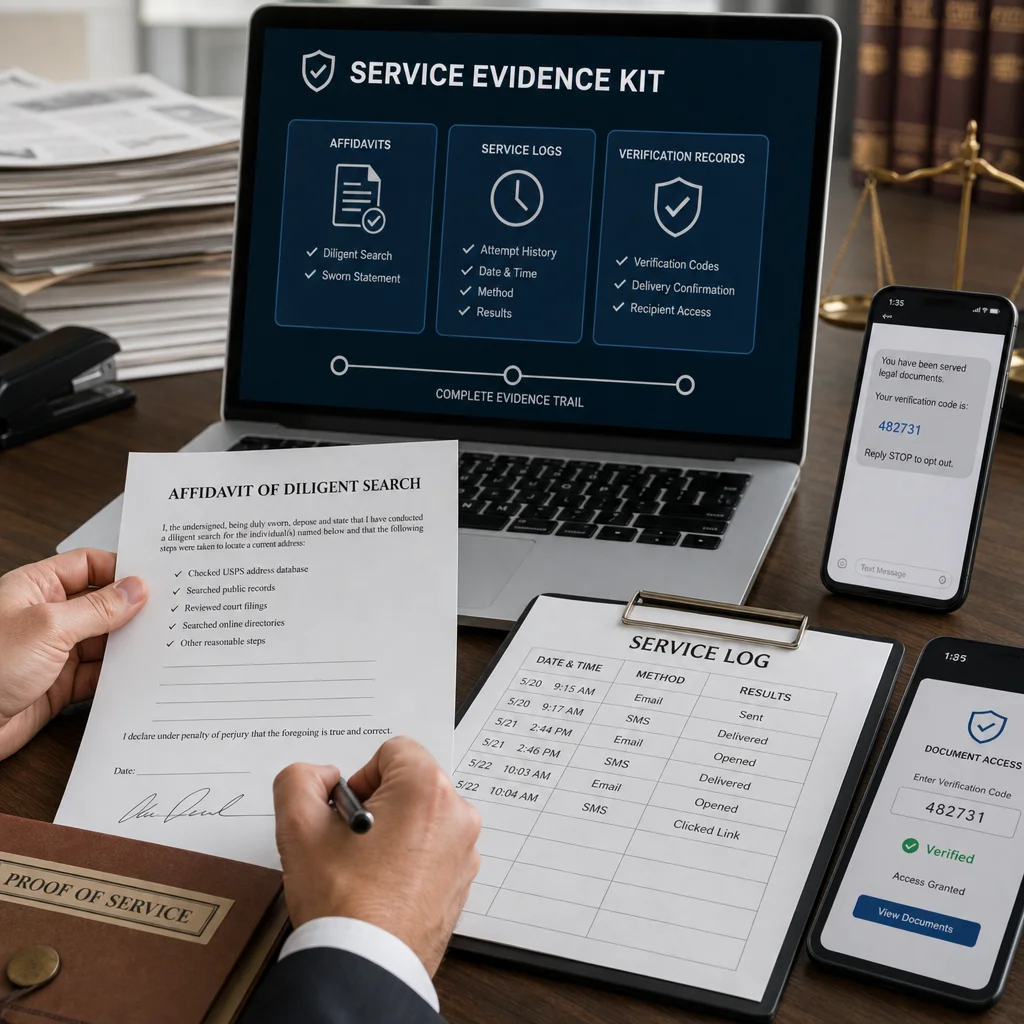
When you document diligent search thoroughly, you establish the foundation for whatever service method follows. This makes your subsequent notification attempts credible and defensible.
Service Logs as Your Documented Notification History
Your service log is a detailed record of every attempt to reach the defendant. It is not a summary or a narrative; it is a timestamped, methodical accounting of each action.
An effective service log includes:
- Date and time of each notification (precise timestamps, not “sometime on Tuesday”)
- Channel used (email address, phone number, WhatsApp, SMS)
- Delivery status (sent, delivered, bounced, read)
- Any recipient response or engagement
- Number of notifications in the sequence (attempt 1 of 60, attempt 2 of 60, etc.)
- System notes or exceptions
If you use a manual process, your log is prone to gaps and transcription errors. Courts may view hand-written or reconstructed logs skeptically because they cannot verify consistency or accuracy. Digital service tracking logs generated automatically by your platform create a contemporaneous, immutable record. Every notification is captured the moment it occurs, with no opportunity for after-the-fact adjustment.
Over a 60- or 90-day notification cycle, your log demonstrates persistent effort. It shows the court that you did not send a single email and assume the case was done. You maintained contact through multiple channels and delivery attempts, creating a compelling narrative of diligent outreach.
Verification Code Records and Recipient Access Documentation
Verification code records answer the question: did the defendant actually receive and access the documents?
When a recipient enters a unique one-time access code to view your documents, that action is logged with timestamp and device information. If geolocation is enabled, you also know where the access occurred. If selfie verification is part of your process, you have photographic evidence of recipient identity at the moment of access.
This data transforms your evidence from “we tried to reach you” to “you accessed the documents on this date at this location using this device.” Courts find this compelling because it closes the gap between delivery and knowledge.
Your verification records should capture:
- Code entry timestamp
- Device type and fingerprint information
- IP address and geolocation (if applicable)
- Selfie or biometric data (if used)
- Document pages viewed and time spent
- Repeat access attempts or continued engagement
These records are particularly valuable in cases where the defendant later claims ignorance or non-receipt. When you can point to objective data showing document access, your position strengthens significantly.
How Electronic Notification Creates Superior Evidence
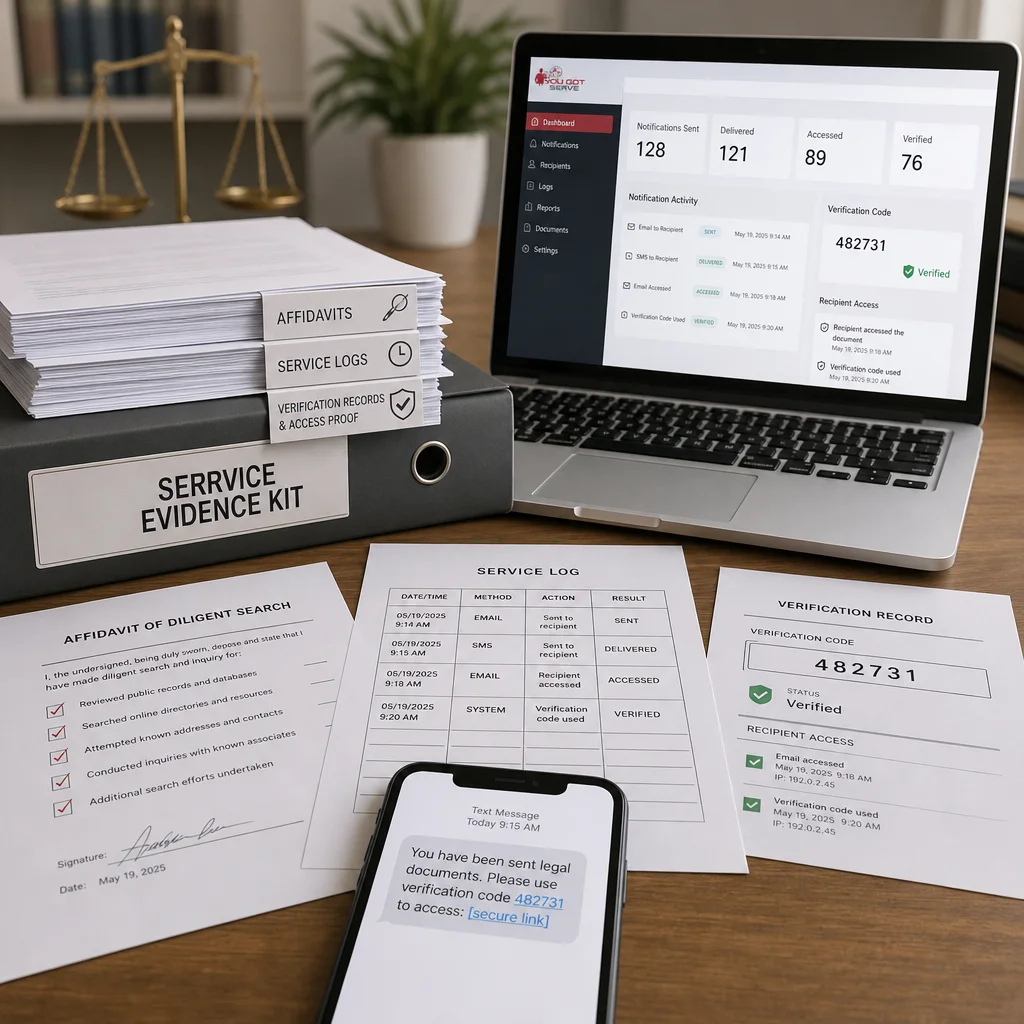
Electronic notification, when properly structured and documented, creates evidence that paper-based methods cannot match. Each sent notification generates a digital record. Each access creates a timestamp. Each delivery status change is captured automatically.
Compare this to newspaper publication, where your only proof is the affidavit of the person who arranged publication and a clipping of the notice. The defendant might argue they never saw the publication. You have no way to prove they did.
Electronic notification also allows for persistence that physical methods cannot sustain. You can send the same document via email three times, SMS twice, and WhatsApp once over a 60-day period, all documented in a searchable, auditable log. Traditional service is typically attempted once or twice.
Courts recognize that modern communication habits make electronic service more reliable than ever. A defendant with a valid email address and active phone number is more likely to see an electronic notification than a newspaper publication in an increasingly digital world. Your evidence kit reflects this reality.
The audit trail itself becomes evidence. You are not asking the court to trust your memory or a written affidavit. You are presenting system-generated records showing exactly what happened and when.
Building Your Evidence Kit with You Got Serve
We designed our platform specifically to help you assemble a complete evidence kit without manual record-keeping. How it works involves three integrated components:
When you initiate service with us, you begin with investigative assistance if needed. We help you locate or verify recipient contact information using skip-tracing resources, reducing gaps in your diligent search documentation.
Next, you configure your notification campaign. You can load up to three email addresses and three phone numbers per recipient. Our system sends notifications across email, SMS, and WhatsApp (where available) on your specified schedule, generating a complete service log automatically.
Recipients access documents using a secure, unique code. Our verification features capture access timestamps, geolocation data, and optional selfie confirmation. Every action is recorded and time-stamped, creating auditable proof of delivery and receipt.
At the end of your 60- or 90-day cycle, you download a comprehensive report. This report pulls together your diligent search notes, the complete notification log, verification records, and recipient engagement history. You now have the foundation for a strong affidavit of service and a supporting evidence kit that courts respect.
We handle the documentation burden so you can focus on your case strategy.
Maintaining Compliance Across Different Jurisdictions
Electronic service rules vary significantly by state and court. Before you implement any service strategy, check your local court rules. Some jurisdictions require court approval before electronic service is permitted. Others allow it only under specific circumstances, such as when the defendant has agreed to it or when personal service has failed.
Your evidence kit must reflect compliance with your specific jurisdiction’s requirements. If your rules require proof of diligent search before electronic service is permitted, that affidavit is mandatory. If your rules allow electronic service only after failed personal service attempts, your evidence should show those failed attempts first.
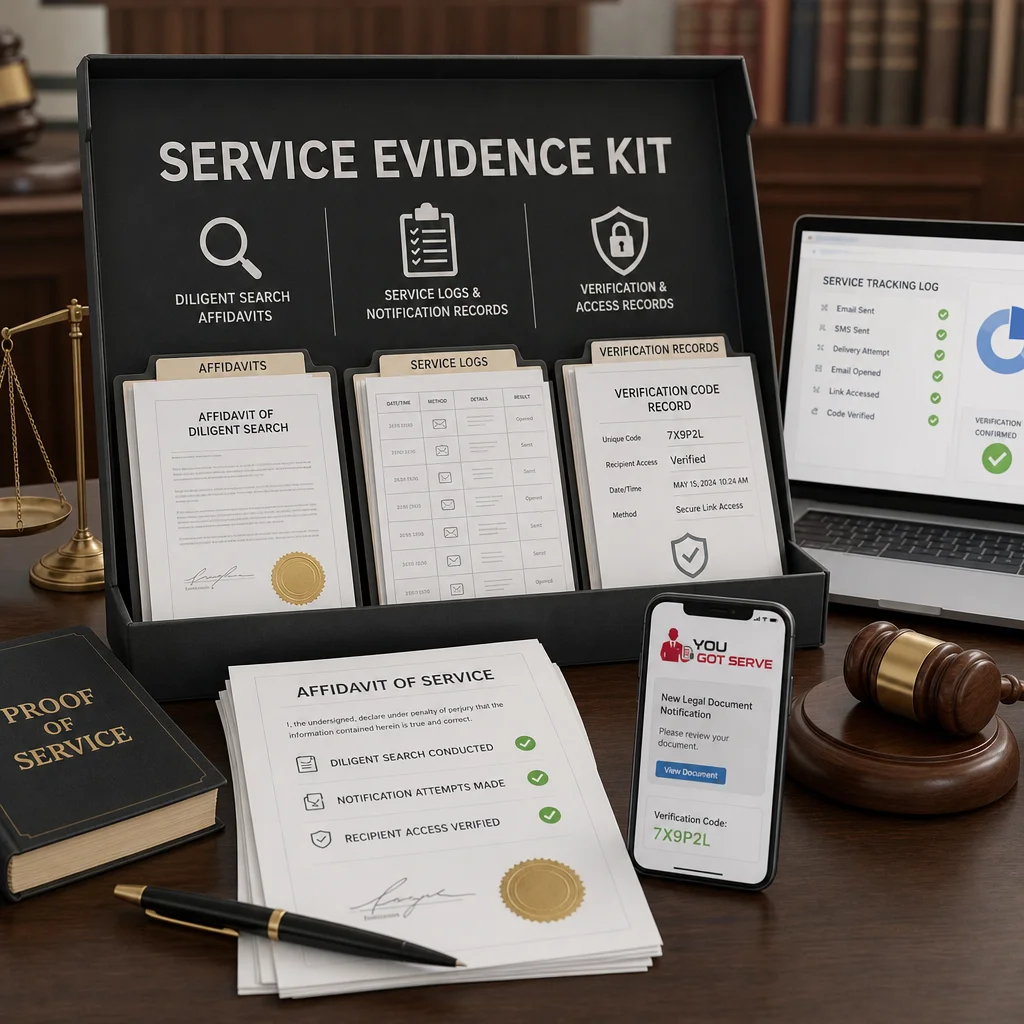
Document your compliance reasoning in your service affidavit. Reference the specific court rule or statute that authorizes your chosen method. Explain why you followed that rule in your particular case. This detail demonstrates to the court that you were not experimenting with electronic service but rather following established procedure.
Jurisdictional rules also affect the length and frequency of your notification campaigns. Some courts expect at least 30 days of notice. Others require 60 or 90 days. Your evidence kit should be calibrated to meet these expectations. We support both 60- and 90-day notification cycles, allowing you to align with your jurisdiction’s requirements.
Common Documentation Gaps That Weaken Your Case
Many litigants build an evidence kit that looks complete on the surface but contains subtle weaknesses.
The affidavit of diligent search that lacks specificity is a common gap. Statements like “I searched available databases” or “I made reasonable efforts to locate the defendant” are too vague. Courts want to see the actual databases, the dates of the searches, and the results. Be specific.
A service log with inconsistent timestamps or gaps suggests inattention or unreliability. If your log shows notifications sent but no delivery status recorded, the court wonders whether delivery actually occurred. Digital logs eliminate this problem because they are generated automatically and cannot have gaps.
Missing verification data is another frequent weakness. If you can show that notifications were sent and delivered, but you cannot demonstrate that the recipient actually accessed the documents, your evidence is incomplete. Even a simple entry of a verification code with a timestamp strengthens your position considerably.
Failure to coordinate your evidence with your affidavit creates internal inconsistencies. Your affidavit might claim you sent seven notifications, but your log shows nine. Your affidavit might list two email addresses, but your log shows three. Courts notice these discrepancies and question your reliability. Before filing, reconcile every detail between your affidavit and your supporting documentation.
Presenting Your Complete Evidence to the Court
When you present your evidence kit to the court, organize it clearly. Your affidavit of service goes first, summarizing your diligent search, notification efforts, and verification findings. This affidavit is the narrative framework.
Then attach your supporting exhibits in logical order:
- Affidavit of diligent search (or diligent search documentation)
- Complete service log with timestamps and delivery statuses
- Verification records (code entries, geolocation data, access timestamps)
- Selfie or biometric data (if applicable)
- Skip-trace results or investigative reports
- Any supplemental documentation showing your compliance with local rules
Courts appreciate organization. Use headers, page numbers, and a clear exhibit list. This formatting shows that you took your evidence seriously and want the court to understand what you did.
In your affidavit of service, reference each exhibit specifically. Do not simply attach everything and hope the court figures it out. Guide the court through your evidence by paragraph and exhibit number. Highlight the key timestamps and access confirmations that demonstrate successful service.
When you present a complete evidence kit backed by digital documentation and contemporaneous records, you position yourself for success. The court sees a methodical, well-documented process that respects the defendant’s right to notice while making a strong showing of diligent effort and verified communication.
Your next step is to audit your current service process. Identify which components of your evidence kit are strong and which need attention. If you are handling service manually, consider whether a platform designed for comprehensive documentation might strengthen your case and reduce your administrative burden. The investment in thorough evidence gathering pays dividends when your service is questioned or appealed.