
The Challenge: Insufficient Documentation in Service of Process Cases
When you attempt to serve a difficult-to-locate defendant or unresponsive party, the burden falls on you to prove the service was genuine, timely, and reasonably likely to reach the recipient. Courts require more than good intentions. They demand documented evidence: proof that you made a good-faith effort, that your notifications reached the intended recipient, and that the process complied with applicable rules.
Traditional service methods often leave gaps. Certified mail can be refused or returned without clear proof of attempted receipt. Personal process servers may miss parties who have moved or are actively avoiding service. Newspaper publication, while sometimes legally required, provides minimal documentation of who actually saw the notice. When these methods fail or prove insufficient, you need an alternative backed by auditable records.
This is where electronic service becomes valuable. But electronic service without proper documentation is nearly useless in court. Judges need to see detailed affidavits and supporting exhibits that demonstrate genuine, persistent notification attempts and clear evidence of delivery or attempted delivery.
Why Traditional Exhibit Methods Fall Short
Affidavits supported by minimal exhibits often trigger judicial skepticism. A simple declaration that you “sent” an email or text message lacks the verification courts expect. Without logs, timestamps, and recipient confirmation data, you’re asking the court to accept your word alone.
Traditional methods create several documentation problems:
- Gaps in the notification record make it hard to show persistent attempts over time
- Single-channel notifications (email only, for example) may not meet court standards requiring multiple reasonable efforts
- Lack of recipient verification leaves open questions about whether the party actually received the notice
- Missing metadata creates doubt about timing, sender authentication, and delivery chain integrity
- No geolocation or code-access data to corroborate that the intended recipient, not someone else, retrieved the document
Courts increasingly expect electronic service documentation to include notification logs, access timestamps, and recipient verification details. If your affidavit can’t support these with credible exhibits, judges may reject your service claim or require you to retry using a different method. That delay costs time and money.
What Courts Require from Supporting Exhibits and Declarations
Most jurisdictions that permit electronic service require you to file an affidavit or declaration under penalty of perjury describing the service process. The exhibits attached to that affidavit are critical: they provide the factual foundation for your claims.
Courts typically expect to see:
- A detailed narrative explaining what method of electronic service you used and why it was appropriate
- Complete notification logs showing dates, times, and channels used (email, SMS, WhatsApp, etc.)
- Evidence that multiple contact points were attempted (different email addresses or phone numbers for the same recipient)
- Timestamps proving when each notification was sent and when it was accessed
- Recipient verification data such as access confirmations, geolocation information, or security code authentication
- Server logs or custodian declarations certifying the authenticity and integrity of the electronic records
- A statement that the service method complied with court rules and applicable local requirements
The strength of your exhibits directly affects whether the court accepts your service claim. Vague or incomplete documentation invites the opposing party to challenge your service, potentially voiding the entire action. Comprehensive, timestamped, multi-channel exhibits make your affidavit credible and defensible.
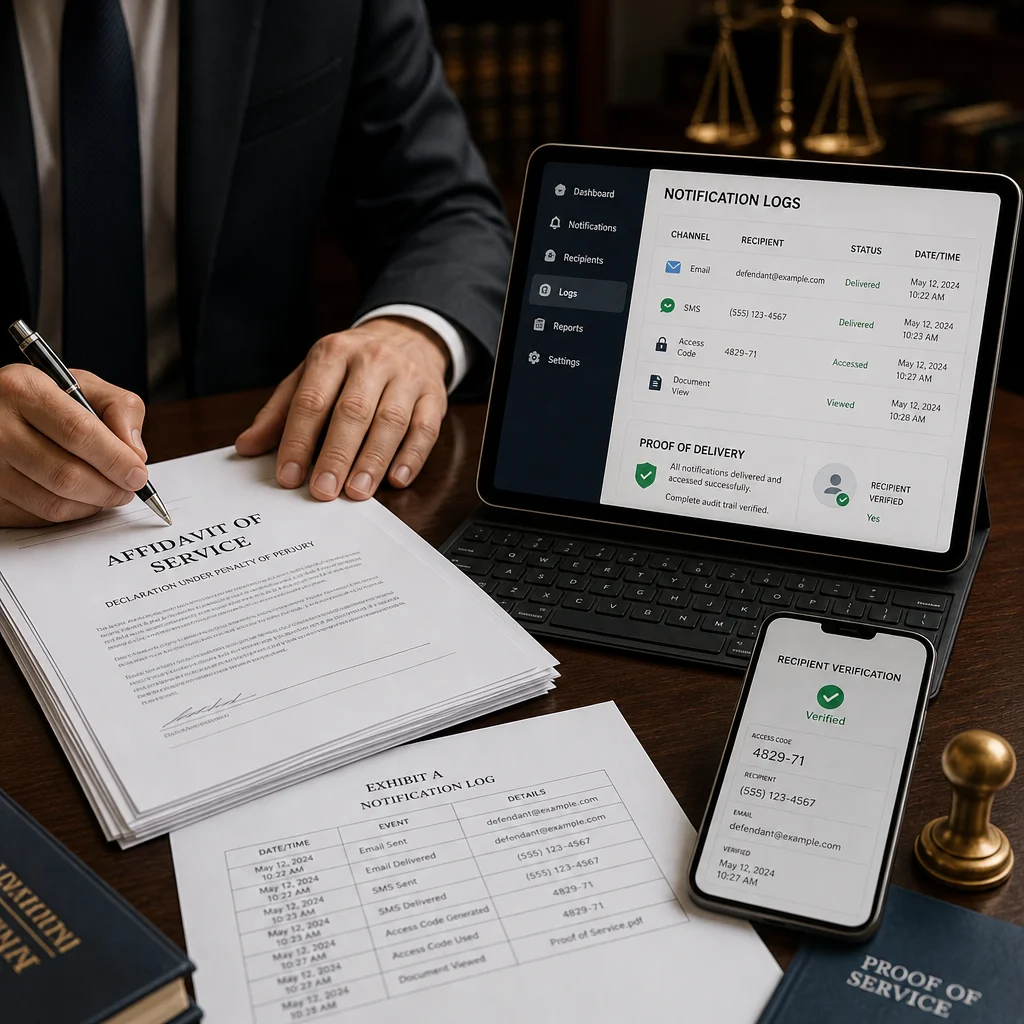
How You Got Serve Creates Auditable Affidavit-Ready Documentation
We designed our platform with this judicial requirement in mind. When you use You Got Serve to electronically notify a recipient, our system automatically generates the complete documentary record that courts expect to see attached to your affidavit.
You don’t have to manually compile logs or reconstruct what happened. The platform captures and stores every critical data point:
- All notification attempts (email, SMS, WhatsApp) with precise timestamps
- Each recipient contact point you entered (up to three email addresses and three phone numbers per recipient)
- Notification frequency and duration (60-day or 90-day service campaigns)
- Document access activity, including when and how the recipient retrieved their documents
- Recipient verification details such as one-time access code usage and available geolocation data
- Complete delivery status (Pending or Delivered)
Our system generates exhibits ready for your affidavit filing. You can export notification logs, access reports, and server records directly from your account. The data is organized chronologically and formatted for easy reference in court documents.
Multi-Channel Notification Logs as Exhibit Evidence
One of the strongest exhibits in a service-of-process affidavit is a detailed notification log showing multiple, persistent attempts to reach the recipient. Courts view multi-channel notifications more favorably than single-attempt efforts because they demonstrate genuine diligence.
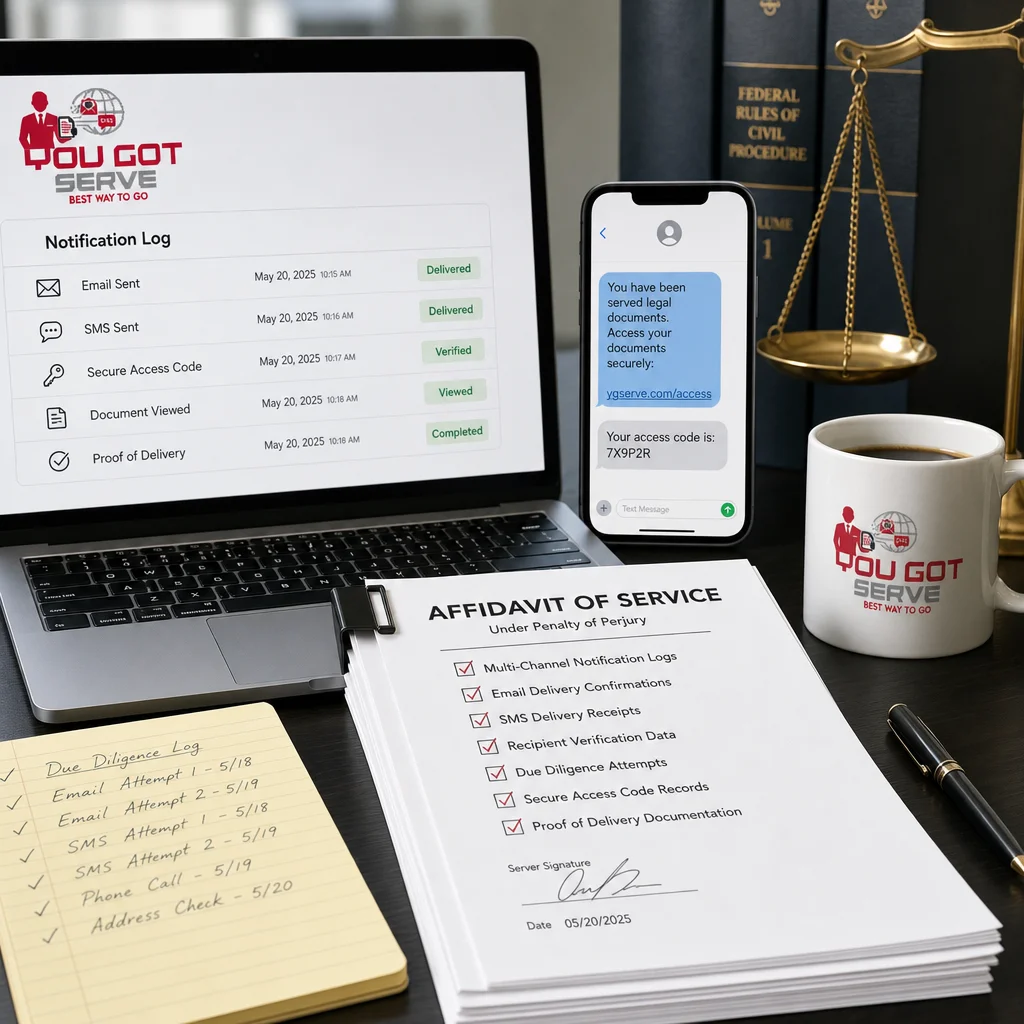
We allow you to enter up to three email addresses and three phone numbers for each recipient. Our platform then sends daily automated notifications through all available channels throughout your service campaign. This creates a powerful exhibit: a complete log showing that you attempted to reach the recipient through multiple pathways over an extended period.
Your notification log exhibits demonstrate:
- Persistent effort: daily notifications over 60 or 90 days prove you didn’t give up after one attempt
- Multiple contact methods: using email, SMS, and WhatsApp (where available) shows reasonable diligence across different communication channels
- Systematic approach: the platform’s automated process proves the notifications were not random or haphazard but part of a coordinated strategy
- Comprehensive reach: attempting multiple addresses and phone numbers for the same recipient shows you made every reasonable effort to locate them
When attached to your affidavit, this log speaks volumes. It shows the court that you approached service seriously, methodically, and with genuine effort to reach the recipient.
Secure Access Codes and Recipient Verification Data
Beyond notification logs, courts value exhibits showing that the intended recipient actually accessed the documents. This is where secure access codes and verification data become critical supporting evidence.
We issue each recipient a unique one-time access code to retrieve their documents. When they use that code, our platform records the access event, including the timestamp and available verification information such as geolocation data. This creates an audit trail proving that someone with knowledge of the unique code accessed the documents at a specific time and location.
Your affidavit exhibits should include:
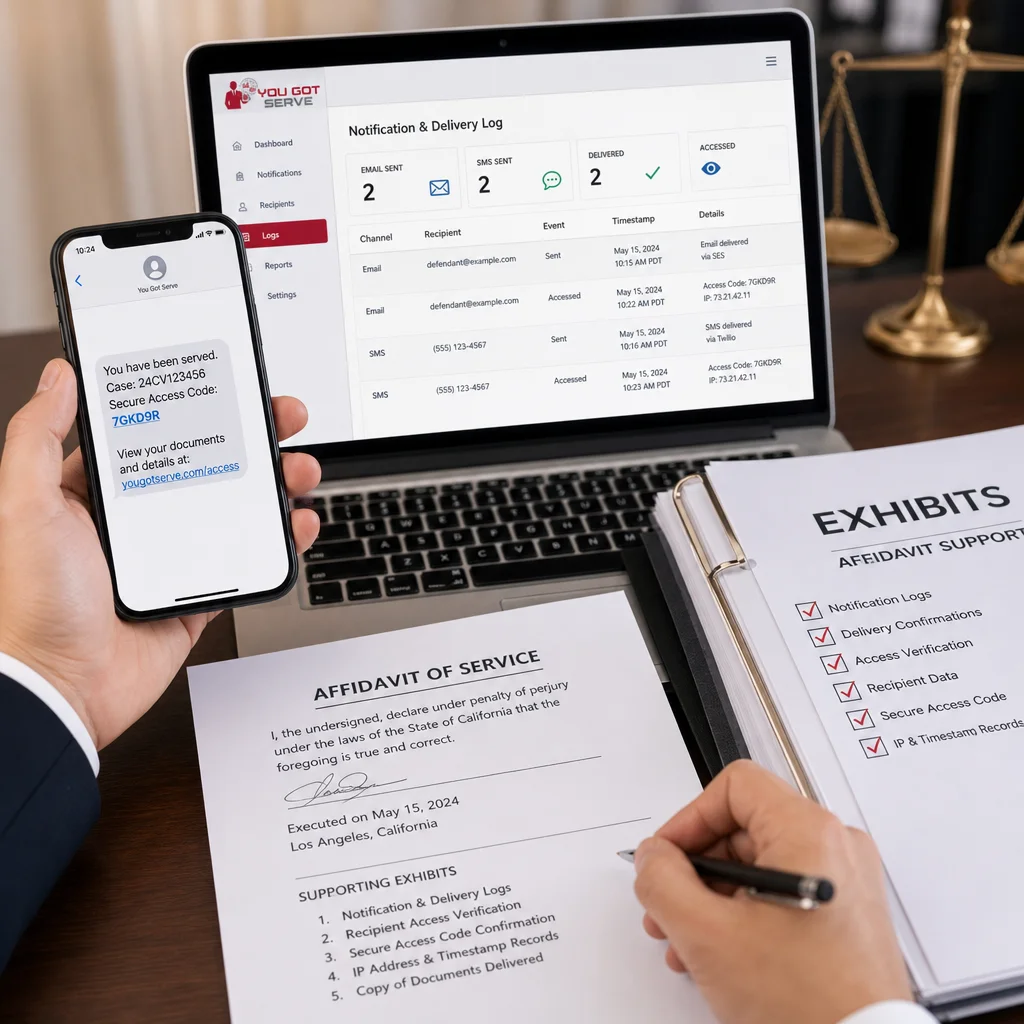
- Record of code issuance and delivery to the recipient’s contact information
- Timestamp showing when the recipient used the access code
- Geolocation information available from the access event
- Any optional verification such as selfie capture if you selected that feature
- Platform certification that the access code was used only once and by the party in possession of the recipient’s verified contact information
This evidence goes beyond simple notification delivery. It demonstrates actual receipt and access by someone connected to the intended recipient’s verified phone number or email address. Courts find this compelling because it closes the loop: you notified them, and they actively retrieved the documents.
Timestamped Server Records and Custodian Declarations
Electronic exhibits gain credibility when supported by server records certified by a qualified custodian of records. You Got Serve provides timestamped server records documenting every step of the notification and delivery process.
A custodian declaration is an affidavit or declaration by someone with direct knowledge of how the records are created, maintained, and stored. The custodian testifies that the records are authentic, are kept in the regular course of business, and accurately reflect the system’s operations. This certification authenticates your exhibits and defends against challenges about the integrity of electronic data.
We maintain timestamped records showing:
- Exact dates and times of all notifications sent through our platform
- Server authentication confirming messages were generated and transmitted by our system
- Document upload and access logs
- Delivery status updates and any bounces or failures
- System configuration showing the notification channels and frequency you selected
Your affidavit can reference a custodian declaration provided by our records custodian, confirming the reliability and authenticity of all You Got Serve exhibits. This transforms your electronic service documentation from self-serving claims into independently verified evidence.
Building a Complete Due Diligence Package
A winning service-of-process affidavit is built on layers of evidence. Your goal is to create a package of exhibits that tells a coherent, well-documented story: you identified the recipient, made persistent, multi-channel attempts to notify them, and created a detailed record of those attempts.
We help you assemble this complete due diligence package:
- Initial contact information and any available skip-trace or investigative data (available through integrated investigative services if your initial contact details are insufficient)
- Your account setup showing the service parameters you selected (60-day or 90-day campaign, contact points, notification channels)
- Complete notification logs with all timestamps and delivery attempts
- Document upload confirmation and access records
- Recipient verification data and geolocation information
- Server logs and custodian declaration certifying record authenticity
- Your affidavit narrative explaining your service efforts and referencing each exhibit
When you file this package with the court, you present a comprehensive, internally consistent, and well-documented case for service. The opposing party has little room to challenge your documentation because every step is logged, timestamped, and certified.
Document tracking through our platform means you can monitor and document service progress in real-time, creating an even stronger contemporaneous record of your diligence.
Streamlined Compliance with Court Rules and Local Requirements
Different jurisdictions have different rules about what constitutes valid electronic service. Some require court authorization. Others permit electronic service only if traditional methods have failed. Many have specific requirements about notification frequency, duration, and recipient verification.
You Got Serve is designed to support compliance with these varying requirements. Our platform allows you to select service durations and notification channels that align with your local rules. We provide documentation that demonstrates your compliance with whatever standard your jurisdiction requires.
Before you file your affidavit, check your local court rules and any applicable statutes regarding electronic service. Confirm that:
- Electronic service is permitted in your jurisdiction and type of case
- Any required court authorization has been obtained
- The notification methods you used (email, SMS, WhatsApp) meet local standards
- The notification duration and frequency comply with local rules
- Recipient verification requirements are satisfied
Our platform generates exhibits that help you affirmatively prove compliance with each of these standards. Your affidavit narrative can reference specific exhibits showing that your service method met every jurisdictional requirement.
Why You Got Serve Delivers the Documentation Advantage
We built You Got Serve specifically for legal professionals and self-represented litigants who need to serve unresponsive or difficult-to-locate recipients and who understand that electronic service requires bulletproof documentation.
Our platform delivers this documentation advantage through:
- Automated daily notifications across multiple channels, creating a persistent, documented service record that courts respect
- Secure access codes and optional verification features that prove actual receipt by the intended recipient
- Timestamped server logs and custodian declarations that authenticate your electronic exhibits
- Comprehensive account and notification reports exportable directly for affidavit filing
- Investigative support (available through our integrated services or CII Services Corp.) to ensure you have sufficient contact information before your service campaign begins
- 60-day and 90-day service options that allow you to demonstrate persistent, methodical diligence
- International service capabilities where technically available and legally appropriate
This combination of persistent notification, multi-channel delivery, recipient verification, detailed logging, and authenticated server records gives you documentation that stands up to judicial scrutiny. You’re not asking the court to take your word. You’re presenting auditable, timestamped, independently verified evidence of genuine service efforts.
Selecting You Got Serve for Your Service of Process Needs
If you’re preparing an affidavit for electronic service and need supporting exhibits that courts will accept, You Got Serve is the platform designed for exactly this purpose. We handle the technical complexity of multi-channel notification, automated logging, and record authentication so you can focus on your case.
Our pricing is straightforward: $350 for a 60-day service campaign or $500 for 90 days. Eligible organizations receive a 10% discount. You enter up to three email addresses and three phone numbers per recipient, upload your documents, and we manage the daily notifications and complete documentation throughout your service period.
How it works at You Got Serve ensures every notification, access event, and verification data point is captured, timestamped, and ready for your affidavit exhibits.
Start your service campaign with confidence, knowing that the documentation you’re generating will withstand judicial scrutiny. You Got Serve delivers the smarter way to serve.