
Why Traditional Service Methods Leave Gaps in Documentation
Traditional service methods often create a documentation vacuum. When an attorney arranges personal service and the process server cannot locate the defendant, the record may simply show “service attempted” with minimal detail about what actually happened. Newspaper publication leaves even fewer traces. You’re left with a published notice and a certificate, but no way to verify whether the defendant ever saw it.
This gap becomes critical when a defendant later contests service in court. Without granular documentation of each attempt, timing, and recipient response, your proof of service weakens considerably. You need more than a signature or a receipt line. You need a forensic record that shows exactly when, how, and whether someone received your documents.
Electronic service offers a solution, but only if it captures the full picture. Basic notification systems send messages and call it done. A comprehensive audit trail does far more: it documents every step, every attempt, and every interaction.
The Problem: Incomplete Records and Insufficient Proof
Many digital notification platforms send emails and texts but fail to create detailed records of the service process. They tell you a message was “delivered” to a carrier, but they don’t show whether the recipient actually opened it, accessed the document, or even received it on their device.
When challenged in court, basic delivery confirmations often fall short. A judge may question: Did the recipient actually open the email? Could geolocation data prove they were in the jurisdiction? Can you show they had multiple opportunities to receive the document? Without answers to these questions, your proof of service looks thin.
The stakes are high. Insufficient documentation can result in a service challenge that delays your case, requires you to re-serve the defendant, or in the worst scenario, results in dismissal of your action. That’s why comprehensive metadata matters.
What Comprehensive Audit Trails Include
A full audit trail captures layers of evidence about the service process:
- Timestamped notification attempts: Exact dates and times each email, SMS, or WhatsApp message was sent.
- Recipient engagement data: Whether and when the recipient opened documents or accessed them through a secure portal.
- Geolocation information: Where the recipient was when they accessed the documents (where available).
- Device and browser details: What device and application the recipient used to retrieve the document.
- One-time access codes: Unique verification codes that confirm the specific recipient accessed the specific document.
- Notification history: A complete log of all delivery attempts across multiple contact points.
- Selfie capture capability: Optional recipient verification through photo identification at document access.
- Service status tracking: Clear designation of whether service remains Pending or has been Delivered.
Each data point builds a stronger case. Together, they create a forensic record that withstands legal scrutiny.
Comparing Basic Notification Systems to Full Forensic Documentation
Basic systems confirm message delivery to a carrier. That’s valuable but insufficient for legal service purposes. They typically show: message sent, carrier acknowledged, and sometimes a read receipt if the email client supports it.
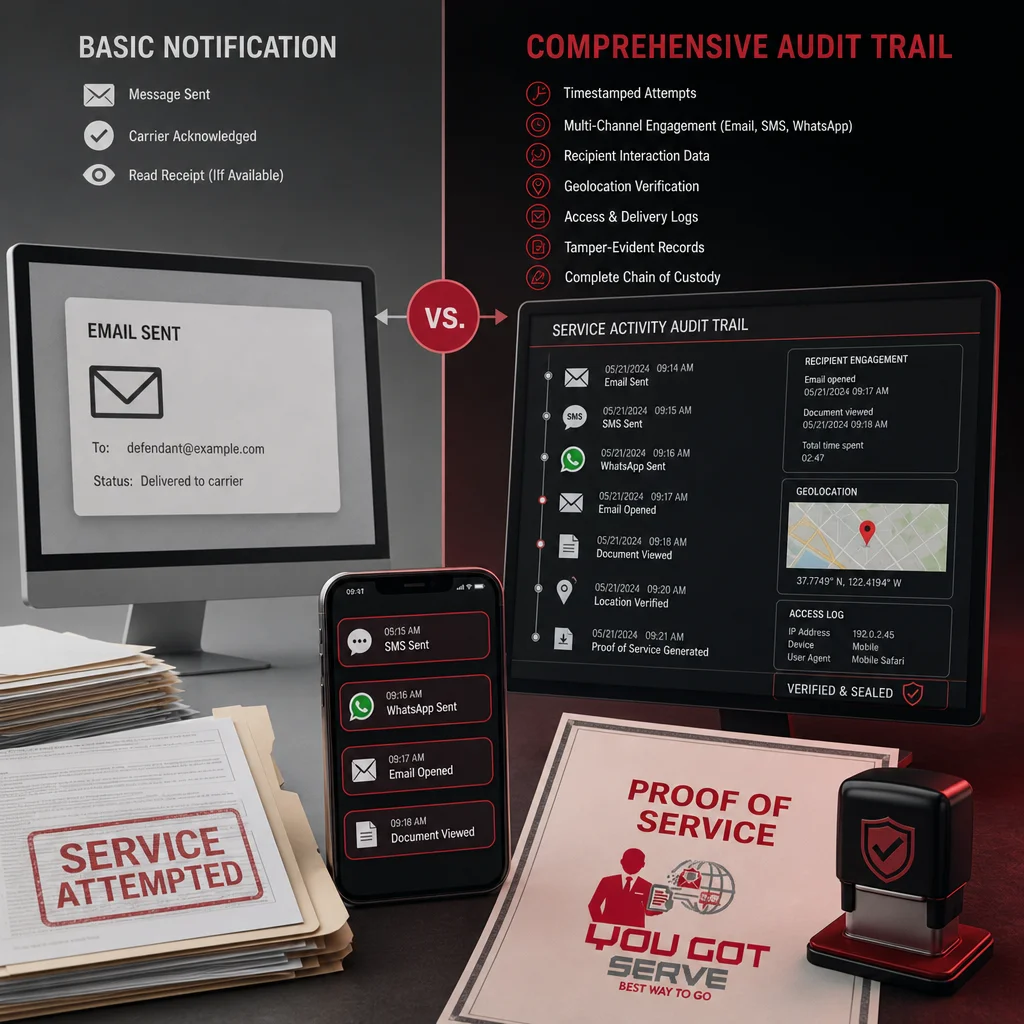
Full forensic documentation goes further. Beyond confirming the message reached a carrier, it documents actual recipient interaction. It shows not just that an email was sent, but that a person with a specific device and location opened a secure portal, entered a one-time code, and viewed the court document on a particular date and time.
When a defendant later claims they never received service, basic records leave you vulnerable to that argument. Forensic metadata makes that claim harder to sustain. You have timestamps, access logs, geolocation data, and device information that create a documented chain of custody.
The difference is the difference between “we sent it” and “we sent it, and here’s exactly what happened next.”
How You Got Serve Captures Complete Service Activity
We designed our platform to document every element of the service process. When you initiate service through You Got Serve, we don’t just send one notification and hope for the best. We create a 60- or 90-day persistent notification campaign that keeps reaching the recipient through multiple channels.
You can enter up to three email addresses and three phone numbers per recipient. Our system sends automated daily notifications via email, SMS, and WhatsApp (where available). Over the course of your chosen campaign, we attempt service repeatedly, creating a dense record of efforts.
Each notification is timestamped. Each access attempt is logged. Each document retrieval is recorded with device, location, and timing data. Recipients use a unique one-time access code to reach the document, which verifies they’re the intended recipient.
This means your proof of service doesn’t rest on a single email or text message. It rests on a documented history of multiple attempts, recipient engagement, and verifiable access. If the defendant claims they never knew about the lawsuit, the audit trail tells a different story.
Multiple Verification Points: Timestamps, Geolocation, and Access Logs
Timestamps form the backbone of any audit trail. Every email sent, every SMS delivered, every document access is time-stamped to the second. This creates an irrefutable record of when service occurred and when attempts were made.
Geolocation data (where available) adds another verification layer. If the defendant claims they were out of state and couldn’t have received service, geolocation information showing they accessed the document while in the state where suit was filed becomes powerful evidence.
Access logs document exactly what happened when the recipient reached the document. We capture which device they used, what browser or application they accessed it through, whether they printed it, and how long they viewed it. This level of detail demonstrates not only that service occurred but that someone with access to the defendant’s contact information actually engaged with the document.
Combined, these verification points create a comprehensive picture that a basic notification system simply cannot provide. You’re not asking the court to infer what happened. You’re showing them the complete activity record.
The Legal Advantage: Court-Ready Proof of Delivery
Courts increasingly expect electronic service to generate detailed documentation. Judges understand that digital communication creates verifiable records; they want to see them.
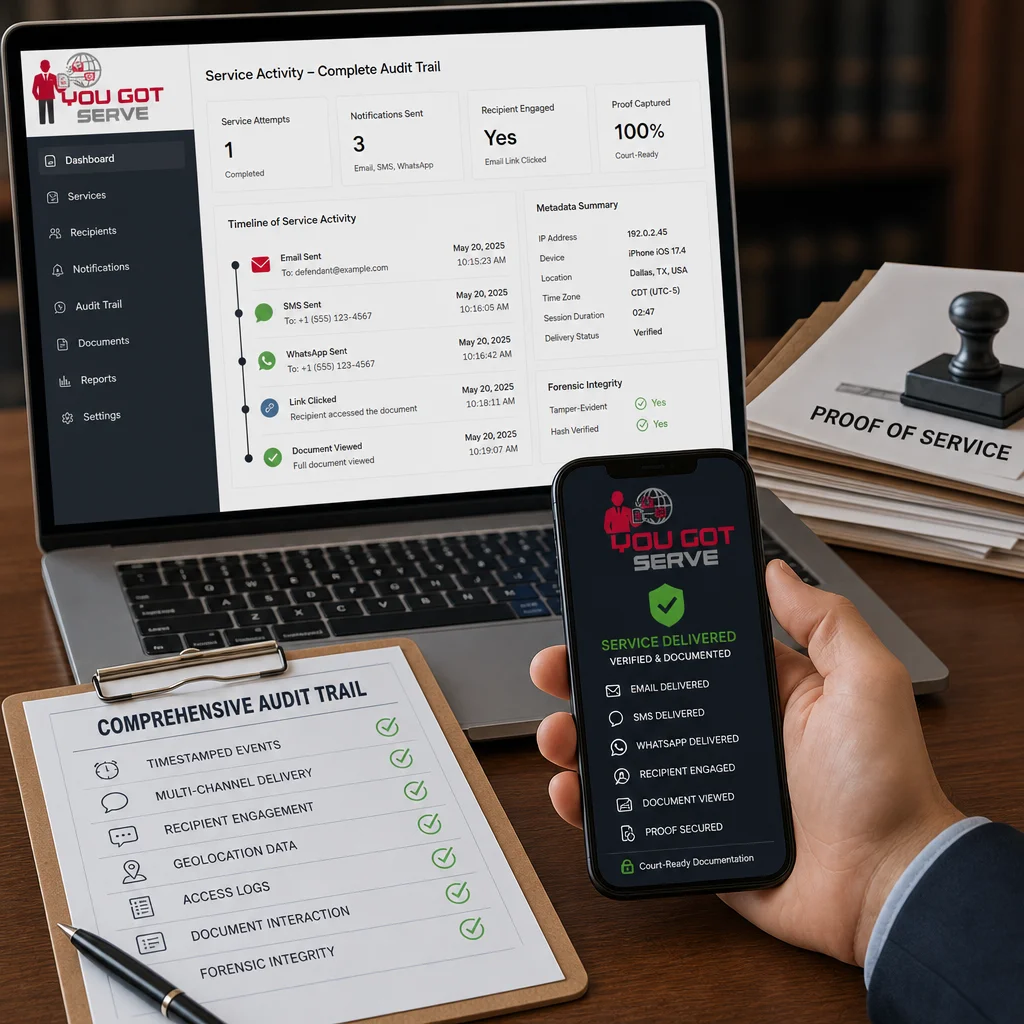
Our proof of delivery records are designed to support compliance with court rules and provide admissible evidence of service. We generate a comprehensive service report that includes:
- Complete notification history with timestamps
- Document access activity and timing
- Recipient verification information
- Geolocation and device data
- A clear status designation (Pending or Delivered)
This report is structured to be court-ready. When you file an affidavit of service or respond to a service challenge, you have concrete data to reference. You’re not making assumptions. You’re presenting forensic evidence.
Building Trust Through Transparent Activity Records
Transparent records build confidence with courts, opposing counsel, and your own clients. When you can point to a detailed activity log and say, “Here’s exactly when we sent each notification, here’s when it was received, and here’s the geolocation data showing the recipient accessed it on this date,” you’ve closed the conversation.
This transparency also reduces disputes. Defendants have a harder time disputing service when presented with comprehensive metadata. They can’t simply claim they never got the message if the record shows them accessing the secure portal multiple times.
For your clients, this creates certainty. They see that you’ve used a rigorous, documented method to serve the other party. That builds confidence in your approach and protects your case from later challenges rooted in incomplete service records.
Real-World Impact: Documentation That Withstands Scrutiny
Consider a scenario: You need to serve a defendant who’s relocated and isn’t responding to traditional process servers. You enter their last known email and phone number into You Got Serve. Over 90 days, we send daily notifications. On day 12, the recipient accesses the secure portal from a location within your jurisdiction. We log the timestamp, geolocation, and device information.
Later, the defendant moves to dismiss on grounds that service was improper. They claim they never knew about the lawsuit. You produce our service report showing the access activity, geolocation data, and complete notification history. The motion fails.
In another scenario, your firm serves multiple defendants across different states. Basic notification systems give you little to no verification. Our platform gives you a document tracking dashboard showing exactly where each defendant stands in the service process. You know which notifications were sent, which documents were accessed, and when. If a defendant later challenges service, you have the data to defend it.
Real-world litigation is full of service disputes. Comprehensive audit trails are the difference between resolving those disputes quickly and ending up in a secondary motion hearing.
Why Detailed Metadata Protects Your Case
A lawsuit can fail on service before it ever reaches the merits. Courts won’t proceed if service is defective. That’s why the proof you generate at service matters as much as the legal argument you’ll make months later.
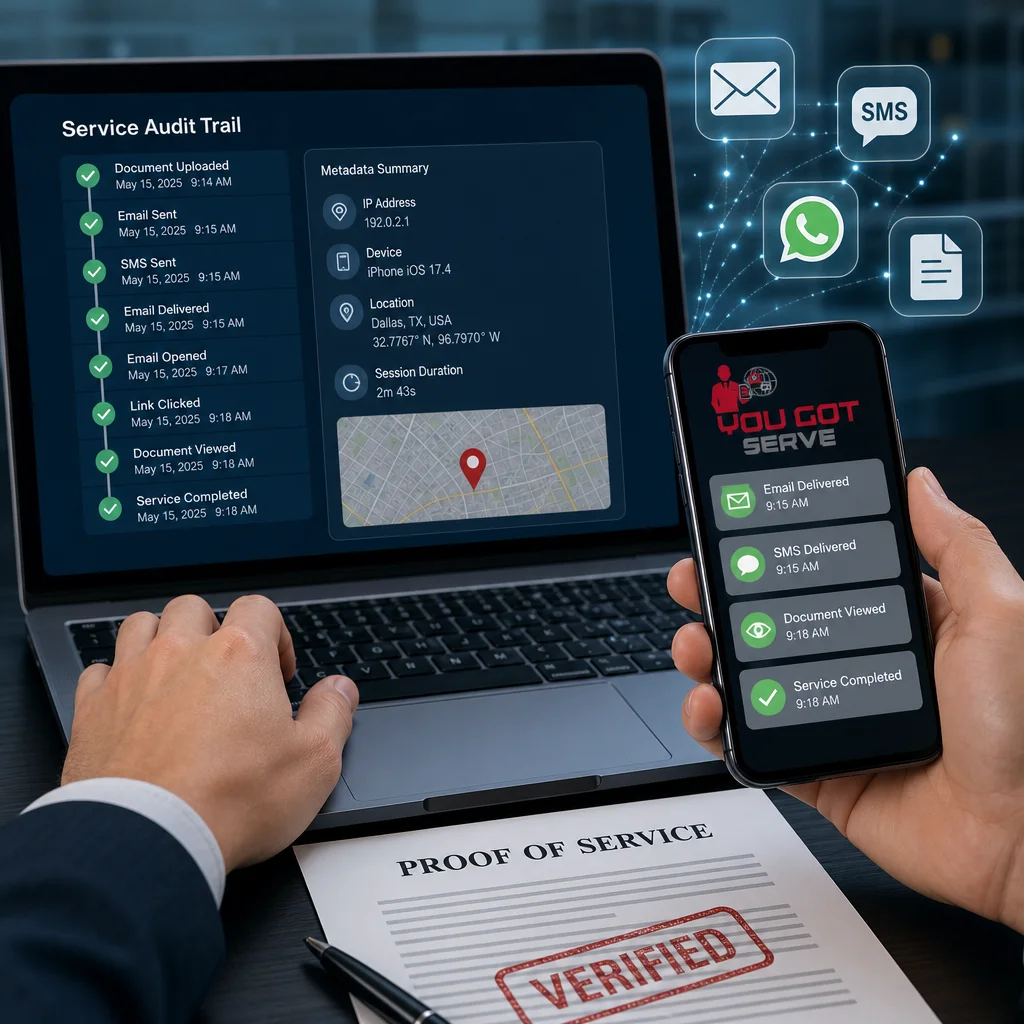
Detailed metadata protects your case by creating an indisputable record. It shifts the burden of proof. Instead of you having to prove service happened, the defendant has to prove it didn’t, and they’re arguing against timestamped logs, geolocation data, and access activity.
This protection extends throughout your case. Even if service is challenged months or years into litigation, comprehensive documentation means you can still defend it. You don’t have to rely on memory or incomplete records. You have forensic data.
The You Got Serve Difference: Persistent Multi-Channel Service with Complete Records
We built You Got Serve specifically for legal professionals and self-represented litigants who need more than basic notification. We combined persistent multi-channel service with comprehensive audit trail capabilities into one integrated platform.
What sets us apart:
- Persistent service campaigns: 60- or 90-day notification cycles with daily contact attempts, not one-time messages.
- Multiple contact points: Up to three email addresses and three phone numbers per recipient, all simultaneously pursued.
- Complete verification: Timestamps, geolocation data, device information, access logs, and optional selfie capture in a single platform.
- Secure document access: Recipients use unique one-time codes, ensuring only the intended recipient can view the documents.
- Investigative integration: When you don’t have sufficient contact information, we can assist with skip tracing and investigative services.
- International capability: Electronic notifications supported internationally where technically available and legally appropriate.
This combination addresses the entire lifecycle of electronic service: finding the recipient, notifying them multiple times, verifying access, and documenting everything. You get persistence, verification, and comprehensive metadata in one solution.
Our service package is straightforward: $350 for 60-day service or $500 for 90-day service. Eligible organizations receive a 10% discount. No hidden fees, no surprise charges. You know your cost upfront and you know exactly what documentation you’ll receive.
Get Started with Verified, Auditable Electronic Service Today
If you’re managing cases where traditional service has failed or where electronic service is permitted or court-authorized, electronic notification with comprehensive audit trail documentation is the smarter approach.
Start by determining whether electronic service is appropriate under your local court rules and jurisdiction. Then, initiate a service campaign through You Got Serve. Enter your recipient’s contact information (email and phone), upload your documents, and select your campaign length. Our system handles the rest: sending daily notifications, logging every interaction, and generating a court-ready service report.
You’ll get a dashboard where you can track service status in real time. You’ll see when notifications are sent, when documents are accessed, and all the metadata associated with each interaction. When service is complete, you’ll have comprehensive documentation that supports your proof of service.
Don’t settle for basic notification systems that leave gaps in your documentation. Use You Got Serve to serve documents electronically with verified receipt tracking, persistent multi-channel outreach, and forensic metadata that withstands court scrutiny.
The smarter way to serve starts with complete records. Get started with You Got Serve today.