

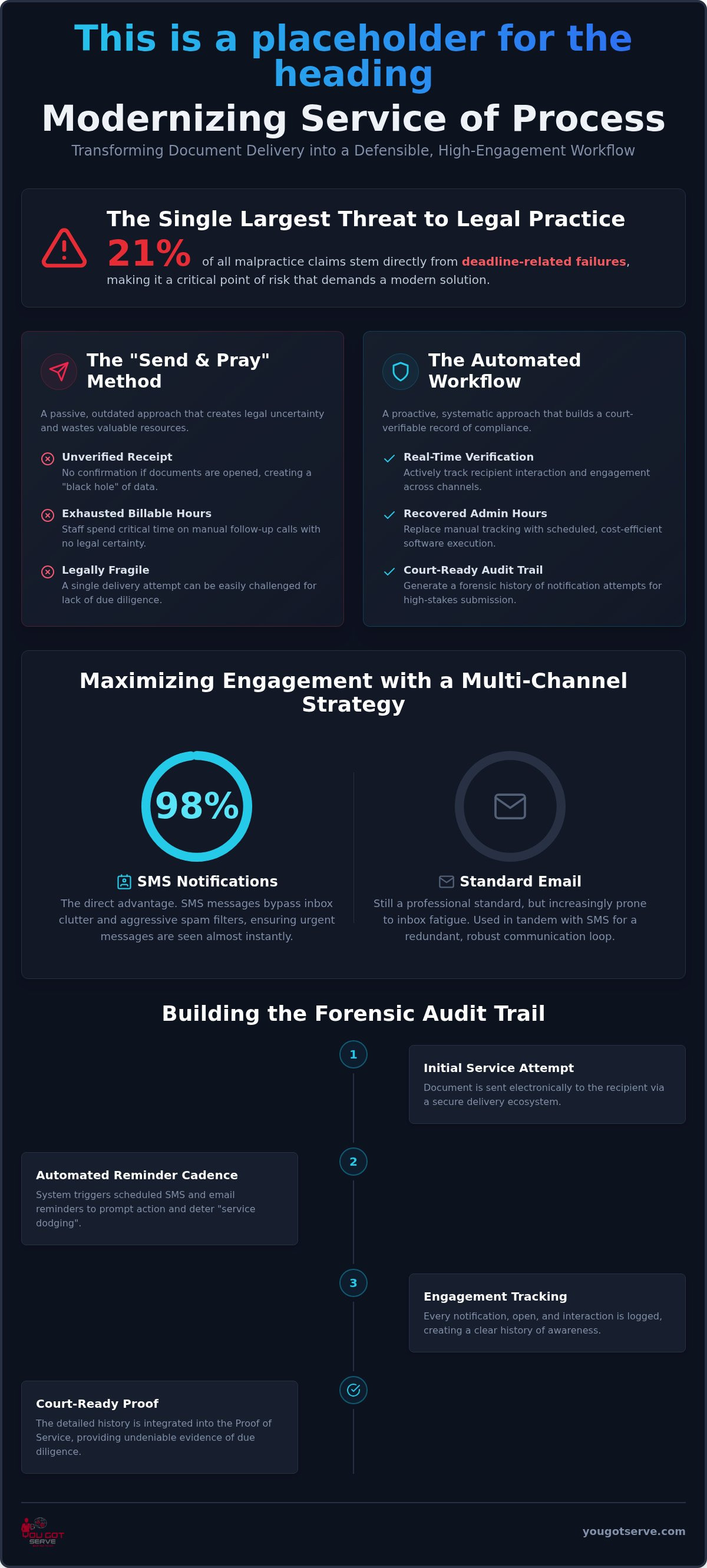
Deadline-related failures are currently the single largest category of malpractice claims, representing 21% of all reported incidents. You likely recognize the professional strain when a recipient ignores a critical notification, forcing your staff to exhaust billable hours on manual follow-ups that provide zero legal certainty. Integrating automated legal delivery reminders into your workflow is no longer a simple convenience. It is a necessary forensic strategy to ensure your service of process remains defensible under intense judicial scrutiny.
We agree that the "send and pray" approach is insufficient for the rigorous demands of modern litigation. This article demonstrates how automated reminder technology transforms document delivery from a passive task into a high-engagement, court-verifiable compliance workflow. You'll learn how to generate a robust audit trail of notification attempts, navigate the nuances of 2026 electronic service regulations, and eliminate administrative bottlenecks. By adopting a methodical notification ecosystem, you can achieve faster service completion and secure a meticulous record that is prepared for any courtroom challenge.
Key Takeaways
- Transition from passive document delivery to a proactive engagement model that tracks recipient interaction and verification in real time.
- Learn how automated legal delivery reminders leverage multi-channel SMS and email templates to maximize open rates and urgency signaling.
- Analyze the cost-efficiency of replacing manual tracking with scheduled software execution to recover lost administrative and billable hours.
- Determine the optimal cadence for notifications to satisfy the requirements of due diligence without infringing on legal harassment boundaries.
- Discover how integrating a detailed reminder history into your Proof of Service provides a forensic audit trail suitable for high-stakes court submission.
The Evolution of Legal Service: Beyond Passive Document Delivery
Automated legal delivery reminders are structured, multi-channel notification systems designed to ensure recipients acknowledge legal documents through persistent, scheduled prompts. Historically, digital service was often a "send and pray" endeavor. Legal professionals would transmit a document and hope the recipient opened it, usually with no way to verify engagement. Modern automated legal delivery reminders replace this uncertainty with active tracking. This technology shifts the workflow from manual process server phone calls to systematic digital follow-ups that execute with algorithmic precision.
This evolution is vital for managing elusive defendants. When a recipient deliberately avoids contact, a single email is easily ignored. However, a system that triggers daily reminders makes "service dodging" significantly harder. It moves the process from a one-time event to a high-engagement workflow. This transition isn't just about efficiency; it's about building a record of persistence that stands up in a courtroom environment. It transforms the delivery process into a documented campaign of notification.
The Problem with Passive Electronic Service
Standard email delivery faces a significant technical hurdle: the "black hole" of unverified receipt. Most modern email clients allow users to disable read receipts, meaning you have no data on whether a file was accessed. This lack of feedback creates a psychological "ignore factor." Recipients often dismiss a single notification as a mistake or a low-priority automated message. From a compliance perspective, relying on a single notification is dangerous. If you only document one attempt, you risk the service being challenged or dismissed for a lack of diligence. It's a fragile foundation for any litigation that requires proof of awareness.
How Reminders Establish Recipient Awareness
Reminders solve the visibility problem by creating a forensic trail of engagement. When a system sends multiple notifications across different channels, it establishes a clear history of awareness. These repeated attempts demonstrate a rigorous, good-faith effort to complete service of process. This is the essence of modern due diligence. By documenting that a recipient received multiple distinct notifications via SMS and email, you make it nearly impossible for them to claim they were unaware of the action. This automated workflow provides the court with the specific evidence of persistence required to move toward alternative service if the recipient remains non-responsive.
How Automated Reminders Drive Recipient Engagement and Compliance
Most legal technology focuses on internal firm deadlines, but the primary challenge of service is often the recipient. automated legal delivery reminders address this by shifting the focus toward external engagement. By employing a multi-channel strategy, these systems ensure that a legal notification is not just sent, but actually seen. Combining email with SMS creates a redundant communication loop that significantly increases the likelihood of a prompt response. This approach mirrors the digital transformation seen in judicial systems globally, such as Puerto Rico's NET System, which utilizes electronic notifications to maintain a steady flow of court information to litigants and attorneys alike.
Effective engagement also relies on urgency signaling within the reminder templates. These notifications are designed to be professional yet direct, clearly outlining the legal significance of the document and the required next steps. This clarity reduces the likelihood of a recipient dismissing the message as junk or a low-priority automated alert. It's a pragmatic way to encourage compliance while maintaining a secure delivery ecosystem that respects professional boundaries.
The SMS Advantage in Legal Notifications
Email is a standard tool, but it's increasingly prone to inbox fatigue and aggressive spam filters. SMS notifications provide a distinct advantage. Industry averages indicate that SMS open rates are approximately 98%, making it an essential channel for time-sensitive legal matters. A text reminder bypasses the noise of a commercial inbox, delivering the notification directly to the recipient’s mobile device. This directness is a critical component of a modern service strategy. It ensures the defendant cannot easily claim they missed the message among promotional emails or social notifications.
Verification and Secure Access Portals
A reminder is simply the entry point into a sophisticated verification workflow. When a recipient interacts with one of the automated legal delivery reminders, they are directed to a secure access portal. This environment does more than just host files; it acts as a forensic sensor. The system captures specific data points including the recipient’s IP address, device type, and the exact timestamp of the interaction. This data provides an objective record of engagement that is far more reliable than a simple read receipt.
Once the recipient acknowledges the documents or "accepts" service within the portal, the sequence of reminders stops automatically. This prevents unnecessary contact and ensures that communication is limited strictly to what is necessary for compliance. By linking persistent reminders to a tracked environment, you create a robust, court-ready proof of service that documents every step of the recipient's journey from the initial notification to final acknowledgement.
Manual Follow-ups vs. Automated Reminders: A Comparative Analysis
Manual follow-up is an expensive, inconsistent process that often depends on a paralegal's memory and availability. When a staff member has to manually track a recipient's response and send individual nudges, they're consuming hours that should be dedicated to high-value billable work. Research indicates that law firms without automation can lose between 6 and 10 staff hours every month just on manual administrative follow-ups. Automated legal delivery reminders operate on a preset schedule that requires zero human intervention once initiated. This ensures that every recipient is notified with professional persistence, regardless of how busy the internal team becomes.
There's also a significant psychological difference between manual and automated communication. Manual follow-ups can feel like "nagging," which sometimes escalates conflict with already elusive defendants. Automated alerts are perceived as neutral, system-generated notifications. This professional distance reduces friction while maintaining the necessary pressure for compliance. It shifts the burden of persistence from the staff to the technology, preserving the firm's professional reputation.
Efficiency and Cost Savings for Law Firms
Status checks represent a major administrative bottleneck in the legal industry. 61% of law firms report that these types of tasks reduce attorney billable hours by more than 20%. By automating the notification loop, firms can scale their litigation volume without the need to hire additional support staff. Faster service completion also leads to fewer "motion for extension of time" filings. This keeps the case moving forward and avoids the additional costs associated with drafting and filing procedural delays. The result is a leaner, more responsive practice that prioritizes results over administrative busywork.
Standardization and Risk Mitigation
Human error is a persistent risk in manual tracking. A paralegal might forget a Friday follow-up or miss a scheduled nudge during a busy trial week. Automated legal delivery reminders eliminate this variability by following a rigorous, case-agnostic protocol. This standardization is a powerful defense against claims of insufficient service. While a manual log might be sparse or inconsistent, an automated system generates a detailed audit trail. This digital record documents every attempt with timestamps and delivery status, providing a robust foundation for court submission that manual notes simply cannot match.
Implementation Guide: Optimizing Court Reminder Cadence
Establishing a "Goldilocks" cadence for automated legal delivery reminders is a critical component of a defensible service strategy. If notifications are too sparse, you fail to demonstrate the "diligent effort" required by most jurisdictions. If they are excessively frequent, you risk crossing the legal boundary from persistent service into harassment. A professional schedule prioritizes persistence while respecting judicial expectations. This balance ensures that your notification log serves as a robust asset rather than a liability during a challenge to service.
To remain compliant, your chosen platform must provide a clear, immutable record of every attempt. When selecting a reminder-capable delivery system, ensure it includes multi-channel capabilities, real-time tracking, and the ability to generate a court-ready log. This log must document the date, time, and delivery status of every notification sent to the recipient. By maintaining this level of technical precision, you protect your firm from claims of insufficient notice or procedural misconduct.
Setting the Notification Schedule
A structured schedule removes the guesswork from document delivery and ensures every case follows a proven protocol. Consider the following three-step escalation logic:
- Step 1: Initial delivery of documents via primary and secondary channels (Email and SMS) immediately upon filing.
- Step 2: The first of your automated legal delivery reminders should trigger at the 24-hour mark if no engagement is recorded in the secure portal.
- Step 3: An escalated reminder at 72 hours. This notification should include a specific "warning of alternative service" notice, informing the recipient that continued non-responsiveness will lead to a motion for substituted service.
Integrating Reminders into Your Motion for Alternative Service
When a defendant remains elusive, you must convince a judge that you've exhausted reasonable means of notification. Presenting a reminder log that shows five or more automated attempts across multiple channels provides powerful evidence of a diligent effort. It transforms a vague claim of "we tried to reach them" into a documented forensic history. When drafting the "Proof of Reminders" section of an affidavit, include the specific timestamps and the device data captured during any partial interactions.
This level of documentation significantly increases the likelihood of a motion for alternative service being granted. It proves to the court that the recipient had every opportunity to engage but chose to ignore the notifications. To ensure your process meets these rigorous standards, you can access a secure delivery platform that automates these compliance workflows for you.
The YouGotServe Advantage: Reminders as a Forensic Compliance Tool
The effectiveness of automated legal delivery reminders depends entirely on the accuracy of the underlying contact data. While generic practice management tools offer basic notification features, they often lack the investigative foundation required for high-stakes litigation. YouGotServe bridges this gap by integrating professional skip-tracing with a secure delivery ecosystem. This ensures that every reminder is transmitted to a verified digital address, significantly reducing the risk of documents being sent to abandoned or unmonitored accounts. When service must be bulletproof, this investigative approach provides the certainty that traditional methods often fail to deliver.
Security is a non-negotiable priority in the digital service of process. Every reminder sent through the YouGotServe platform acts as a secure gateway, leading the recipient to an encrypted environment. Access is granted only after verification, ensuring that sensitive legal documents are protected from unauthorized interception. By positioning these reminders within a forensic framework, the platform provides a reliable alternative to unsecure email attachments, maintaining the integrity of the legal documents throughout the entire delivery cycle.
Investigative Precision in Digital Delivery
YouGotServe operates under Florida Private Investigator License #A1400196, which serves as the foundation for its data accuracy and skip-tracing capabilities. This licensing allows the platform to employ investigative techniques to locate and verify the most current email addresses and phone numbers for recipients. Having a licensed investigator oversee the delivery logic means that reminders are deployed with a level of precision that generic software cannot match. It ensures that your firm is not wasting time on delivery attempts to "dead" accounts, but is instead focusing on active, verified digital footprints.
Seamless Court Submission
The culmination of this process is the Court-Ready Proof of Service. Unlike manual logs that require tedious compilation, this final report is generated automatically and includes a chronological history of every delivery and reminder attempt. This level of detail is designed to simplify the paralegal’s job during the filing process. The report provides an immediate, audit-ready document that highlights recipient engagement, timestamps, and delivery verification. It's a comprehensive forensic record that is prepared for immediate judicial review, ensuring your service of process stands up to the most rigorous scrutiny. You can streamline your process service with YouGotServe’s automated reminders today to secure this level of compliance for your firm.
Securing a Defensible Future for Legal Document Delivery
Modern litigation demands a transition from passive notification to a proactive, documented engagement model. By integrating automated legal delivery reminders, your firm replaces administrative guesswork with a high-engagement workflow that satisfies the most rigorous standards of due diligence. This technology doesn't just save billable hours; it builds a forensic history of persistence that is essential for overcoming service challenges in court.
YouGotServe provides the necessary infrastructure to ensure your service is bulletproof. Backed by Florida Private Investigator License #A1400196, the platform offers real-time recipient verification and tracking that manual methods can't match. Every attempt is logged, and court-ready affidavits are generated automatically to simplify your filings. This systematic approach ensures that you remain compliant with evolving regulations while maintaining a focus on case results rather than administrative bottlenecks.
Start Serving Smarter with YouGotServe’s Automated Reminders. Adopting a forensic approach to document delivery is a decisive step toward a more efficient and reliable legal practice.
Frequently Asked Questions
Are automated legal delivery reminders considered harassment under the law?
Automated notifications are generally not considered harassment when they are conducted within a reasonable frequency for the purpose of official legal notice. These attempts are documented as a good-faith effort to complete service of process. By using a structured cadence, you demonstrate professional persistence rather than malice. It's essential to use a platform that stops notifications immediately once the recipient acknowledges the documents, ensuring communication remains strictly limited to necessary legal compliance.
Will a judge accept a log of automated reminders as proof of due diligence?
Judges frequently accept detailed logs of automated legal delivery reminders as evidence of due diligence, especially when seeking a motion for alternative service. The log provides an objective, chronological record of every attempt made via SMS and email. This forensic audit trail shows the court that you exhausted digital means to reach the recipient. Providing specific timestamps and delivery statuses strengthens your position that the recipient was given ample opportunity to respond.
Can I customize the frequency and wording of the reminders?
Most professional platforms allow for the customization of both the notification schedule and the template language. You can set specific intervals, such as 24-hour or 72-hour triggers, to create a logical escalation of urgency. The wording should remain professional and authoritative, clearly stating the legal nature of the delivery. This flexibility ensures that the reminders align with the specific requirements of your jurisdiction and the sensitive nature of the case at hand.
What happens if the recipient blocks the phone number or email address used for reminders?
If a recipient blocks the communication channel, the system documents this failure as part of the delivery history. This action can be presented to the court as evidence of active evasion. Because the system uses multi-channel delivery via both SMS and email, blocking one channel usually does not stop the other. This redundancy is a core benefit of a secure delivery ecosystem, ensuring that the forensic record remains robust even when a recipient is uncooperative.
Do automated reminders work for international service of process?
Digital notifications can reach recipients globally, though the legal validity of such service depends on the Hague Convention and the specific laws of the receiving country. While the technology functions internationally, you must ensure that electronic service is a permitted method in that jurisdiction. The automated legal delivery reminders will still provide a record of attempts, which can be valuable when demonstrating to a domestic court that you attempted to reach an international party.
How does the system verify that the recipient actually saw the reminder?
Verification occurs when the recipient interacts with the secure link provided in the reminder. The platform tracks specific data points, including the recipient's IP address, device type, and the exact timestamp of the interaction. This goes beyond a standard read receipt by documenting engagement within a secure environment. Once the recipient accesses the documents, the system generates a verification record that serves as objective proof of awareness for your final court-ready affidavit.
Is there a limit to how many reminders can be sent per document?
There is typically no technical limit, but professional standards suggest a finite schedule, such as daily reminders for 60 or 90 days. Sending an excessive number of notifications can be counterproductive and may raise concerns about harassment. A pragmatic approach involves a structured sequence that provides enough attempts to satisfy due diligence requirements without becoming redundant. The goal is to establish a clear pattern of notification that supports your legal objectives.
How do these reminders integrate with traditional skip tracing?
Reminders are the active component of a skip-tracing strategy. While skip tracing identifies the correct phone numbers and email addresses using investigative techniques, the reminders ensure those channels are utilized to prompt engagement. At YouGotServe, our Florida Private Investigator License #A1400196 informs this process, ensuring that notifications are sent to verified digital footprints. This integration transforms passive investigative data into an active, high-engagement workflow for successful document delivery.


