

You've hired a process server three times, spent hundreds of dollars, and your spouse is still "not home" despite their car sitting in the driveway. It's a common tactic for defendants to intentionally dodge physical service in hopes of stalling the litigation or forcing a dismissal. When these traditional methods fail, serving divorce papers electronically offers a modern, court-compliant path to move your case forward. In 2026, the legal system has increasingly recognized that a digital inbox is often more reliable than a physical doorstep for establishing due process.
We understand the frustration of feeling like your life is on hold because someone else refuses to cooperate with the legal system. You need a solution that satisfies strict judicial verification requirements without the endless delays of repeated failed delivery attempts. This guide provides a comprehensive roadmap for utilizing email and SMS to achieve legal service, including the specific "reasonable diligence" standards you must meet to satisfy the court. You'll learn how to leverage skip tracing to locate elusive digital contact information and how to secure a high-integrity Affidavit of Service. We'll examine current 2026 regulations and the technical steps necessary to ensure your divorce remains on track.
Key Takeaways
- Identify the specific circumstances where traditional process serving fails and how digital alternatives provide a viable path forward.
- Master the "due diligence" standards required by courts before you can begin serving divorce papers electronically to an elusive spouse.
- Compare the reliability of email, SMS, and social media to determine which channel offers the highest level of judicial acceptance for legal notification.
- Leverage skip tracing and investigative tools to verify active digital contact information before initiating the service process.
- Obtain court-ready documentation through automated tracking and recipient verification to ensure your divorce proceedings remain on schedule.
Understanding Electronic Service of Process for Divorce
Service of process is the foundational legal requirement that ensures a defendant receives formal notice of a lawsuit. In family law, this step is critical because it establishes the court's jurisdiction over your spouse. Without verified delivery of the summons and petition, your case cannot legally proceed. While traditional methods rely on physical hand-delivery, the legal landscape in 2026 has shifted to accommodate the realities of a digital world. Serving divorce papers electronically is no longer a futuristic concept; it's a pragmatic necessity when physical contact is impractical or intentionally avoided.
The transition toward digital delivery reflects a broader judicial effort to modernize. Courts recognize that an active email account or a frequently used mobile device is often a more reliable point of contact than a physical residence. By utilizing electronic methods, the legal system maintains the integrity of due process by ensuring that the notification is "reasonably calculated" to reach the intended party. This shift provides a secure, traceable alternative that eliminates the ambiguity often found in traditional service attempts.
The Difference Between E-Filing and E-Service
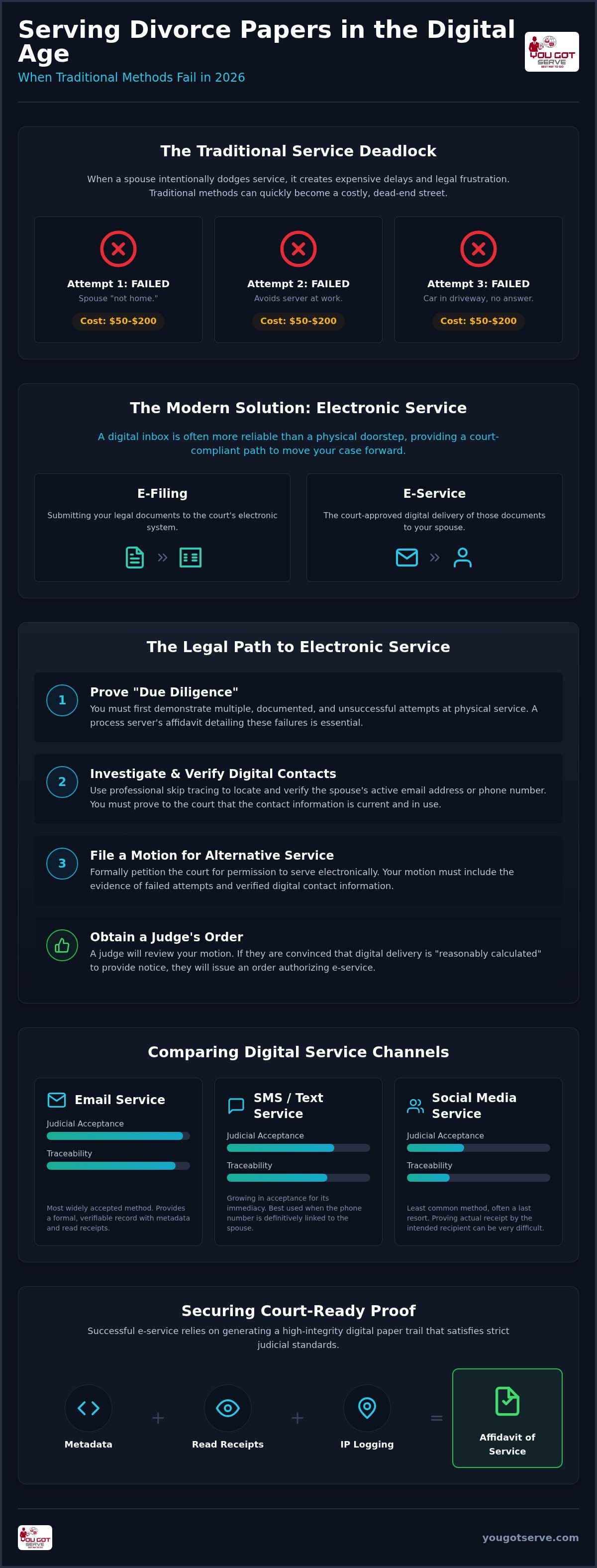
It's vital to distinguish between two distinct digital procedures. E-filing refers to the act of submitting your legal documents to the court's electronic system. Conversely, e-service is the actual delivery of those filed documents to your spouse. You can't simply email papers to your spouse and consider the task complete. Specific procedural steps are required to ensure the delivery is court-compliant. In this digital environment, the role of a process server evolves from a physical courier to a technical verifier. They ensure that metadata, read receipts, and IP logging provide the necessary proof of receipt that a court requires.
Common Challenges with Elusive Spouses
Intentional "dodging" is a primary reason divorce cases stall. When a spouse avoids a physical process server, it creates a significant legal bottleneck. This behavior isn't just frustrating; it's expensive. Traditional process servers typically charge between $50 and $200 per attempt, and repeated failures can quickly drain your resources. Digital footprints are much harder to obscure than physical presence. While a spouse can refuse to answer the door, their continuous activity on verified digital channels provides the court with actionable evidence. Moving the service process online bypasses these physical barriers and keeps the litigation moving forward without unnecessary delays.
The Legal Threshold: When Can You Serve Divorce Papers Electronically?
Alternative Service of Process is a court-ordered method used when personal service is impractical. Unlike traditional hand-delivery, this method is not a default right; it is a remedy of last resort. To qualify, you must first satisfy the requirement of "due diligence." This means you've made several documented attempts to serve your spouse at their home, workplace, and other known locations using a professional process server. Only after these physical efforts fail can you petition the court for permission to move the process online.
The judge plays a critical role in this transition. They won't authorize digital delivery based on a simple request. Instead, they evaluate the reliability of the digital contact information you provide. You must demonstrate that the email address or phone number is active and currently used by the defendant. If a judge isn't convinced that the electronic notification will actually reach the spouse, they'll likely deny the motion to protect the spouse's constitutional right to notice.
Filing a Motion for Alternative Service
To initiate this shift, you must file a formal Motion for Alternative Service. This legal filing requires a supporting affidavit from your process server detailing every failed attempt at physical delivery. Including professional skip tracing reports strengthens your motion by showing the court that you've investigated all available leads without success. These reports act as objective evidence of your diligence. Once filed, the timeline for a judge to issue an order for digital service usually spans several weeks, depending on the court's current backlog.
Jurisdictional Variations in 2026
State courts are adopting digital standards at different speeds. For instance, several jurisdictions have updated their rules for electronic service in January 2026 to provide clearer pathways for serving elusive defendants. However, you must adhere strictly to the specific language in your judge's "Order for Service." If the order specifies email, you cannot substitute it with an SMS message. A "one size fits all" approach doesn't work in family law because every jurisdiction maintains its own standards for what constitutes a "verified" digital channel. Always verify that your delivery method matches the court's specific authorization to avoid a dismissal for improper service.
Comparing Methods: Email, SMS, and Social Media Service
Selecting the right digital channel is a strategic decision that directly impacts the court's perception of your service efforts. While several options exist, judicial acceptance varies based on the channel's ability to provide objective proof of delivery. Currently, email is the primary method for serving divorce papers electronically because it offers a sophisticated balance of technical tracking and widespread usage. SMS has emerged as a powerful secondary tool, often used to deliver secure links to documents. Social media platforms remain a last resort, reserved for cases where every other digital and physical avenue has been exhausted.
Email Service Requirements
Email is the gold standard of digital service because it generates a robust audit trail. To satisfy a judge, you need more than just a sent confirmation. You require delivery tracking metadata that provides a clear, unbroken chain of verification. Your delivery report should ideally include:
- The recipient's verified IP address and device fingerprint.
- Detailed timestamps for the initial delivery and each subsequent time the document was accessed.
- Confirmation that the email did not encounter a "bounce-back" or server rejection.
It's essential to prove the email address is actively monitored. If you receive a technical failure notification, you cannot ignore it. These failures must be documented and reported to the court as part of your diligence record to maintain the integrity of the process.
SMS and Social Media: The New Frontier
Text messaging provides a direct line to a spouse's mobile device, often bypassing the spam filters that can plague email. In many jurisdictions, SMS service involves sending a secure link that requires the recipient to complete a multi-factor authentication step before accessing the documents. This prevents "identity denial" defenses where a spouse claims someone else accessed their phone. This added layer of security is why many legal professionals prefer this method when serving divorce papers electronically to high-conflict defendants.
The legal discourse surrounding alternative service by social media highlights that while these platforms are increasingly relevant, they carry unique evidentiary hurdles. Courts typically require proof of recent account activity, such as public posts or direct message interactions, to ensure the defendant is actually seeing the notification. Without this verification, a judge may rule the service invalid, potentially resetting your case timeline and increasing your legal costs.
Step-by-Step: Moving from Physical to Digital Service
Transitioning from physical to digital service requires a meticulous shift in strategy to satisfy judicial scrutiny. The process begins with documenting failed personal service. You must obtain an "Affidavit of Non-Service" from a traditional process server. This document proves to the court that you've exhausted physical options at the defendant's last known residence or workplace. When an address is completely unknown, the burden of proof for "due diligence" increases significantly. You cannot simply guess where your spouse might be; you must demonstrate a professional effort to locate them before the court will entertain alternative methods.
Once you have documented these failures, the next phase is securing a specific court order. This legal authorization allows you to transition your efforts toward serving divorce papers electronically. After the judge signs the order, you execute service through a secure, trackable platform. This ensures the delivery is not lost in a spam folder or dismissed as a casual communication. Using a professional platform instead of a personal email account provides the technical weight necessary to withstand a legal challenge from an elusive spouse.
Skip Tracing as a Foundation
Professional skip tracing is the backbone of successful digital service. Unlike a standard Google search or a public social media scan, licensed investigators utilize proprietary databases to identify active, verified digital contact information. A Google search often yields outdated or unverified data that a judge will likely reject. Licensed investigators provide detailed reports that link specific email addresses and phone numbers to the defendant's current activity. These investigative reports are essential for meeting the court's strict due diligence requirements, especially when a physical residence cannot be established. This investigative layer provides the "reasonable certainty" that judges require before granting an order for alternative service.
Drafting the Affidavit of Electronic Service
The final step is the creation of a court-ready Affidavit of Service. This document must go beyond a simple statement of delivery. To be legally sound, it must include specific technical data such as IP address logging, device fingerprints, and exact delivery timestamps. This metadata proves the document reached the intended recipient's device. Ensuring your proof of service is technically robust prevents the defendant from claiming they never received the notification. If you are ready to move your case forward, you can start your digital service and skip tracing investigation to secure the necessary proof for your filing. This integrated approach ensures your documentation is prepared for immediate judicial review.
Securing Court-Ready Proof with YouGotServe
YouGotServe bridges the gap between digital convenience and the rigid requirements of the judicial system. While court approval is always required for alternative methods, our platform provides the technical infrastructure needed to transform a digital transmission into a legally recognized event. By automating the verification of document receipt, the platform eliminates the ambiguity that often causes judges to reject serving divorce papers electronically. Every delivery generates a comprehensive audit trail, ensuring that your efforts meet the highest standards of transparency and reliability.
The primary advantage of the platform is the integration of licensed investigative skip tracing with secure digital delivery. Holding Florida Private Investigator License #A1400196, YouGotServe utilizes professional-grade databases to identify and verify active email addresses and mobile numbers. This investigative foundation ensures that when you execute service, you are targeting accounts with a documented history of activity. This integrated workflow saves time and provides the "reasonable diligence" evidence necessary to satisfy the court's requirements for alternative service.
Technical Verification and Security
Establishing "actual notice" requires more than a simple "sent" timestamp. YouGotServe utilizes sophisticated tracking features that capture granular metadata the moment a recipient accesses the documents. This includes logging the recipient's IP address, device type, and browser fingerprint. To protect sensitive family law data, all documents are delivered via encrypted channels. Our recipient verification process ensures that the documents are only accessible by the intended party, providing a layer of security that traditional email cannot match. Additionally, automated follow-up reminders are sent to the recipient, creating a persistent record of notification that further reinforces the validity of the service in the eyes of the court.
Streamlining the Litigation Workflow
Traditional process serving can take weeks of failed attempts and mounting costs. By moving to a digital-first approach, legal professionals can often reduce the time-to-service from weeks to just hours once a court order is obtained. Real-time tracking alerts notify you instantly when papers are accessed, allowing you to move to the next phase of your case without waiting for a physical return of service. This digital proof of service integrates seamlessly with modern law firm management practices, providing a "court-ready" Affidavit of Service that is prepared for immediate filing. This efficiency ensures that your divorce case remains on schedule and avoids the common bottlenecks associated with elusive defendants.
Start your secure digital service of process today to ensure your delivery meets strict judicial standards and moves your litigation forward without delay.
Modernizing Your Divorce Proceedings
Navigating the complexities of an elusive spouse doesn't have to stall your legal progress. By meeting the judicial threshold for due diligence and securing a specific court order, serving divorce papers electronically becomes a powerful tool to move your litigation forward. This modern approach replaces the uncertainty of physical hand-delivery with the precision of technical verification. Success in this digital transition relies on robust metadata, verified skip tracing, and a platform that satisfies strict evidentiary standards.
YouGotServe operates under Florida Private Investigator License #A1400196, providing the professional investigative foundation needed to locate valid digital contact information for skip tracing. Our platform automates delivery tracking and recipient verification, ensuring your documentation is prepared for immediate judicial review. You don't have to face legal bottlenecks alone. It's time to leverage technical innovation to ensure your right to due process is met with efficiency and security.
Secure your court-ready proof of service with YouGotServe and take the final step toward resolving your divorce case with confidence.
Frequently Asked Questions
Is serving divorce papers via email legally binding in 2026?
Yes, email service is legally binding in many jurisdictions, provided you have obtained a specific court order. In California, for example, rules expanded in January 2026 to allow this method for elusive defendants. You must first prove that you've exercised due diligence through traditional methods. It isn't an automatic right; a judge must authorize the request based on evidence that the email address is active and monitored.
What happens if my spouse refuses to open the email or text?
Intentional evasion doesn't necessarily invalidate the process if you use a platform that tracks technical delivery metadata. YouGotServe captures IP addresses and device fingerprints the moment a notification reaches the recipient's device. Even if they don't click the link, automated reminders and investigative proof of an active account help establish "actual notice" to the court's satisfaction, preventing the case from being dismissed due to a lack of service.
Can I serve divorce papers via social media without a court order?
No, you cannot serve legal documents through social media platforms without specific judicial authorization. Courts categorize platforms like Facebook or LinkedIn as "Alternative Service," which requires a formal motion and a showing of reasonable diligence. You must demonstrate to the judge that the account is currently active and that other methods, including physical service and email, have been unsuccessful or are entirely impossible to perform.
How do I prove to the judge that my spouse actually received the papers?
You must provide a technical Affidavit of Service that contains comprehensive delivery logs and verification data. Professional platforms track when the message reached the server and exactly when the recipient interacted with the secure link. This data, combined with skip tracing reports that confirm the digital contact info is current, provides the evidentiary weight needed when serving divorce papers electronically to satisfy strict judicial requirements.
What is a Motion for Alternative Service and when do I need one?
This is a formal legal request asking the judge to allow notification methods other than personal hand-delivery. You need this motion when a spouse is intentionally dodging a process server or cannot be located at a physical address. The motion must be supported by an affidavit detailing your failed attempts at traditional service. The court will only grant permission for digital methods once you've proven that physical service is impractical.
Can a private investigator help with electronic service of process?
Yes, licensed investigators are critical for identifying the verified digital contact information required for a successful motion. YouGotServe holds Florida Private Investigator License #A1400196 and utilizes investigative skip tracing to find active email addresses and phone numbers. This professional verification ensures that the court accepts the digital channel as a reliable way to reach the defendant, which is essential for meeting the "reasonable diligence" standard in family law.
What technical data is required for a digital Affidavit of Service?
A court-ready affidavit must include specific metadata such as the recipient’s IP address, device fingerprints, and exact timestamps for both delivery and access. This technical proof establishes a transparent audit trail that simple email receipts can't provide. Including these details prevents the defendant from claiming they never received the notification. This is a vital safeguard in high-conflict divorce cases where a spouse might attempt to stall the litigation by denying receipt.
How much does it cost to serve someone electronically compared to a physical server?
While physical process servers typically charge between $50 and $200 per attempt, serving divorce papers electronically often reduces the overall financial drain by eliminating the cost of repeated failed visits. Digital delivery streamlines the workflow and utilizes automated follow-up reminders to ensure compliance. This method is significantly more cost-effective when dealing with an elusive spouse, as it bypasses the expensive bottlenecks associated with traditional, in-person service attempts.


