

What does a “delivered” notification actually establish if the recipient later says they never saw the documents? A court admissible delivery confirmation can document events recorded during an electronic delivery attempt, but a sent, delivered, or opened status does not automatically prove who accessed the message or whether legal service was valid.
That distinction matters when a recipient disputes receiving or accessing documents. Email logs may record transmission and delivery events. A documented email-and-SMS workflow can also show notification history, timestamps, access activity, and other available details. These records help describe delivery efforts, but their evidentiary value depends on the facts and applicable rules.
This article explains what digital delivery records can show, how to assess their usefulness, and what to check before relying on them. It also compares basic email records with a workflow that includes email and SMS notifications, secure recipient access, activity tracking, and downloadable reporting. Electronic-service requirements vary by jurisdiction and case type, and court authorization or other procedural requirements may apply. A platform record documents activity; it does not, by itself, establish that electronic service was legally sufficient.
Key Takeaways
- A court admissible delivery confirmation documents recorded delivery events and available recipient activity, but does not determine whether service meets legal requirements.
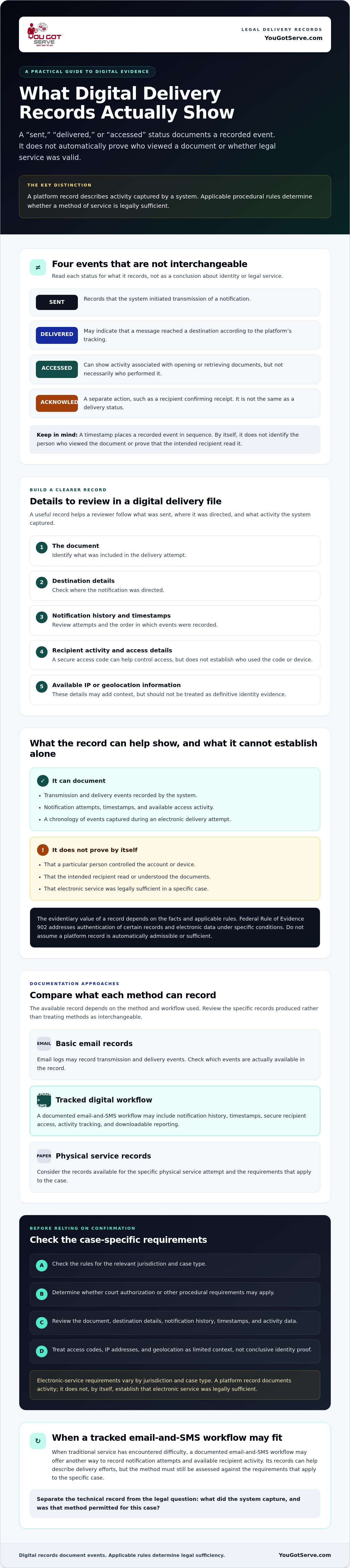
- Distinguish sending, delivery status, document access, and acknowledgment when reviewing a digital record.
- Check the document, destination details, notification history, timestamps, and activity data. Treat IP or geolocation information as limited evidence.
- Compare what ordinary email, tracked digital delivery, and physical service records can show before choosing a documentation method.
- Before relying on electronic service, check the case-specific rules and any required court authorization. A documented email-and-SMS workflow may be an option when traditional service has encountered difficulty.
What Court-Admissible Delivery Confirmation Can and Cannot Show
A delivery record can help answer a practical question: what events did the delivery system record, and when? It may document a notification being sent, a delivery status, or recipient activity such as accessing documents. But a court admissible delivery confirmation is not a court ruling. A record alone does not establish that a particular person received, reviewed, or was legally served with the documents.
Consider an email notification for a legal document. A “sent” event records that the system initiated transmission. A “delivered” status may indicate that the message reached a destination according to the platform’s tracking. An access event can show activity associated with opening or retrieving documents. An acknowledgment is a separate action, such as a recipient confirming receipt. These events are not interchangeable, and none automatically proves who controlled the account or device.
This video explains how “delivery” can have different meanings in a legal process:
What does a digital delivery confirmation record?
A digital delivery confirmation is a chronological record of transmission events and any recipient activity the workflow captures, not proof by itself that legal service was sufficient. Depending on the system, the history may include notification attempts, timestamps, delivery statuses, and document access activity. A timestamp identifies when the platform recorded an event. On its own, it does not identify the person who viewed the document or prove that the intended recipient read it.
For example, a log may show that a document was accessed using a secure code. That is useful information about recorded activity, but it does not necessarily establish the user’s identity or understanding. A well-organized chronology can help preserve evidence history, a concept discussed under Chain of custody. Tracking still cannot guarantee actual receipt, review, or acknowledgment by the intended person.
Why is a delivery status not the same as valid service?
A platform records technical events. Procedural rules determine whether a document was served through an authorized method. Electronic-service requirements depend on the jurisdiction and case type, and court authorization or other legal requirements may apply. A “delivered” or “accessed” status should not be treated as universally admissible or sufficient. Before relying on a digital record, check the applicable rules and any court order, and consult qualified counsel about case-specific questions.
Which Details Make a Digital Delivery Record More Useful?
A useful digital delivery record helps a reviewer follow what was sent, where it was directed, and what activity the system recorded. Each detail adds context, but no single entry should be treated as conclusive proof of a recipient’s identity or legal service.
How do timestamps, access codes, and activity records help?
Timestamps arrange events in sequence, such as a notification attempt followed by a recorded document-access event. A unique recipient access code can help control access to documents, but it does not establish who entered the code or used the device. Notification history, timestamps, recipient activity, and available IP or geolocation information can show recorded system events. They cannot alone prove that a specific person received, read, or was legally served with the documents.
IP addresses and geolocation details, when available, may add context to an activity record. They should not be treated as definitive identity evidence. Federal Rule of Evidence 902 addresses authentication of certain records and electronic data under specific conditions. Review the Federal Rules of Evidence for self-authenticating records rather than assuming a platform report is automatically authenticated or admissible.
What should a reviewer check in the documentation?
Read the report as a timeline, not just a final status. Check whether it identifies the documents and intended recipient details, then compare each notification event, timestamp, and recorded activity. Note gaps or unclear entries. Do not fill missing information with assumptions.
- Document: Can the record distinguish which materials were included or made available?
- Destination: Are the email address or phone details documented clearly enough to assess the intended recipient information?
- Events: Does the report show notification attempts and available delivery or access activity in order?
- Context: Are timestamps understandable, and are IP or geolocation details identified as available information rather than proof of identity?
Downloadable reporting can consolidate recorded details into one reviewable history. It can make the sequence easier to examine, but does not guarantee judicial acceptance or satisfy a case’s service requirements. YouGotServe’s email-and-SMS workflow includes secure access codes, notification history, timestamps, activity tracking, and downloadable service reporting. For a closer look at this documented delivery option, visit YouGotServe’s electronic document delivery. Use electronic service only where applicable rules and any required authorization permit it.
Compare Basic Email Receipts, Tracked Delivery, and Other Methods
Different delivery methods create different records. The useful comparison is what each method documents and whether it fits the requirements for the specific case, not which method is universally best.
| Method | Events it may document | Limits to consider |
|---|---|---|
| Ordinary email | A sent message and, when enabled and available, a delivery or read receipt. | A sent message does not necessarily show delivery, document access, recipient identity, or valid service. |
| Tracked digital delivery | Notification history, timestamps, delivery statuses, secure access workflow, and recorded recipient activity, depending on the platform. | Available data varies. Activity records do not alone prove who used an account or device, read the documents, or was legally served. |
| Physical service documentation | Service attempts and other details recorded by the person performing service. | The record reflects what was documented about those attempts. Whether the method and documentation satisfy applicable requirements depends on the case. |
What can a basic email receipt tell you?
An ordinary sent message can help establish that an email was prepared and sent to a listed address. A delivery or read receipt, if generated, adds a separate data point. But such receipts may not establish who controlled the account, whether the attached documents were opened, or whether the method complied with service rules. The relevance of an email receipt depends on the evidence and procedural context.
What does tracked digital delivery add to the comparison?
A tracked workflow can organize notifications and available activity into a more detailed timeline than a basic email record. For example, a documented email-and-SMS process may show notification attempts, timestamps, secure access activity, and downloadable reporting. These records are limited to the events and data the platform captures. NIST’s digital forensics resources provide context on handling digital evidence, but a delivery log does not automatically establish admissibility or legal sufficiency.
For a broader overview of rules and considerations, see Electronic Service of Process: The Definitive Guide to Digital Legal Delivery in 2026. Method selection must account for applicable rules and any required authorization. If traditional service has encountered difficulty and electronic delivery is permitted or authorized, review You Got Serve LLC’s electronic document delivery.
How to Evaluate Confirmation Against Case-Specific Service Requirements
Start with the case’s procedural requirements when evaluating a delivery record. A court admissible delivery confirmation documents platform activity. It does not authorize electronic service or guarantee that a court will admit or rely on the record.
Which legal and procedural questions should be resolved first?
Identify the jurisdiction and case type, then determine which service requirements apply to the documents at issue. Requirements can differ between initial service and later filings. Check whether electronic service is allowed and whether a court order, consent, or another procedural step is required. Review the applicable rules and any orders in the case, or ask qualified counsel to resolve questions specific to the matter. This information is not legal advice.
How should a team review the available record?
After confirming the method is permitted or authorized, compare the report with the matter’s records. Check that the reporting period, documents, and recipient details align, then note missing or unclear entries. If a recipient disputes access, a log can show what the system recorded, but may not establish who personally received or reviewed the materials.
A practical review can follow this sequence:
- Confirm the scope: Identify which documents and delivery period the report covers.
- Verify the destination: Compare recorded contact details with the information associated with the intended recipient.
- Check the sequence: Review recorded events in order and distinguish system activity from conclusions about receipt.
- Document gaps: Preserve questions about missing or ambiguous information for counsel rather than making assumptions.
For related guidance, see How to Verify Email Receipt for Court Proceedings and Ensuring Court Compliant Electronic Delivery. Qualified counsel can help assess how a disputed event or documentation gap affects the procedure in a particular case.
When electronic delivery is permitted or authorized, You Got Serve LLC offers a documented email-and-SMS workflow with tracking and downloadable reporting. Review electronic document delivery options and assess whether the available records fit your matter’s requirements.
When a Documented Email-and-SMS Workflow May Fit
If traditional service has encountered difficulty, a digital workflow may be worth considering when electronic service is permitted or authorized for the specific matter. It offers another way to document delivery efforts, not a universal replacement for traditional service. Before selecting it, confirm the applicable rules, case type, and any court order or other authorization requirements with qualified counsel.
What does the You Got Serve workflow document?
You Got Serve provides legal-document delivery through email and SMS. Its workflow offers 60-day and 90-day campaign options with recurring daily notifications. A unique access code supports secure document access, while notification history, timestamps, and recorded recipient activity create a reportable sequence of events. Downloadable reporting can consolidate available records for review.
These records describe system activity. They do not guarantee that the intended person received, read, or acknowledged the documents, and they do not by themselves establish legal sufficiency. IP address and geolocation information may be included when available, but neither should be treated as conclusive proof of identity. The workflow is patent-pending.
For example, if a defendant in a family-law matter has been difficult to reach through traditional methods, an attorney could first determine whether electronic delivery is allowed and authorized. If so, the campaign history may help document repeated email and SMS notifications and any recorded access activity. The record supports review of what the platform captured, not assumptions about events it could not verify.
Optional contact investigation through CII Services Corp is a separate service that may be relevant when contact details need investigation. It is distinct from the delivery workflow.
What should readers do before choosing a digital option?
Confirm the rules and any required authorization with qualified counsel before starting electronic service. Then compare the matter’s needs with the workflow’s features: notification channels, secure access, event history, timestamps, and available reporting. If the record contains missing or unclear activity, identify that limitation rather than treating it as proof of receipt.
For a broader review of documentation practices, see Securing Court-Ready Proof of Service: The Complete Compliance Checklist (2026). A court admissible delivery confirmation can help preserve a record of digital activity, but legal sufficiency depends on the case and governing requirements.
Learn how You Got Serve documents digital delivery activity.
Use Delivery Records With a Clear Legal Framework
A court admissible delivery confirmation is most useful when its recorded events are clear and reviewed in the context of the case. Sending, delivery status, document access, and acknowledgment describe different events. None alone proves who personally received or reviewed the documents, or establishes that service was legally sufficient.
Before relying on electronic delivery, confirm the rules for the jurisdiction and case type, including whether court authorization or another procedural requirement applies. Then assess whether the available record clearly identifies the documents, intended recipient details, notification history, timestamps, and recorded activity. Treat missing or uncertain information as a limitation, not a fact to assume.
When traditional service has encountered difficulty and electronic delivery is permitted or authorized, You Got Serve offers a documented email-and-SMS workflow. It includes secure access using a unique recipient access code, activity tracking, downloadable service reporting, and a patent-pending workflow. These records document platform activity, not guaranteed receipt or court acceptance.
Review You Got Serve’s digital document delivery platform to see how its workflow records delivery activity. With careful review and the right procedural checks, you can make a more informed decision about documenting delivery efforts.
Frequently Asked Questions
Is a delivery confirmation enough to prove legal service?
No, a delivery confirmation is not enough by itself in every matter. It may document notifications, timestamps, or recorded recipient activity, but legal sufficiency depends on the jurisdiction, case type, and any required court authorization. A “sent,” “delivered,” or “accessed” status does not automatically satisfy service rules. Treat a court admissible delivery confirmation as a record of platform activity, then review the governing requirements with qualified counsel.
What is the difference between sent, delivered, and accessed?
“Sent” generally describes a transmission event, while “delivered” refers to a delivery status recorded by a system. “Accessed” indicates that the platform recorded an interaction with the document workflow. These events are not interchangeable. None necessarily identifies who used an account or device, confirms that the person read the document, or establishes that service was legally sufficient. Review each status in context with the rest of the available record.
Can email and SMS delivery records be used in a court matter?
They may document electronic delivery activity, but whether and how the records can be used depends on the applicable rules and the facts of the case. Electronic service may require court authorization or other procedural steps. A platform record does not guarantee admissibility or court acceptance. Before relying on email or SMS documentation, check the rules and any relevant court order, and ask qualified counsel to assess the requirements for your matter.
What information can a digital delivery report include?
Depending on the platform and available data, a report may include notification history, timestamps, and recorded recipient activity. You Got Serve also provides secure document access through a unique recipient access code and downloadable service reporting. IP address or geolocation information may be recorded when available, but it is not definitive proof of identity. These details show what the platform documented, not necessarily that a recipient received, understood, or acknowledged the documents.
What happens if a recipient says they never received the documents?
Preserve the available report and review its timeline, notification events, and recorded activity. The record may help show what the delivery workflow documented, but may not resolve a dispute about identity, access, or legal service. Avoid describing a status as proof of personal receipt unless the evidence supports that conclusion. Ask qualified counsel how to address the dispute and whether any additional procedural steps are required.
Do I need court authorization before using electronic service?
It depends on the jurisdiction, case type, and applicable procedural requirements. Do not assume electronic delivery is permitted without authorization. Review the relevant rules and any court order before proceeding, and consult qualified counsel about your case. A delivery platform records activity; it does not create authorization or replace required court approval. This information is educational and is not legal advice.
How can recurring email and SMS notifications help document delivery efforts?
Recurring notifications can create a history of notification attempts and recorded activity across a campaign period. You Got Serve offers 60-day and 90-day campaigns with email and SMS notifications, secure recipient access, and downloadable reporting. These features can help organize documented delivery efforts, but they do not guarantee the recipient received or acknowledged the documents, or that service meets legal requirements. Confirm authorization before relying on electronic service. Review You Got Serve’s electronic document delivery options.


