

What should you look for in an sms summons delivery platform? The value may lie less in sending a text and more in documenting what the system records afterward. When traditional service attempts haven’t resolved a delivery challenge, recurring digital notifications may be another workflow to evaluate. But a text notification alone doesn’t establish that legal service was completed or that the recipient received or reviewed the documents.
It’s reasonable to want a clear record of notifications and recipient activity, especially when a matter has stalled. It’s just as important to know whether electronic service is permitted in your case. Requirements vary by jurisdiction and case type, and court authorization or other conditions may apply.
This guide explains what to assess before choosing a platform, including secure document access, notification schedules, timestamps, activity tracking, and downloadable records. It also covers legal questions to resolve before use and how a technology-based option such as YouGotServe may fit alongside traditional service methods, rather than universally replacing them.
Key Takeaways
- Before using an SMS summons delivery platform, verify the rules for your jurisdiction and case type, including whether court authorization or other requirements apply.
- Compare secure recipient access, notification history, timestamps, activity tracking, and downloadable reports to see whether a platform supports your documentation workflow.
- A unique access code records an access step, but it doesn’t by itself confirm a recipient’s identity or prove that legal service was completed.
- Document prior service efforts where relevant, confirm contact details, and follow applicable procedural requirements before starting digital delivery.
- You Got Serve offers recurring email and SMS notifications, secure access, tracking, and reporting through 60-Day and 90-Day campaign options. These options don’t guarantee service or court acceptance.
When an SMS Summons Delivery Platform May Fit a Difficult Service Situation
Repeated attempts to reach a party through traditional methods can leave a law firm, property manager, or individual unsure what to do next. A digital workflow may be worth evaluating, but a text message is not automatically valid service. Whether electronic delivery can be used depends on the applicable rules, case type, and any required consent or court authorization.
An SMS summons delivery platform provides access to legal documents, sends notifications, and records related activity. Those functions can support a documented workflow, but they don’t determine whether service is legally sufficient. For foundational context, see this overview of service of process.
This video illustrates SMS delivery callbacks. A system event is distinct from a legal determination that service is complete.
Separate digital notifications from official service
Recurring texts or emails can remind a recipient that documents are available. They don’t independently establish that legal service occurred. A platform may record when a notification was sent or whether a recipient accessed a document. That activity record is not necessarily proof of delivery, receipt, identity, or acknowledgment.
Before relying on electronic delivery, review the rules for the jurisdiction and case type, confirm any authorization requirements, and consult qualified legal counsel about the matter. Treat platform records as documentation of recorded activity, not as a substitute for the legal standard that applies.
Identify situations where a digital workflow merits evaluation
Consider a case where a process server has made attempts but hasn’t reached a defendant, or a property manager is trying to move an eviction matter forward after difficulty contacting a tenant. A collection agency or self-represented individual may face a similar obstacle. These circumstances may prompt a review of other permitted options, not an assumption that text delivery is allowed.
If electronic service is permitted or authorized, assess whether document access and activity records suit the case. You Got Serve provides electronic document delivery through email and SMS, with secure recipient access and activity tracking. This technology-based option may be relevant when traditional service encounters difficulties, but it doesn’t replace traditional methods in every situation or guarantee legal service.
How to Evaluate Security, Recipient Access, and Delivery Records
A useful SMS summons delivery platform should let you review how recipients access documents and what activity the system records. Compare specific controls and reports rather than treating a “sent” status as proof that a recipient received or read the documents.
| Capability | What to assess |
|---|---|
| Recipient access | Does the recipient use secure access, such as a unique code, rather than receiving sensitive documents as ordinary text or email attachments? |
| Security controls | Ask about account protections and malware scanning, and confirm how these controls apply to documents and accounts. |
| Notification history and timestamps | Can you review which notifications were sent and their recorded times? |
| Recipient activity | Does reporting show document-access activity? Are IP or geolocation details included only when available? |
| Downloadable reporting | Can you export records for review and retention in the matter file? |
Check how recipients access sensitive documents
Consider whether a secure access process is more appropriate for your documents than sending attachments directly. With You Got Serve, recipients use a unique access code to reach documents. The code records an access step, but shouldn’t be treated as conclusive identity verification. You Got Serve also lists document malware scanning and account security controls. Check how these features fit your organization’s security requirements.
Assess what delivery activity the platform records
An activity record is a platform’s documented history of notification events and recipient interactions, such as timestamps and recorded document access. It describes what the system logged. It doesn’t, by itself, establish who used a device, confirm receipt or understanding, or prove that legal service was completed.
You Got Serve provides notification history, timestamps, recipient activity information, and downloadable service reporting. IP and geolocation information may be available, but shouldn’t be assumed for every interaction. Preserve and assess records in light of the rules and evidentiary requirements that apply to your matter. For federal civil cases, review the Federal Rules of Civil Procedure for electronic service and confirm which provisions apply to the documents and parties involved.
For a practical comparison, review You Got Serve’s electronic delivery workflow against your matter’s access, tracking, and reporting needs. Platform records can support documentation, but they don’t replace required authorization or determine legal sufficiency.
Compare SMS Summons Platforms by Workflow, Reporting, and Fit
Compare an SMS summons delivery platform by the work it supports, not by the number of messages it sends. For a law firm handling a hard-to-reach party, useful differences may include campaign duration, notification channels, secure document access, activity tracking, and downloadable reports. Confirm what each provider includes, and keep legal permission separate from technical capability.
Rules can differ by jurisdiction. For example, a state court’s rules on electronic service describe a specific court rule concerning summons by text, email, and social media. That example should not be treated as authority for another jurisdiction or case. Check the rules that govern your matter before selecting a workflow.
Review campaign structure, access, and reporting
You Got Serve offers a 60-Day Digital Service Campaign and a 90-Day Digital Service Campaign. Both use automated daily email and SMS notifications, with secure recipient access through a unique access code, activity tracking, and downloadable reporting. Compare the campaign options with your matter’s needs, including the expected notification period and the records your team needs to retain. For recurring organizational use, Organization Accounts apply a 10% discount to each service/document campaign.
- Notification workflow: Check which channels are used, how often notices are sent, and how long the campaign runs.
- Document access: Confirm how recipients reach the documents and what access activity is recorded.
- Reporting: Review whether notification history, timestamps, and recipient activity can be downloaded for the case file.
- Workflow boundaries: Determine how the platform records activity and what your team must handle outside the system.
Recurring reminders can maintain a notification workflow, but they don’t establish that service is legally complete. Platform features document recorded activity; they do not decide whether service is legally valid. Assess the records for operational fit, then confirm legal requirements independently.
Distinguish delivery platforms from investigation services
A delivery platform works with contact information you provide. If an email address or mobile number is unknown or needs investigation, ask whether contact discovery is included, available separately, or outside the provider’s scope. Don’t assume a campaign includes investigation simply because both capabilities relate to reaching a recipient.
You Got Serve’s optional background or contact investigation is provided separately through CII Services Corp, not as an included campaign feature. For more on that distinct workflow, see the skip tracing guide for legal professionals. Compare based on your actual need: documented digital delivery, contact discovery, or both, while verifying the legal path for your case.
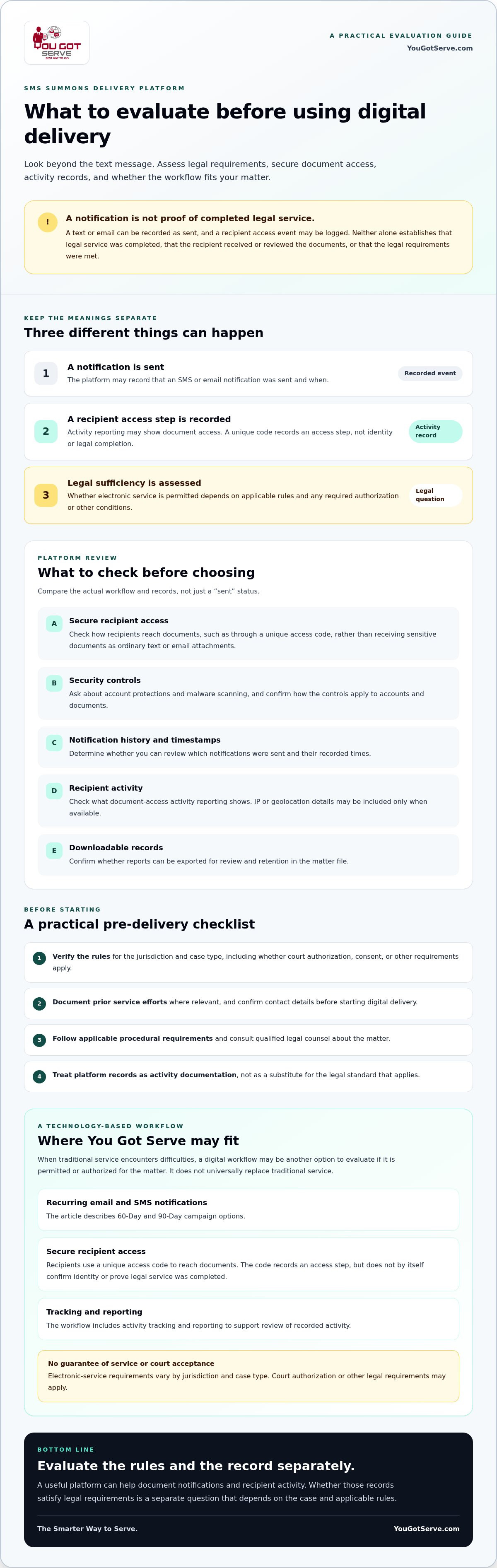
Use a Practical Checklist Before Starting Digital Summons Delivery
Before entering recipient details into an SMS summons delivery platform, establish that electronic delivery is an available path for this specific matter. A consistent review helps prevent a platform’s technical capabilities from being mistaken for legal authorization. Keep records of earlier service efforts where relevant, and follow the procedures that apply to your case.
Use this sequence as a starting point. It’s educational information, not legal advice. For more background, see this electronic service of process guide.
- Review applicable rules. Check the requirements for the jurisdiction, case type, recipient, and proposed delivery method.
- Confirm authorization. Determine whether a court order, recipient consent, or another procedural step is required before electronic delivery.
- Check contact details. Assess whether the phone number and email address are reasonably associated with the intended recipient.
- Assess platform fit. Compare secure document access, notification workflow, activity records, and reporting with the requirements of your matter.
- Document the process. Retain relevant information about prior service attempts and platform activity, following applicable procedural requirements.
Confirm the legal pathway before sending documents
Rules for electronic service can differ by jurisdiction and case type. Check whether the proposed method is permitted for the specific document and recipient, and identify any required authorization or procedural step before sending notifications. If you’re uncertain how the rules apply, consult qualified legal counsel. A platform can support a delivery workflow, but it can’t authorize electronic service or determine whether the method satisfies the law.
Prepare contact details and a documented workflow
Verify the contact information you plan to use and note the basis for associating it with the recipient. If contact details are unknown or need investigation, determine whether separate assistance is appropriate. You Got Serve’s optional background or contact investigation is provided separately through CII Services Corp, not as an included campaign feature.
Plan how your team will preserve records and respond to gaps. For example, if a recipient doesn’t interact with a document link, record what the platform shows, such as notifications and timestamps. Don’t characterize non-interaction as receipt, acknowledgment, or completed legal service. Platform activity records can support documentation, but they don’t guarantee legal sufficiency.
Once you’ve confirmed the legal pathway and reviewed your workflow needs, review You Got Serve’s digital document delivery options as a technology-based option when traditional service encounters difficulties.
Assess You Got Serve Against Your Case Requirements
After reviewing the legal pathway and the records your matter requires, assess whether You Got Serve’s workflow fits the task. The platform provides recurring email and SMS notifications, secure recipient access through a unique access code, activity tracking, timestamps, and downloadable service reporting. These features create a documented digital workflow, but they don’t establish that a recipient received or acknowledged the documents.
The two campaign options are a 60-Day Digital Service Campaign and a 90-Day Digital Service Campaign. Treat them as defined platform options, not promises that delivery will succeed or that service will be legally sufficient. Consider which campaign structure fits your matter, then verify that electronic delivery is allowed for the jurisdiction, case type, and recipient. Court authorization or other requirements may apply.
What the platform documents and what remains case-dependent
Notification records and recipient activity can help you review and retain a history of what the platform recorded. Downloadable reporting supports documentation, but it doesn’t guarantee that a court will accept the records or find service valid. The legal effect depends on applicable rules and the circumstances of the case. For a record-keeping review, consult this court-ready proof of service checklist.
Use the report to understand documented events, not to infer events the system can’t confirm. For example, a notification timestamp records a notification event. It doesn’t alone prove who saw it, whether they understood it, or whether service was completed under the governing procedure.
Decide whether to explore the platform
Consider whether recurring email and SMS notifications, secure access, activity tracking, and downloadable reports match your operational needs. Also consider whether traditional service remains necessary or more appropriate under the applicable rules or facts. A technology-based workflow is not a universal replacement for traditional methods.
If the rules permit or authorize electronic delivery and the documented workflow fits your matter, explore You Got Serve as one option. Confirm suitability with qualified legal guidance before relying on any electronic method. You Got Serve, The Smarter Way to Serve.
Choose a Documented Workflow That Fits Your Matter
A practical buying decision starts with two questions: Is electronic service permitted or authorized for this case, and does the platform document the activity your workflow requires? A text notification or access record can help create a traceable history, but it doesn’t establish receipt or determine whether legal service is complete.
You Got Serve offers 60-Day Digital Service Campaign and 90-Day Digital Service Campaign options, with secure recipient access, notification history, and downloadable service reporting. Optional contact investigation is provided separately through CII Services Corp. Assess these capabilities against your matter’s requirements, and keep traditional service in consideration where rules or circumstances call for it. Requirements vary by jurisdiction and case type, so confirm the applicable process with qualified legal guidance.
If a technology-based approach may fit after traditional service reaches a roadblock, explore You Got Serve’s digital delivery workflow and evaluate its suitability for your case. With the right legal checks and a clear recordkeeping plan, you can make a more informed next move.
Frequently Asked Questions
Is serving a summons via SMS legally binding in the United States?
It depends on the jurisdiction, case type, and applicable service rules. Electronic delivery may require court authorization, consent, or another procedural step before it can be used. An SMS summons delivery platform can record notifications and recipient activity, but using one doesn’t automatically make service legally sufficient. Before relying on text delivery, confirm the requirements for the specific matter with qualified legal counsel.
What happens if the defendant claims they never received the text message?
Preserve the available platform report and follow the procedural requirements that apply to your case. The report may show notification history, timestamps, and recorded recipient activity, but it can’t guarantee that the defendant received, read, or acknowledged a message. A lack of recorded interaction doesn’t prove that the person saw the text. The legal significance of a denial depends on the circumstances and governing rules, so consult qualified counsel.
Do I need a court order to use an SMS summons delivery platform?
Not in every situation, but the requirements depend on the jurisdiction, case type, and applicable rules. Some matters may require court authorization, consent, or another procedural step before electronic service can be used. A platform doesn’t provide automatic judicial authorization. Confirm whether SMS delivery is permitted in your specific matter and obtain any required approval before sending documents through a digital workflow.
How does the platform verify that the correct person received the summons?
A platform may use secure access steps, such as a unique recipient code, and record timestamps and recipient interactions. These features document aspects of the delivery workflow, but they shouldn’t be treated as conclusive identity verification or proof that a particular person received or acknowledged the documents. Review how the platform’s access process works, what information its report captures, and what evidence is appropriate under the rules for your case.
Can I serve legal papers via SMS if I don’t have the defendant’s phone number?
A text campaign requires an identified phone number, and finding one doesn’t establish that it belongs to the intended recipient or that SMS service is legally permitted. You Got Serve offers optional background and contact investigation through CII Services Corp as a separate service, not as an included campaign feature. Verify contact details and confirm applicable service requirements before using an electronic method.
What is included in a court-ready proof of service for SMS delivery?
Reporting may include notification history, timestamps, recipient activity, and IP or geolocation information when available. The contents depend on what the platform records and includes in its downloadable report. A report can document platform activity, but it doesn’t guarantee court acceptance or legally sufficient service. Check the rules for your matter and confirm that the available documentation addresses the requirements that apply.
How much does it cost to serve a summons via SMS compared to traditional methods?
You Got Serve lists its 60-Day Digital Service Campaign at $350 and its 90-Day Digital Service Campaign at $500. Optional background or contact investigation through CII Services Corp is a separate service listed at $150 per investigation. These are You Got Serve’s listed prices, not a comparison with traditional process-serving fees. Confirm current pricing and terms directly with the provider before proceeding.
Can I use this platform for international service of process?
You Got Serve indicates that international digital delivery may be supported, subject to the applicable laws, rules, treaties, and authorization for the jurisdictions involved. Don’t assume that a method permitted in one country is valid in another. Before sending documents across borders, consult qualified legal counsel about the requirements for the case and destination. This information is educational, not legal advice.
To assess whether a documented digital delivery workflow fits your matter, review You Got Serve’s campaign options and confirm the applicable rules and authorization requirements before use.


