

The true cost of a failed physical service attempt isn't just the process server's mileage; it's the weeks of litigation delay and mounting administrative overhead. As courts nationwide embrace digital transformation, the per document electronic service fee has emerged as a critical metric for legal professionals seeking both efficiency and fiscal predictability. You likely feel the frustration of paying for multiple delivery attempts that yield no results, or the anxiety of wondering if a digital transmission meets strict judicial standards. It's no longer enough to simply send a document. You must ensure that every fee paid translates into a verifiable, court-ready event.
This guide will help you master the complex cost structures of digital process service and show you how to evaluate per-document fees for maximum courtroom compliance. We'll examine the shift from legacy delivery models toward secure, multi-channel systems that utilize email and SMS tracking. You'll learn how to identify hidden costs in legal tech platforms and how to prioritize features like recipient verification and automated reminders. By the end of this analysis, you'll have a clear framework for selecting a service that provides transparent pricing and legally defensible proof of service.
Key Takeaways
- Distinguish between administrative court filing costs and the specialized fees required for secure, recipient-facing digital delivery.
- Master how to evaluate a per document electronic service fee by assessing the inclusion of multi-channel transmission and recipient identity verification.
- Compare the ROI of digital delivery against traditional methods to reduce litigation delays caused by defendants evading physical process servers.
- Identify the specific tracking data and verification protocols necessary to produce a legally defensible, court-ready proof of service.
- Learn how investigative skip tracing ensures digital address accuracy, providing a more reliable foundation for electronic document delivery.
What is a Per Document Electronic Service Fee?
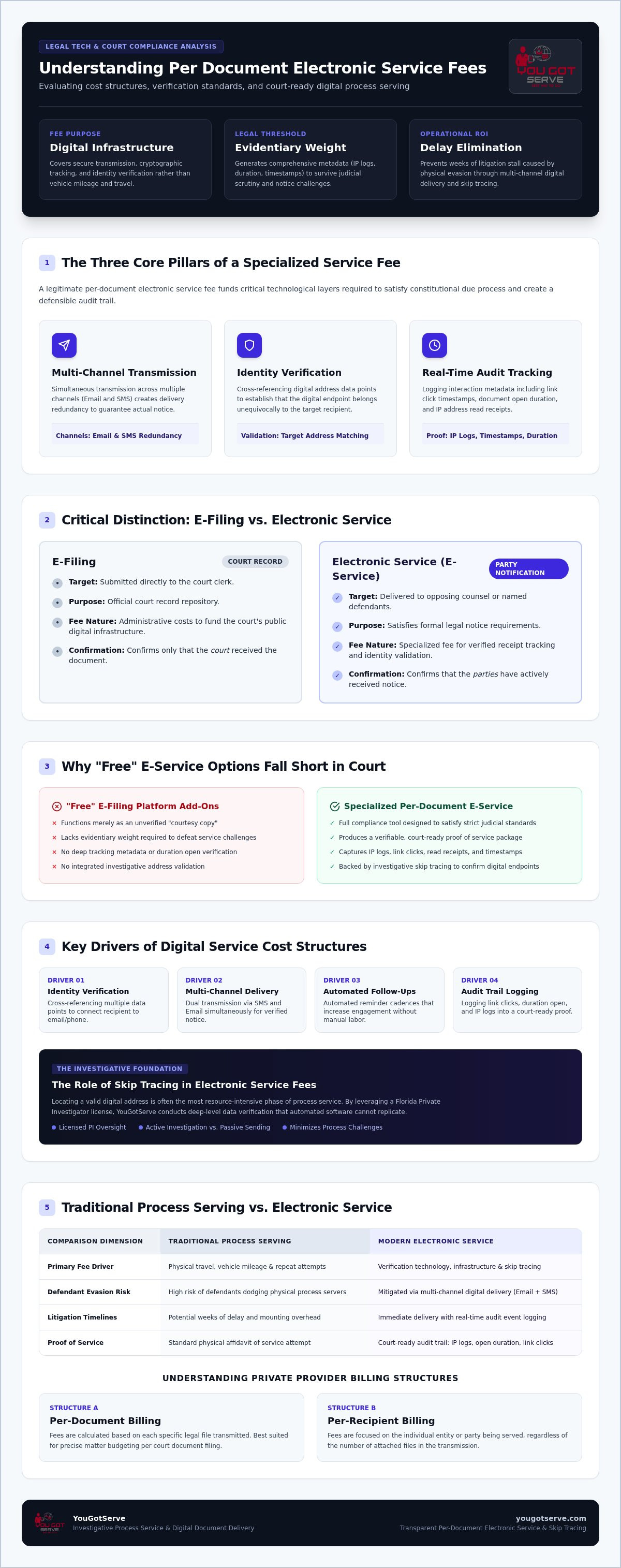
A per document electronic service fee represents the specific cost associated with the secure, digital transmission of legal documents to a designated recipient. Unlike traditional methods, this fee isn't for physical travel or mileage. It covers the technological infrastructure required to provide a legally defensible audit trail. A professional service includes three core pillars: secure multi-channel transmission via email and SMS, real-time delivery tracking, and recipient identity verification. When evaluating a per document electronic service fee, it's essential to look beyond the simple act of sending an email. Modern litigation increasingly relies on these digital methods to fulfill the constitutional requirements of service of process.
Many "free" e-service options provided by e-filing platforms often lack the evidentiary weight required by judges. These complimentary services typically function as a simple courtesy copy without robust tracking. In contrast, a specialized fee ensures that every transmission is backed by metadata, such as IP logs and read receipts, which are necessary to overcome challenges in court. It's a compliance tool, not just a delivery method.
The Difference Between E-Filing and E-Service
E-filing is the act of submitting documents to the court clerk for the official record. The fees associated with e-filing are administrative, funding the court's digital infrastructure. Conversely, electronic service is the act of delivering those same documents to opposing counsel or defendants. Separate fee structures exist because service requires active verification of receipt. While filing confirms the court has the document, service confirms the parties have been notified. This distinction is critical for maintaining procedural integrity.
Statutory vs. Private Provider Fee Models
State statutes often influence the maximum allowable fees for service, but private technology platforms justify their rates through enhanced security and investigative capabilities. You'll encounter two primary billing models: "per-document," which charges based on the specific file sent, and "per-recipient," which focuses on the individual being served regardless of the file count. Platforms like YouGotServe integrate investigative oversight, using skip tracing to ensure the digital address is valid before transmission. This proactive approach reduces the risk of service of process challenges and ensures the per document electronic service fee provides actual value rather than just a digital paper trail.
Factors That Determine Electronic Service Costs
The structure of a per document electronic service fee is rarely a reflection of simple bandwidth costs. Instead, the fee represents a sophisticated bundle of verification and tracking technologies designed to withstand judicial scrutiny. Accurate identity verification serves as the foundation of this cost. Ensuring that a digital address, whether an email or a mobile number, belongs specifically to the target recipient requires cross-referencing data points that go beyond a basic contact list. This level of diligence is what differentiates a legally sound service from a mere notification.
Multi-channel delivery further influences the cost by transmitting documents via both SMS and email simultaneously. This redundancy isn't just for convenience; it's a strategic move to ensure actual notice is achieved. Real-time tracking mechanisms log every interaction, from the moment a link is clicked to the duration a document remains open. These logs provide the raw data for a court-ready proof of service. Additionally, automated follow-up sequences increase the likelihood of recipient engagement without requiring manual intervention from your legal staff.
The Role of Skip Tracing in Service Fees
Finding a valid digital address is often the most resource-intensive part of the process. In many cases, a per document electronic service fee includes the cost of investigative skip tracing. At YouGotServe, our Florida Private Investigator license allows us to conduct deep-level data verification that standard software cannot match. By involving a licensed professional to verify recipient data, the service moves from a passive attempt to an active investigative effort. This investigative layer is often bundled into the fee to provide a seamless compliance package for legal teams who need reliable document delivery.
Security and Compliance Infrastructure
Transmitting sensitive legal documents requires strict adherence to high-level encryption standards. The infrastructure behind the fee must maintain an immutable audit trail and server logs that serve as evidence of delivery. These technical requirements align with the Federal Rules of Civil Procedure, specifically those governing the service of documents after the initial complaint. Maintaining these records in a court-compliant manner for years after the service is performed is a significant operational cost that ensures your case remains protected against future procedural challenges. Robust security protocols protect client confidentiality while providing the transparency necessary for modern litigation.
Electronic Service Fees vs. Traditional Process Serving
Traditional process serving often involves a complex web of variable costs. A sheriff or private server typically charges a base rate, but mileage, rush fees, and multiple attempt charges quickly inflate the total. When evaluating legal service costs, it's clear that physical delivery is prone to "no-service" returns. This happens when a defendant intentionally avoids the server, a practice known as ghosting. With a fixed per document electronic service fee, these physical barriers disappear. Digital delivery is instant; it doesn't rely on a server finding a person at home or at their place of business during specific hours.
Geographic flexibility is another major advantage of the digital model. Traditional service requires coordinating with local contractors across various counties or states, which creates administrative friction and inconsistent results. Digital delivery provides national reach from a single platform. You don't have to vet servers in remote jurisdictions or pay for their travel time. This streamlined approach ensures that the distance between the law firm and the recipient does not dictate the success or the cost of the service.
Hidden Costs of Traditional Service
Traditional methods carry heavy administrative weights that are often overlooked. If a server fails after three attempts, you've paid for their time but still have an unserved party. This failure often necessitates filing motions for alternative service, which adds significant billable hours for attorneys and additional filing fees for the court. These cascading expenses are rarely captured in the initial quote from a process serving agency. Managing a network of local servers also requires constant follow-up calls and manual status tracking, which drains internal resources.
The Efficiency of Digital Per-Document Fees
A per document electronic service fee offers much-needed predictability for law firm accounting and client invoicing. Costs are fixed per document, making it easier to project litigation expenses and justify them to clients. This model reduces the "billable hour" drain on paralegals who would otherwise spend time chasing status updates. Because elusive defendants often maintain a robust digital footprint even while dodging physical visits, digital delivery frequently achieves higher success rates. By shifting to a digital-first strategy, firms can bypass the physical gates and security systems that often stymie traditional process servers.
Evaluating ROI: When Is the Fee Worth It?
Determining the return on investment for digital delivery requires looking beyond the immediate invoice. The primary value lies in mitigating the risk of "service of process" challenges that can derail a case months after it begins. If a defendant successfully argues they weren't properly notified, the subsequent legal fees to rectify the error often dwarf the initial per document electronic service fee. You aren't just paying for a transmission; you're investing in the procedural integrity of your entire litigation strategy.
The cost of litigation delays caused by unserved defendants is a silent drain on firm profitability. Every week a case sits in the "service pending" phase is a week where no discovery occurs and no settlement negotiations can finalize. For high-volume caseloads or defendants known to be evasive, the efficiency of digital delivery becomes even more apparent. Shifting to a digital-first model allows your team to bypass the physical obstacles that typically slow down a case, ensuring that the transition from filing to active litigation is as seamless as possible.
Securing Court-Ready Proof of Service
A valid affidavit of electronic service must contain more than just a statement of "sent." It requires specific, timestamped logs, recipient IP addresses, and verification data that confirms the document was actually accessed. These technical details provide the evidentiary weight necessary to satisfy a judge's inquiry into the validity of the notice. A professional fee covers the evidence of service, not just the act. By providing a comprehensive audit trail, you ensure that your proof of service is resilient enough to withstand aggressive cross-examination or motions to quash.
Reducing Litigation Friction
Courts are increasingly burdened by a backlog of motions for alternative service, often caused by the inherent limitations of physical process serving. By utilizing a per document electronic service fee that includes automated reminders, you trigger recipient action more effectively than a single knock on a door. These automated sequences keep the document at the top of the recipient's digital inbox, increasing the likelihood of actual notice without additional manual effort from your staff. This proactive approach reduces administrative friction and allows your paralegals to focus on substantive legal work rather than managing service attempts. To streamline your workflow and ensure compliance, you can secure your court-ready delivery today through our specialized platform.
YouGotServe: Transparent Per-Document Electronic Service
YouGotServe operates at the intersection of legal technology and professional investigation. Our platform is designed specifically for legal professionals who require more than just a digital transmission. By leveraging our investigative background, including our Florida Private Investigator License (#A1400196), we provide a level of oversight that standard automated systems can't match. Every per document electronic service fee paid through our platform represents an investment in accuracy. We don't just send documents; we verify the recipients through a rigorous multi-channel system that utilizes both SMS and email delivery to ensure actual notice.
Simplified billing is a core component of our service. Modern law firms require predictable expenses to maintain healthy client relationships and efficient internal accounting. Our per-document model eliminates the guesswork associated with traditional process serving, where hidden mileage and attempt fees can fluctuate wildly. This transparency allows firms to invoice clients with confidence, knowing that the cost of service is fixed and the results are verifiable. It's a pragmatic solution for a modern legal environment.
Beyond Just an Email: Our Verification Process
Our verification process begins long before the first digital transmission is sent. We utilize professional skip tracing to identify and verify the digital contact information of the recipient. This investigative step is crucial because the validity of a digital serve rests entirely on the accuracy of the destination. By ensuring the email address or phone number belongs to the target, we maximize the value of the per document electronic service fee. This professional investigator oversight acts as a safeguard against future service of process challenges, providing the due diligence that judges look for in digital delivery cases.
Getting Started with Digital Service
Initiating a serve through YouGotServe is a streamlined process that fits into a busy legal workflow. You can upload your court-ready documents and initiate service in minutes through our intuitive interface. Once the process is active, you can track your serve in real-time through a secure dashboard that logs every interaction, from transmission to receipt. This level of transparency provides peace of mind and allows your team to move forward with litigation without waiting for a server to return a physical affidavit. To experience the benefits of a modern, investigative approach to document delivery, you can optimize your litigation workflow with YouGotServe. Our system is built to provide the legally defensible proof of service your cases demand, backed by the expertise of licensed professionals.
Modernizing Your Litigation Strategy
Transitioning to a digital-first delivery model is a strategic necessity for firms prioritizing efficiency and legal defensibility. You've seen how a transparent per document electronic service fee replaces the volatility of traditional process serving with predictable, fixed costs. By integrating investigative skip tracing and multi-channel delivery, you don't just send a file; you establish a verifiable audit trail that satisfies judicial requirements. It's a pragmatic shift that protects your case from procedural challenges while accelerating the timeline of your litigation.
Our methodology is backed by Florida Private Investigator License #A1400196, ensuring that every recipient is accurately identified before transmission. We provide court-ready affidavits for every successful serve, giving you the security needed to move forward with confidence. Don't let your cases stall due to elusive defendants or failed physical attempts. You can Start Serving Documents Digitally with YouGotServe today and secure your workflow with our multi-channel SMS and email delivery system. Your firm deserves the precision and reliability of a modern legal-tech partner.
Frequently Asked Questions
Is a per document electronic service fee different from a court filing fee?
Yes, a per document electronic service fee is distinct from a court filing fee. Filing fees are administrative costs paid to the court clerk to enter documents into the official record. Conversely, the service fee covers the secure digital transmission and verification of those documents to the opposing party. While filing confirms the court's possession, the service fee ensures the recipient has been formally notified in compliance with procedural rules.
Can I charge the electronic service fee back to my client as a legal expense?
Most law firms treat the digital delivery fee as a billable litigation expense that is passed through to the client. Because these fees are fixed and provide a clear audit trail, they are easily justifiable in client invoices. It's common practice to categorize these alongside other third-party costs like courier fees or traditional process serving charges, provided the client agreement allows for such disbursements.
What happens if the recipient never opens the electronic service email?
If a recipient does not open the initial email, the system utilizes multi-channel delivery via SMS and automated reminders to increase the probability of notice. Professional platforms log every delivery attempt and transmission receipt. Even if a recipient avoids clicking, the detailed server logs and IP tracking provide evidence of delivery that can be used to support a motion for alternative service or to prove due diligence.
Do courts require a specific motion before I can pay for electronic service?
For the initial service of a summons and complaint, many jurisdictions require a motion for alternative service if traditional physical methods have failed. However, for subsequent documents under rules similar to Federal Rule 5, electronic service is often the standard and doesn't require a specific motion. You should always verify local rules to determine if a formal court order is necessary for your specific case type.
What is included in a court-ready proof of service for digital delivery?
A court-ready proof of service includes a detailed affidavit supported by technical metadata. This typically includes the date and time of transmission, the specific email address or phone number used, and IP logs confirming delivery. It also features recipient verification data and a record of any automated reminders sent. These elements collectively establish a legally defensible record that the document was successfully delivered to the intended party.
How does skip tracing affect the total cost of electronic process service?
Skip tracing is a vital component that ensures the per document electronic service fee results in a valid delivery. By utilizing investigative techniques to verify a recipient's digital contact information, firms avoid wasting resources on inactive accounts. This investigative layer is often bundled into the service fee to provide a comprehensive compliance package, ensuring that the technology is targeting the correct individual from the outset.
Are electronic service fees refundable if the defendant is never located?
Fees associated with electronic delivery are generally non-refundable because they cover the investigative work and the technological attempts to establish contact. The revenue model for these services is based on the effort to locate and transmit documents to a recipient. Even if a defendant remains elusive, the logs generated during the process serve as the necessary evidence of due diligence required to seek further judicial remedies.
Is electronic service via SMS and email legally binding in all states?
The legal validity of digital delivery via SMS and email depends on specific state statutes and court orders. While many states have adopted rules allowing for electronic service between attorneys, serving a defendant directly often requires a court order for alternative service. The per document electronic service fee supports these efforts by providing the tracking and verification data needed to satisfy constitutional due process requirements across national jurisdictions.


