

A "not found" return from a process server shouldn't be the end of your litigation, yet for many, it signals a costly and indefinite delay. If you're facing the strict 90-day deadline under Federal Rule 4(m), a single failed attempt can feel like a death knell for your case. It's a common frustration; litigation stalls, costs mount, and the path forward remains obscured by defendants who are experts at evading traditional contact. You need a reliable, technology-driven strategy to locate and serve defendant parties without relying solely on a physical knock at the door.
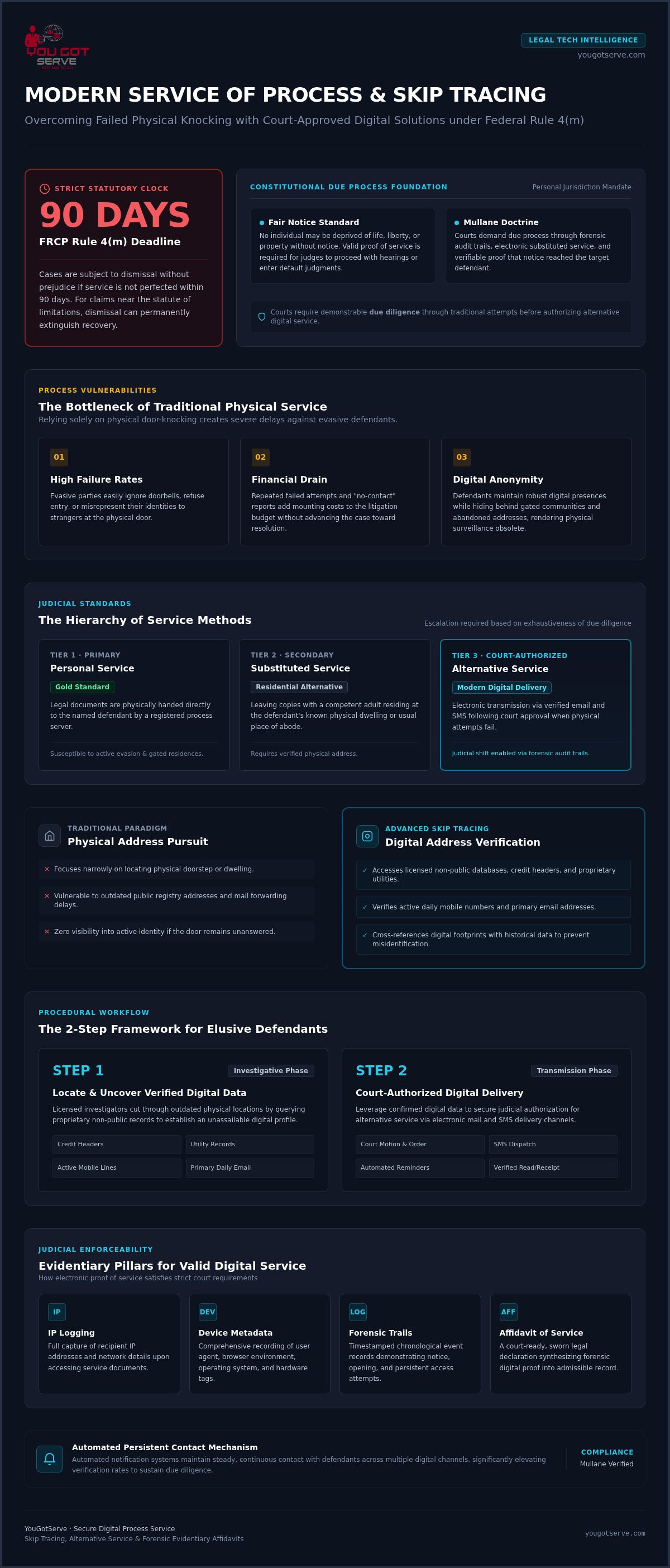
This guide outlines the modern, court-approved strategies required to find elusive defendants and complete service of process using advanced skip tracing and digital delivery. We'll examine how to satisfy the Mullane doctrine's due process requirements through forensic audit trails and electronic substituted service. You'll learn how to transform a confirmed digital footprint into a valid, court-ready affidavit of service. We'll explore the judicial shift toward SMS and email delivery to ensure your legal documents reach their destination and your case moves forward with the necessary authorization.
Key Takeaways
- Master the legal triggers that allow you to transition from failed physical attempts to court-authorized alternative service.
- Leverage professional skip tracing techniques to uncover verified digital contact information through licensed investigative databases.
- Follow a structured, two-step process to locate and serve defendant individuals who are actively evading traditional process servers.
- Identify the evidentiary requirements for digital delivery, such as IP logging and device metadata, to ensure your affidavit remains legally sound.
- Discover how automated notification systems maintain persistent contact with defendants to increase the likelihood of successful verification.
Understanding the Legal Requirement to Locate and Serve a Defendant
The legal system operates on the fundamental principle of Due Process, which mandates that no individual can be deprived of life, liberty, or property without fair notice. This constitutional right is the bedrock of service of process requirements. Without a verified delivery of the summons and complaint, a court lacks personal jurisdiction over the defendant. Essentially, if you can't prove the defendant received notice, your litigation cannot move forward. A valid proof of service is the only mechanism that allows a judge to proceed with hearings or enter a default judgment.
Courts require a high standard of "due diligence" before they'll consider any deviation from standard procedures. This means you must demonstrate an exhaustive effort to locate and serve defendant parties through traditional means first. If these efforts fail, the consequences are severe. Under Federal Rule of Civil Procedure 4(m), cases are typically dismissed without prejudice if service isn't perfected within 90 days. For those nearing the end of a statute of limitations, such a dismissal can effectively end the possibility of legal recovery forever.
What Constitutes Valid Service of Process?
Service of process is a hierarchy of methods rather than a singular action. Personal service, where documents are physically handed to the defendant, remains the gold standard. When this is impossible, courts may allow substituted service, which involves leaving papers with a competent adult at a residence, or alternative service, such as digital delivery. The affidavit of service serves as the official sworn statement that satisfies the court's evidentiary requirements. In modern litigation, defendants often dodge service by avoiding their registered addresses or utilizing gated communities, making the traditional affidavit increasingly difficult to obtain.
The Problem with Traditional Physical Service
The traditional model of "knocking on doors" is increasingly ineffective against elusive individuals. Relying solely on physical process servers often leads to a cycle of "no-contact" reports and mounting costs. It's a frustrating bottleneck for legal professionals. When you need to locate and serve defendant parties who are actively hiding, traditional methods often fall short for several reasons:
- High Failure Rates: Evasive defendants can easily ignore a doorbell or misrepresent their identity to a stranger at the door.
- Financial Drain: Every failed attempt by a traditional server adds to the litigation budget without bringing the case closer to a resolution.
- Digital Anonymity: Many defendants maintain a robust digital presence while keeping their physical location obscured, rendering traditional surveillance methods obsolete.
As defendants move their lives and businesses online, the legal industry's reliance on physical geography creates a gap that evasive parties exploit. The challenge is no longer just finding a house; it's about verifying a digital identity that the court will recognize as valid for notice.
Professional Skip Tracing: How to Find Elusive Defendants
Skip tracing is a specialized investigative process designed to uncover the location of individuals who have effectively disappeared from public view. While many associate the process with debt collection, it's a critical component of legal compliance. Licensed investigators utilize non-public databases, such as credit headers and proprietary utility records, to establish a defendant's current location. This investigative phase is essential to meet the standards set by Federal Rule of Civil Procedure 4, which governs how a plaintiff must diligently attempt to locate and serve defendant parties. By accessing data that isn't available to the general public, investigators can cut through the noise of outdated addresses.
The focus of modern investigations has shifted. Finding a physical doorstep is no longer the only goal; investigators now prioritize finding a "digital address." This involves verifying active mobile numbers and primary email accounts that the individual uses daily. By cross-referencing digital footprints with historical data, investigators ensure the contact information belongs to the correct person, reducing the risk of serving the wrong party. This verification is the first step toward moving a stalled case back into the courtroom.
The Mechanics of Modern Skip Tracing
Skip tracing is the methodology of locating a person whose whereabouts are unknown. Modern investigators go beyond basic searches by analyzing social media activity, property records, and even professional licensing boards. This data-driven approach identifies where a defendant actually spends their time, rather than where they're merely registered. Identifying an active email address or a verified cell phone number creates a viable pathway for service when physical addresses are intentionally obscured. For those struggling to find a starting point, utilizing skip tracing and investigation services can bridge the gap between a cold lead and a verified contact.
Due Diligence Reports for the Court
Judges don't grant alternative service orders based on a single failed attempt. They require a comprehensive due diligence report that documents an exhaustive search. This report serves as a narrative of your efforts, detailing every database queried and every address verified. It acts as the evidentiary foundation for a motion for alternative service. By presenting a skip tracing report that shows no viable physical address exists, you provide the court with the necessary justification to authorize digital delivery methods. This documentation proves to the court that you've exhausted all reasonable means to locate and serve defendant parties through traditional avenues.
Alternative Service: When the Physical Address is Unknown
When physical addresses remain elusive despite professional investigation, the court's priority shifts from geographic location to the fundamental requirement of actual notice. Personal service remains the gold standard in the judicial hierarchy, but it's not the only path to a valid judgment. When you cannot locate and serve defendant parties through traditional means, the legal system provides "alternative service" triggers. Usually, this requires an affidavit of due diligence proving that personal service was attempted and failed, alongside a skip trace report showing that the defendant's physical whereabouts are unknown or they are actively evading service.
Historically, the default alternative was service by publication in a newspaper. In 2026, this is increasingly viewed as an outdated legal fiction that fails to satisfy the Mullane doctrine's requirement for notice "reasonably calculated" to reach the interested parties. Courts now recognize that digital delivery methods provide far better evidence of actual notice than a tiny advertisement in a local classifieds section. This shift toward technology ensures that the legal process remains functional even when a defendant abandons their physical footprint for a digital one.
Service via Email and SMS
The judicial acceptance of electronic document delivery via email and SMS has grown significantly. Under Federal Rule of Civil Procedure 4 and various state-level "catch-all" provisions, judges are increasingly comfortable authorizing digital service when traditional methods are exhausted. This authorization isn't granted for casual communication; it requires a secure platform capable of providing a forensic audit trail. To be court-ready, the delivery must include:
- Recipient Verification: Proof that the intended individual accessed the documents.
- IP Tracking and Metadata: Digital evidence of when and where the message was opened.
- Persistent Reminders: Automated follow-ups that increase the likelihood of the defendant engaging with the notice.
SMS service is particularly effective because it provides a direct, immediate line to the individual. While an email might sit in a spam folder, a text message is typically viewed within minutes, providing strong evidence of actual notice.
Service via Social Media
Social media platforms like LinkedIn, Facebook, or Instagram offer another avenue for those struggling to locate and serve defendant targets. Courts may allow this when a plaintiff can prove the account is active and clearly belongs to the defendant. This proof often involves showing recent posts, timestamps of account activity, or evidence of direct interactions. However, social media service carries inherent risks without professional tracking. Unlike dedicated legal technology platforms, social media apps don't naturally provide the detailed affidavits of service or secure unique access codes required to withstand a motion to quash in court.
How to Secure Court Authorization for Electronic Service
Securing a court order for electronic service is a methodical process that requires transitioning from physical investigation to legal petition. You can't simply choose email because it's convenient; you must prove it's necessary. Judges require a clear narrative showing that you've exhausted traditional avenues before they'll permit a deviation from personal service. This sequence ensures your request meets the high evidentiary standards required in 2026:
- Step 1: Attempt traditional service and document the failure with a detailed affidavit of due diligence.
- Step 2: Perform professional skip tracing to identify verified digital contact info, such as primary email addresses or mobile numbers.
- Step 3: Draft a Motion for Alternative Service citing the specific technology you intend to use.
- Step 4: Present evidence of the defendant’s recent digital activity to the judge to prove the account is active.
- Step 5: Execute service via a secure, trackable platform that provides a forensic audit trail.
When you've exhausted efforts to locate and serve defendant parties at their last known residence, these steps provide the evidentiary bridge to digital delivery. The goal is to demonstrate that the defendant is actively using the digital channel you've identified, making it the most reliable way to provide actual notice.
Drafting the Motion for Alternative Service
The motion is your primary tool for convincing a judge that traditional methods are no longer viable. It must highlight the exhaustive efforts already taken, such as multiple visit logs and skip trace results. You must explain why the proposed digital method is likely to provide actual notice, rather than just being a shot in the dark. Referencing a platform like YouGotServe as a secure delivery platform helps reassure the court that the documents won't just sit in an unread inbox. It positions the delivery as a controlled, verifiable event rather than a casual communication. The motion should clearly state how the technology tracks recipient engagement to satisfy constitutional due process.
Providing Court-Ready Proof of Service
A judge won't accept a simple "sent" receipt as proof of service. There's a significant difference between an outgoing email and a verified delivery report. To withstand a challenge, your evidence must include tracked IP addresses, precise timestamps, and device metadata. These forensic details prove the defendant actually accessed the summons and complaint. Ensuring the affidavit of service meets all jurisdictional requirements is the final step in securing your legal standing. For a reliable outcome that avoids the risk of a motion to quash, you should utilize court-ready proof of service to document every stage of the digital delivery process.
The YouGotServe Advantage: Secure Digital Process Service
YouGotServe bridges the gap between investigation and service by integrating licensed skip tracing with encrypted digital delivery. When you need to locate and serve defendant parties who have successfully avoided physical servers, our platform provides a unified solution. We don't just find a contact; we verify it. By leveraging our professional private investigator credentials, we access high-level databases to ensure your legal documents reach the correct recipient. This integration eliminates the friction of moving data between separate investigators and process servers, ensuring a seamless transition from detection to delivery.
In the 2026 legal landscape, recipient verification is the standard for digital notice. YouGotServe utilizes unique access codes and device-level tracking to confirm that the intended party has engaged with the summons. Our automated delivery reminders maintain persistent contact throughout the notification window. This persistence ensures defendants can't claim they missed the notice or that it was lost in a digital shuffle. Every interaction is recorded, building a robust evidentiary record that judges can trust. It transforms a simple notification into a verifiable legal event.
Security and Compliance
Handling sensitive legal documents requires more than just an email client. YouGotServe employs end-to-end encryption to protect the integrity of the summons and complaint. Our platform generates comprehensive audit trails that document every timestamp, IP address, and metadata point. These records are designed to withstand aggressive cross-examination in court. Because we operate as licensed investigators, our methodology meets the strict due diligence standards required for alternative service. This expertise ensures that your affidavit of service is a legally sound instrument rather than just a confirmation of delivery.
Streamlining the Litigation Workflow
Physical service attempts often stall for weeks, plagued by "not found" returns and scheduling conflicts. YouGotServe reduces this timeline from weeks to days by removing the geographical barriers of physical delivery. It's a pragmatic, cost-effective alternative that avoids the mounting fees of repeated, unsuccessful physical attempts. You can move from filing to a verified proof of service without the typical delays of the traditional process. If you're ready to bypass the bottlenecks of elusive defendants, Start your secure digital service today with YouGotServe.
Modernize Your Litigation Strategy
The shift from physical geography to digital identity has redefined how legal professionals manage service of process. To keep your case moving, you must move beyond the limitations of traditional door-knocking and embrace investigative precision. By establishing a robust record of due diligence, you can successfully locate and serve defendant parties who have abandoned their physical footprints. This modern approach ensures that your litigation remains on track and your legal rights are protected through court-approved digital channels.
Our platform combines the expertise of Licensed Private Investigators with real-time tracking and verification to provide the forensic proof judges demand. With court-ready delivery reports at your fingertips, you can transform a stalled case into a valid affidavit of service in just a few days. It's time to leverage technology that respects the gravity of the legal system while prioritizing your efficiency. Reliable service is within reach; start your journey toward a valid proof of service today.
Securely Locate and Serve Your Defendant with YouGotServe
Frequently Asked Questions
How do you serve a defendant who is intentionally hiding?
Serving an evasive defendant requires a strategic shift from physical geography to digital footprints. First, you must exhaust traditional attempts and document these failures in an affidavit of due diligence. Once physical service is proven impossible, you can petition the court for alternative service. By using professional investigative tools to identify active email or SMS channels, you can deliver documents through a secure platform that tracks recipient engagement and satisfies constitutional notice requirements.
Is it legal to serve court papers via email in 2026?
Serving court papers via email is legally valid in 2026 when authorized by a judge or permitted under specific procedural rules. The court's primary concern is ensuring the method is reasonably calculated to provide actual notice. To meet this standard, the delivery must utilize forensic tracking, including IP logging and device metadata. This evidentiary trail proves the defendant actually accessed the documents, distinguishing professional digital delivery from a standard, unverified email.
What is a skip trace and how does it help with service of process?
A skip trace is a specialized investigative process used to uncover the current whereabouts of an individual. Licensed investigators access non-public databases, credit headers, and utility records to locate and serve defendant parties who are actively hiding. This process identifies both physical residences and verified digital contact information. By establishing a reliable point of contact, skip tracing provides the necessary evidentiary foundation to move a stalled case forward in the legal system.
Can I serve someone via text message?
You can serve someone via text message if you obtain a court order for alternative service under modern procedural rules. This method is often more effective than email for elusive defendants because mobile devices are checked frequently. To be court-ready, SMS service must utilize a secure link that tracks when the recipient opens the documents, providing the forensic proof needed for a valid affidavit of service that withstands judicial scrutiny.
What happens if a defendant refuses to sign for the papers?
Refusal to sign for papers doesn't stop the litigation process when using digital delivery methods. Unlike certified mail, which requires a physical signature, electronic service platforms utilize recipient verification through unique access codes. When the defendant clicks the link and accesses the documents, the system captures their IP address and device metadata. This digital footprint serves as the evidentiary equivalent of a signature, proving the defendant received the required legal notice.
What information is needed to perform a successful skip trace?
To perform a successful skip trace, you generally need the defendant's full legal name and any known aliases. Additional identifiers like a last known address, date of birth, or Social Security number significantly increase the accuracy of the search. In 2026, providing previous phone numbers or old email addresses is also critical. This data allows investigators to cross-reference multiple proprietary databases to locate and serve defendant targets by finding their current digital and physical locations.
How do I get a judge to approve alternative service?
Judges approve alternative service when you present a compelling Motion for Substituted Service supported by an affidavit of due diligence. This document must detail the specific dates, times, and outcomes of failed physical service attempts. You must also include a skip tracing report that demonstrates the defendant's physical address is unviable but their digital contact information is active. Proving a recent digital footprint is key to showing the court that electronic service will work.
What makes an affidavit of service "court-ready"?
A court-ready affidavit of service is a sworn statement that includes comprehensive forensic evidence of delivery. It goes beyond a simple confirmation and includes the recipient's IP address, timestamped logs of document access, and device-specific metadata. For digital service, it should also document the automated reminders sent to the defendant. This level of technical detail ensures the affidavit can withstand cross-examination and meet the strict evidentiary standards of modern judicial systems.


