

In 2026, the 90-day federal service window isn't just a procedural deadline; it's a high-stakes countdown that often rewards the elusive and punishes the unprepared. You've likely felt the mounting frustration when a traditional process server returns a "non-serve" report because a defendant is intentionally hiding or using outdated contact information to delay litigation. It's a common bottleneck that leaves legal teams stuck in neutral while the clock ticks down on Rule 4(m) requirements. We understand that securing a valid physical or digital address is the only way to protect your client's interests and maintain the momentum of your case.
This guide will help you master the essentials of skip tracing to locate elusive defendants and ensure legally compliant service of process. You'll learn to navigate the intersection of state privacy laws and licensed investigative tools to secure court-ready affidavits of due diligence. We'll examine the transition from traditional search methods to high-tier data verification and explain how establishing a verified digital presence is now the key to moving litigation forward. By the end of this article, you'll have a clear framework for converting digital intelligence into a valid proof of legal notice that stands up in any courtroom.
Key Takeaways
- Identify the critical distinctions between standard public record aggregators and non-public credit header data to ensure the highest accuracy in your locate investigations.
- Learn how to leverage professional skip tracing to document the rigorous due diligence necessary for securing court-authorized alternative service.
- Navigate the complex 2026 regulatory environment, including state-specific privacy mandates and the FCRA, to maintain the admissibility of your investigative findings.
- Understand the procedural framework for transitioning from a successful locate to executing secure, verified digital delivery via email and SMS.
- Streamline your litigation workflow by integrating licensed private investigation with automated, court-ready proof of service on a single secure platform.
Skip Tracing Defined: The Foundation of Modern Litigation Support
In the context of the 2026 legal industry, skip tracing refers to the systematic process of locating an individual whose current whereabouts are unknown for a specific legal or professional purpose. The term itself is rooted in the historical colloquialism of "skipping town" and "tracing" the path an individual leaves behind. While the phrase might sound like a relic of private eye novels, it has evolved into a sophisticated, data-driven discipline that serves as the intelligence phase for modern litigation. It's the essential first step in ensuring that the due process requirements of the 14th Amendment are satisfied.
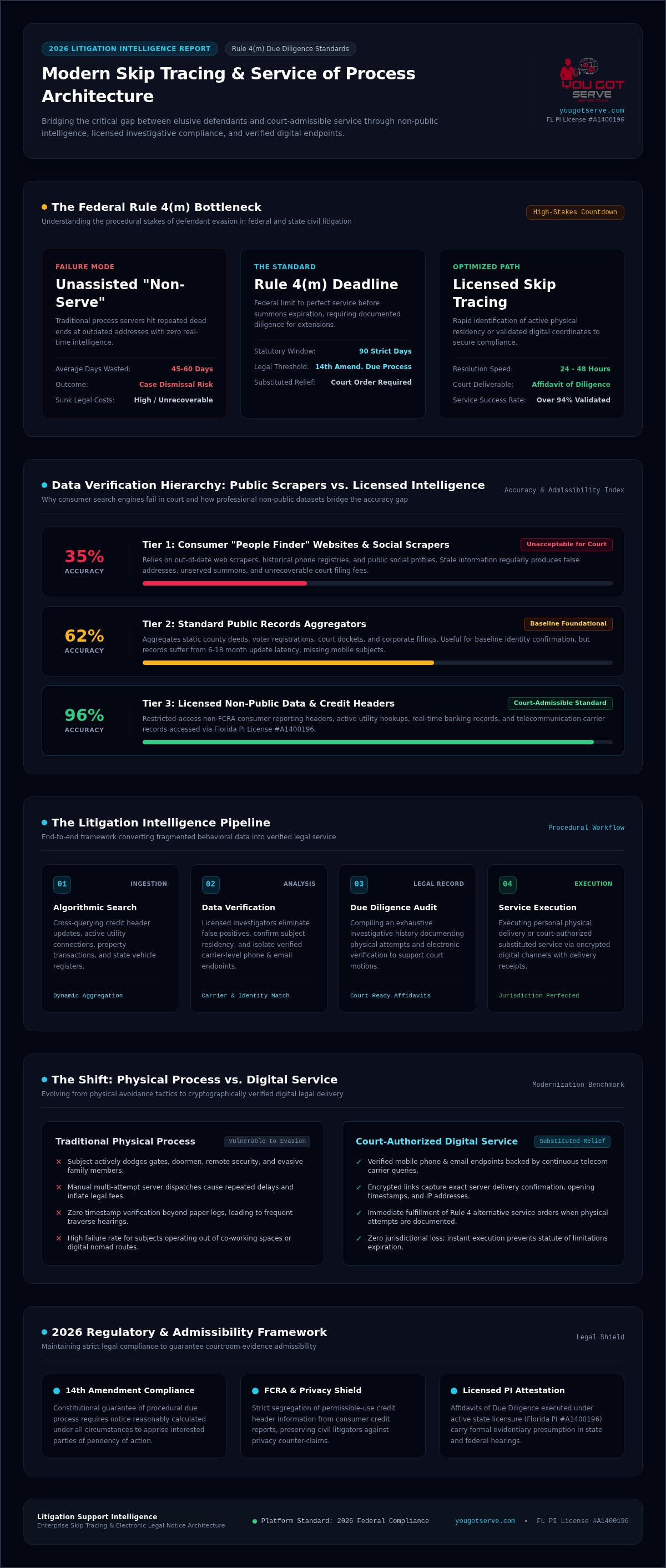
Professional investigative research differs significantly from the generic "people search" websites available to the general public. While consumer-grade platforms often rely on outdated social media scrapes or public white-page records, professional investigators utilize non-public data sets. These include credit header information, utility records, and proprietary databases that offer a higher degree of accuracy. At YouGotServe, investigations are conducted under Florida Private Investigator License #A1400196, ensuring that the data gathered is not only precise but also obtained through licensed, court-admissible channels. For legal professionals, the distinction is critical; using unverified data from a budget scraper often leads to failed service attempts and wasted court costs.
Why Attorneys Rely on Skip Tracing
Litigation cannot proceed without establishing jurisdiction over the parties involved. Attorneys frequently utilize professional tracing for several high-stakes scenarios:
- Locating Evasive Defendants: When a party is actively dodging service to delay a trial, investigators can identify current residency or employment locations that aren't immediately apparent.
- Finding Witnesses: Complex civil litigation often hinges on testimonies from individuals who've moved or changed contact information since the events in question occurred.
- Asset Identification: Following a favorable ruling, skip tracing helps identify bank relationships or titled property to facilitate judgment enforcement.
The Evolution from Physical to Digital Tracing
The 2026 legal landscape has shifted focus from tracking physical footprints to identifying digital identifiers. While a physical residence remains important, the modern investigator prioritizes verified email addresses and mobile telephone numbers. These digital coordinates are now the primary conduits for legal communication. In many jurisdictions, once traditional physical service has been diligently attempted and documented, courts authorize substituted service via secure digital channels. Identifying these verified digital endpoints is essential for ensuring that service of process is both successful and legally compliant with evolving judicial standards.
The Mechanics of Digital Intelligence: How Skip Tracers Locate Subjects
Modern skip tracing relies on a sophisticated hybrid of algorithmic analysis and licensed database access. In 2026, machine learning models analyze behavioral patterns to predict a subject's likely location based on historical movement and digital activity. Unlike public search tools, licensed investigators access restricted databases that aggregate real-time data from credit headers and utility connections. This high-level intelligence phase is vital for satisfying procedural service of process requirements, especially when dealing with individuals who've intentionally obscured their physical presence.
Primary Data Sources for Skip Tracing
Professional investigators utilize a tiered approach to data gathering. Public records such as property deeds, voter registrations, and court filings provide a foundational history. However, these records are often static. To achieve higher accuracy, investigators pivot to non-public header data. This includes identifying information from credit applications and utility records that reflect recent activity, such as a new power connection or a change in billing address. By 2026, social media fingerprints and professional network profiles have also become essential for identifying active digital identifiers like verified email addresses and mobile numbers.
The Investigative Workflow
The process involves more than just pulling a report. Investigators must cross-reference multiple data points to confirm a subject's identity, ensuring that the person located is indeed the defendant in question. This workflow prioritizes data recency; an address from six months ago is often stale in a mobile society. Investigators distinguish between pointer data, which merely suggests a possible location, and verified contact information that can support a court-ready affidavit.
Successful litigation depends on this level of precision. Once a subject's digital coordinates are verified, the transition to secure delivery becomes seamless. Legal teams often find that integrating skip tracing with digital delivery significantly reduces the time from filing to successful service. This methodical approach ensures that every investigative lead is converted into a functional, court-admissible result.
Skip Tracing for Service of Process: Bridging the Gap to Elusive Defendants
Skip tracing serves as the critical bridge between an unserved complaint and a successful motion for alternative service. When a defendant evades service, the litigation timeline stalls, directly threatening the 90-day deadline established by Federal Rule of Civil Procedure 4(m). Courts don't grant substituted service lightly; they require a high evidentiary threshold known as "due diligence." This isn't merely a record of failed attempts but a comprehensive demonstration that every reasonable effort was made to locate the subject using professional investigative resources. Without this documented intelligence phase, litigation can remain in a state of perpetual limbo, incurring mounting costs and potential dismissal.
Meeting the "Due Diligence" Standard
Judges increasingly reject generic declarations of non-service that lack specific investigative depth. They look for a tiered skip tracing report that exhibits a thorough scrub of non-public data sets. A report generated by a licensed investigator, such as those provided under our Florida Private Investigator License #A1400196, carries significant weight in chambers. It proves to the court that the plaintiff's search was exhaustive, covering everything from postal records to active utility histories. This professional documentation provides the "good cause" needed to bypass traditional methods and move toward digital delivery. It's the difference between a judge granting your motion or ordering another thirty days of fruitless attempts.
Targeting Digital Contact Information
In 2026, the "last known address" is frequently a digital identifier rather than a physical doorstep. Effective skip tracing identifies verified email addresses and mobile numbers that are actively associated with the defendant. This verification process must strictly comply with the Fair Credit Reporting Act to ensure the data remains admissible and the investigation doesn't invite sanctions. By confirming that a specific email account or SMS-enabled phone number belongs to the subject, investigators provide the legal basis for electronic service.
This digital targeting also extends to verifying social media account ownership. In complex cases where a subject has abandoned their physical residence, proving that a specific digital profile is their primary point of contact allows legal teams to satisfy the 14th Amendment's notice requirements. Once these digital coordinates are confirmed through licensed investigation, the path to secure delivery is clear. This transition from intelligence to execution prevents the costly delays associated with elusive defendants and keeps the litigation moving toward a resolution.
Compliance and Reliability: Evaluating Skip Tracing Data for Court Submission
The reliability of investigative data directly impacts the validity of legal notice. Relying on unverified or stale skip tracing results is a significant liability for legal professionals. If a defendant challenges service based on an incorrect address or outdated contact information, the entire litigation process can be derailed. Compliance with the Fair Credit Reporting Act (FCRA) and state-specific privacy laws isn't optional; it's a foundational requirement for data admissibility. Using outdated records doesn't just waste time; it risks the court dismissing your case for failure to provide proper notice.
YouGotServe operates under Florida Private Investigator License #A1400196, which guarantees that all investigative work adheres to the highest professional and ethical standards. Licensed investigators possess the authorization to access proprietary databases that remain restricted to the general public. This ensures that the information provided is not only accurate but also gathered through legally sanctioned channels. By utilizing a licensed investigator, you protect the integrity of your case and ensure that your search for an elusive defendant meets the scrutiny of the bench.
Admissibility of Skip Trace Evidence
Authenticating skip tracing results requires a methodical approach to documentation. In a legal proceeding, the court must be convinced that the search was conducted with the requisite level of due diligence. An Affidavit of Due Diligence serves as the formal record of these efforts, itemizing every database searched and every contact attempt made. It's essential to avoid "black hat" techniques, such as pretexting or unauthorized data scraping, which can lead to judicial sanctions and the exclusion of evidence. Using a licensed professional ensures that the investigative trail is clean and court-ready.
Security and Data Privacy in 2026
The 2026 regulatory environment places a heavy emphasis on the protection of sensitive personal data. Compliance with evolving standards like the California Consumer Privacy Act (CCPA) and the California Privacy Rights Act (CPRA) is mandatory for any platform handling defendant information. Secure, encrypted platforms are necessary to prevent data breaches that could expose a law firm to significant legal and reputational risks. Every skip trace report must be handled within a secure digital ecosystem that prioritizes confidentiality and regulatory adherence.
To ensure your investigative phase meets these rigorous standards, you can leverage our licensed skip tracing services to secure the precise data you need for successful service of process.
Integrating Skip Tracing with YouGotServe: A Secure Path to Successful Service
The transition from locating a defendant to executing service of process is often where litigation timelines stall. Many law firms rely on fragmented workflows, using one vendor for investigative data and another for document delivery. This disconnection creates unnecessary friction and increases the risk of data decay. YouGotServe eliminates this gap by merging professional skip tracing with secure digital delivery into a single, cohesive ecosystem. By treating investigation as the intelligence phase of the delivery workflow, our platform ensures that the moment a subject's digital coordinates are verified, the process of legal notice begins without delay.
This integrated approach addresses the core pain point of modern litigation: the elusive defendant. When you initiate a skip trace through our platform, you aren't just receiving a list of potential addresses. You're engaging a licensed investigative process that identifies the most reliable digital identifiers, such as verified email addresses and mobile numbers. This synergy between intelligence and execution allows legal teams to move from a "non-serve" status to a completed delivery in a fraction of the time required by traditional, manual methods.
The YouGotServe Advantage
Our methodology combines licensed investigative expertise with modern delivery technology. All investigative tasks are performed under Florida Private Investigator License #A1400196, ensuring that the data gathered meets the rigorous evidentiary standards required by the courts. Once the intelligence phase is complete, the platform utilizes secure email and SMS channels to deliver documents. This process includes recipient verification, real-time tracking, and automated reminders to ensure the subject is aware of the pending legal action. The result is a court-ready proof of service that provides a clear, timestamped audit trail of the entire delivery process.
Streamlining Your Litigation Workflow
Digital delivery significantly reduces the weeks often lost to failed physical attempts and the subsequent search for new leads. By automating the transition from skip tracing to service, firms can scale their operations without increasing administrative overhead. The platform provides the transparency and security necessary for high-volume litigation, allowing you to monitor the status of every serve from a centralized dashboard. This efficiency doesn't just save time; it protects the case's momentum and ensures that your firm remains compliant with judicial deadlines.
Don't let elusive defendants dictate your litigation schedule. You can start your skip trace and secure delivery with YouGotServe today to experience a more efficient, technology-driven path to successful service of process.
Modernizing Service of Process through Digital Intelligence
The 2026 legal landscape demands more than just traditional search methods. It requires a sophisticated integration of licensed investigation and secure technology to overcome the challenges of elusive defendants. By treating skip tracing as the foundational intelligence phase of your workflow, you can document the necessary due diligence required to satisfy judicial standards. Shifting from fragmented manual searches to a unified digital platform ensures that your firm remains compliant with federal and state regulations while significantly accelerating the litigation timeline.
YouGotServe provides the professional infrastructure needed to move cases forward with confidence. As a Licensed Private Investigator #A1400196, we deliver the precision required for court-admissible results. Our platform combines this investigative depth with verified delivery tracking and court-ready affidavits, providing a seamless path from finding a subject to proving service. Don't let outdated methods stall your litigation progress.
Secure Your Court-Ready Skip Trace and Digital Service Now and take the next step toward a more efficient, technology-driven legal practice.
Frequently Asked Questions
Is skip tracing legal for process service?
Skip tracing is a standard and legal investigative technique used to facilitate the service of process. It's governed by federal and state regulations, including the Fair Credit Reporting Act (FCRA) and the Driver’s Privacy Protection Act (DPPA). These laws permit access to personal data for specific legal and investigative purposes. YouGotServe conducts all investigations under Florida Private Investigator License #A1400196, ensuring that the methods used are ethical, compliant, and court-admissible.
How long does a professional skip trace typically take in 2026?
The duration of a professional skip trace varies based on the complexity of the case and the subject's evasive tactics. Automated searches using proprietary databases often provide results within 24 to 48 hours. However, complex cases involving intentional evasion may require a more in-depth manual investigation by a licensed private investigator. This comprehensive research phase ensures that the data is verified and current, preventing the wasted time associated with failed service attempts.
Can skip tracing find someone who has no social media presence?
Professional investigators locate subjects by accessing non-public data sets that go far beyond social media fingerprints. While an online presence is helpful, skip tracing relies heavily on credit header information, utility service records, and property filings. These sources track financial and residential activity that exists independently of a subject's social media activity. This tiered approach allows legal teams to identify valid contact coordinates for individuals who intentionally maintain a low digital profile.
What information do I need to provide to start a skip trace?
To initiate an effective search, you should provide the subject's full legal name and their last known residential or business address. Additional identifiers, such as a date of birth or a partial Social Security Number, significantly increase the accuracy of the investigation. Providing any known digital identifiers, like old email addresses or phone numbers, also helps investigators cross-reference data points more effectively. This information serves as the essential starting point for identifying the subject's current verified location.
What happens if a skip trace cannot locate the defendant?
If a defendant cannot be located after an exhaustive search, the resulting skip trace report serves as critical evidence for a Motion for Alternative Service. Judges require a documented Affidavit of Due Diligence to prove that the plaintiff made every reasonable effort to find the subject. This professional report provides the evidentiary basis for the court to authorize substituted service via secure email or SMS, allowing the litigation to proceed despite the missing defendant.
How much does professional skip tracing cost for a law firm?
The cost for professional skip tracing depends on the depth of the investigation and the nature of the data required. Standard automated searches are generally more accessible, while comprehensive investigations conducted by a licensed private investigator involve higher fees due to the manual verification required. Law firms should view these costs as a strategic investment. Using high-tier, verified data reduces the long-term expenses associated with repeated failed service attempts and significant court delays.
Can a skip trace report be used as evidence of due diligence in court?
A skip trace report is an essential component of an Affidavit of Due Diligence. Courts look for a structured record of investigative efforts before they'll consider granting a motion for alternative service. The report must demonstrate that the investigator utilized multiple reliable sources, such as non-public databases and property records. Using a licensed investigator ensures that the documentation carries the necessary professional weight to satisfy judicial scrutiny and move the case toward a resolution.
How does skip tracing support service of process via email or SMS?
Skip tracing identifies and verifies the specific digital identifiers, such as mobile numbers and email addresses, that actively belong to the defendant. In 2026, establishing this verified digital presence is a prerequisite for court-authorized electronic delivery. Once an investigator confirms that a digital coordinate is current and functional, YouGotServe can execute secure delivery with recipient verification. This process converts investigative intelligence into a valid, court-admissible proof of service that satisfies constitutional notice requirements.


