

What if the most elusive defendant in your caseload could be legally served without a single knock on their door? For years, legal professionals have struggled with the rising costs of traditional process servers and the frustration of defendants who simply refuse to answer the bell. You've likely felt the weight of a stalled litigation timeline because a physical hand-off proved impossible. Utilizing a legally binding email service is no longer a futuristic concept; it's a precise, court-validated strategy for modern practice.
You're right to feel cautious about the evidentiary standards required to make digital delivery stick in front of a judge. This guide explores the rigorous legal requirements and technological frameworks that define electronic process service in 2026. We'll examine how court-admissible proof is generated through sophisticated tracking and verification methods. By the end of this article, you'll understand how to secure successful service of process while drastically reducing your reliance on expensive, outdated delivery methods. We'll break down the specific standards that transform a simple digital message into a robust legal instrument.
Key Takeaways
- Distinguish between standard digital signatures and a legally binding email service designed to meet strict judicial requirements.
- Learn how to establish the due diligence required by courts before transitioning from traditional methods to electronic delivery.
- Discover why metadata is the essential evidentiary trail that proves a document wasn't just sent, but successfully delivered.
- Identify the specific data points needed for a court-ready Affidavit of Electronic Service that withstands legal scrutiny.
- See how advanced skip tracing techniques help you find valid contact information for defendants who've intentionally gone off the grid.
What is a Legally Binding Email Service?
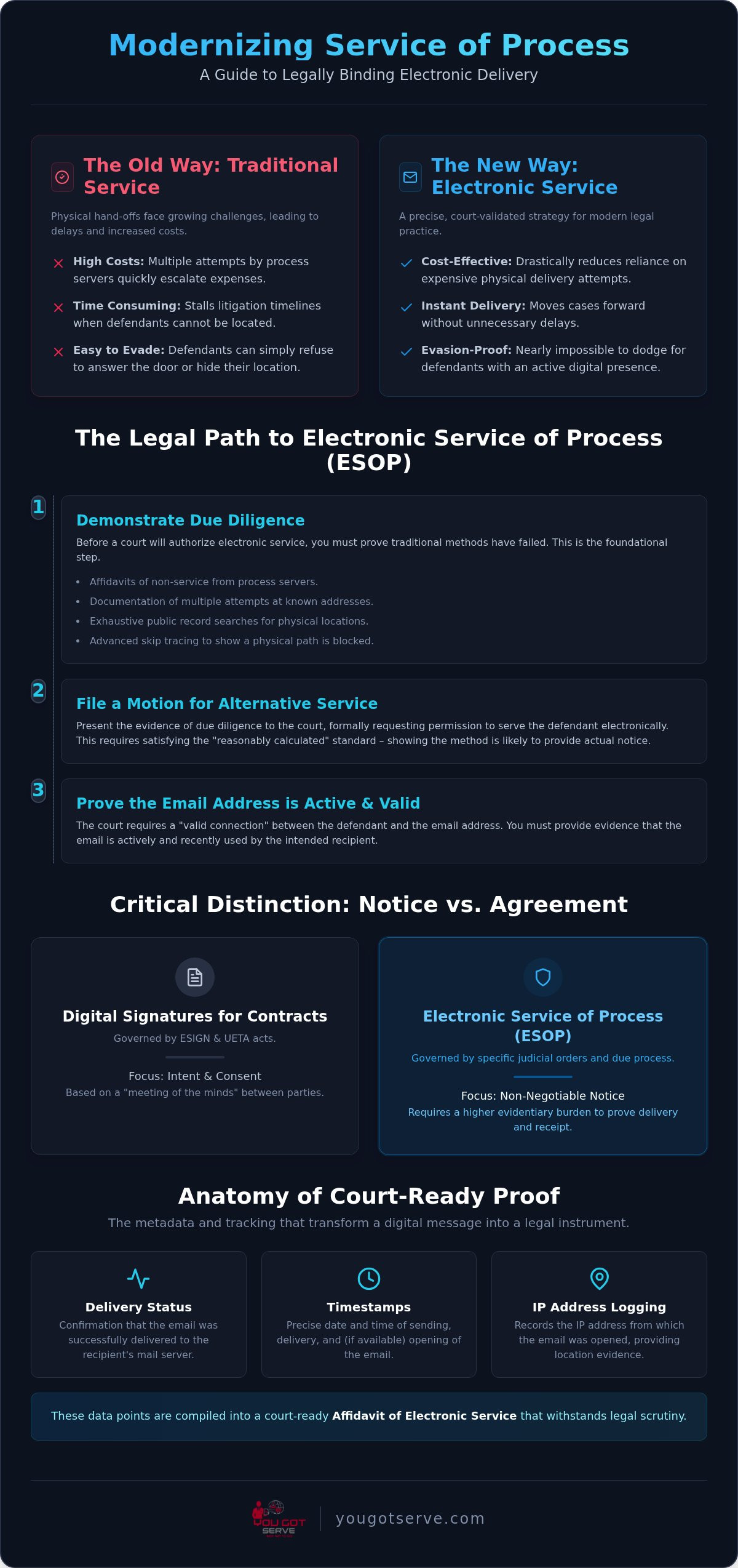
A legally binding email service involves the transmission of court-ordered documents through electronic mail in a manner that satisfies the constitutional requirements of due process. Unlike casual communication, this method requires a rigorous evidentiary trail to prove that the recipient received actual notice of the legal action against them. It is not enough to simply click "send" on a standard email client; the process must be verifiable, secure, and often authorized by a specific judicial order.
One common misconception is that a standard read receipt provides sufficient proof for court submissions. In most jurisdictions, these receipts are easily bypassed or blocked by recipient privacy settings. Judicial standards in 2026 demand more robust verification, including delivery status notifications, IP address logging, and metadata that confirms the document reached the recipient’s server or inbox. Before utilizing digital delivery, legal professionals must typically file a motion for alternative service. This requires demonstrating due diligence by proving that traditional physical service was attempted and failed, or that the defendant is actively evading service.
Digital Service vs. Digital Contracts
There is a critical distinction between electronic signatures used for business contracts and the electronic service of process. While the ESIGN Act and UETA provide a solid foundation for digital agreements, they focus primarily on the intent to sign and the consent of the parties. Contract law is built on a "meeting of the minds," but process service is built on the non-negotiable requirement of notice. The evidentiary burden is significantly higher when notifying a defendant of a lawsuit because it involves the court’s jurisdiction over an individual's rights. ESOP is the court-authorized transmission of legal notice via digital channels. Leveraging a legally binding email service ensures that the delivery meets these heightened standards, providing a level of tracking and security that standard contract platforms don't offer.
The Shift Toward Electronic Service in 2026
Modern courts have moved toward a digital-first approach to accommodate the realities of remote litigation and global commerce. The traditional model of a process server waiting outside a physical residence is often inefficient, especially when dealing with defendants who operate entirely online or travel frequently. Digital footprints are now often more reliable than physical addresses. As a result, judges are increasingly receptive to digital alternatives when traditional methods reach a dead end. This shift has made "dodging" service nearly impossible for defendants who maintain an active digital presence. When a plaintiff can verify that a defendant is actively using a specific email account, a legally binding email service becomes the most pragmatic and effective tool for moving a case forward without unnecessary delays.
Legal Requirements for Electronic Service of Process (ESOP)
Establishing a legally binding email service requires more than just a digital delivery platform. It necessitates a clear judicial path, typically starting with a motion for alternative service. Courts generally view electronic delivery as a secondary option, reserved for situations where traditional personal service is impractical or the defendant is intentionally evasive. To succeed, legal professionals must satisfy the "reasonably calculated" standard, which means the method chosen must be likely to provide the defendant with actual notice of the proceedings. This standard is the cornerstone of due process in the digital age.
The Due Diligence Requirement
Before a judge grants an order for alternative service, you must demonstrate due diligence. This involves documenting exhaustive attempts to serve the defendant through conventional means. Judges won't authorize digital delivery simply because it's more convenient; they require proof that the physical path is blocked. Common requirements for your motion include:
- Submitting affidavits of non-service from physical process servers documenting multiple attempts.
- Verifying the defendant's last known physical address through exhaustive public record searches.
- Attempting service at both known residential and business locations.
When these efforts fail, skip tracing becomes the bridge to electronic delivery. By utilizing investigative skip tracing, you can gather the necessary evidence to prove to the court that traditional methods are exhausted and that a digital alternative is the only viable path forward.
Proving the Email Address is Active
A court won't authorize service to a generic "info@" address or an abandoned inbox. You must establish a "valid connection" between the recipient and the specific email address. This proof often relies on recent activity logs, such as documented correspondence within the last 30 to 90 days or social media accounts linked directly to that address. It's about showing the inbox is currently monitored.
Investigative techniques, often performed by licensed private investigators, are vital for verifying digital contact information. They look for data points that confirm the defendant is active online. This might include cross-referencing the email with professional registrations, identifying recent account activity indicators, or confirming the email appears in recent credit headers. Without this level of technical verification, your motion for alternative service risks being denied. A legally binding email service is only as strong as the investigative foundation supporting the claim that the recipient will actually see the notice. By providing the court with a clear link between the individual and their digital presence, you move the litigation forward with confidence.
When is an Email Legally Binding? Comparing Standards
Determining when a digital transmission becomes a legally binding instrument requires a shift in perspective from standard communication to forensic evidence. In the eyes of the court, there's a profound difference between "sent" and "delivered." A message that leaves your outbox but hits a spam filter or bounces due to a full inbox doesn't constitute notice. A professional legally binding email service bridges this gap by providing a detailed evidentiary trail that proves the data reached the recipient's server.
Metadata serves as the "DNA" of electronic service. It captures the technical journey of the document, including timestamps, server handshakes, and delivery status notifications. Establishing a legally binding email service requires this granular data to prevent a defendant from claiming they never received the documents. If a judge finds the tracking data insufficient or incomplete, they may vacate the service, potentially resetting your litigation timeline by months.
Sent vs. Delivered vs. Opened
Standard email clients like Gmail or Outlook aren't designed for legal scrutiny. They lack the forensic depth required to prove receipt in a contested hearing. Courts in 2026 increasingly look for IP address logging and device fingerprinting to confirm that a specific individual accessed the files. Additionally, utilizing automated delivery reminders significantly increases the probability of establishing "Actual Notice," as it demonstrates a persistent effort to reach the recipient across multiple points in time. Common reasons for a judge to vacate include a lack of proof that the email address was active or the failure to provide a complete tracking log that includes the recipient's IP address.
SMS as a Complementary Service Channel
While email is the primary vehicle for ESOP, SMS serves as a powerful secondary channel. Sending a text message alert alongside an email creates a multi-channel verification system that judges find highly persuasive. This approach ensures the recipient is notified on the device they carry in their pocket, making it much harder for them to argue they were unaware of the legal action. In some jurisdictions, SMS is even being explored as a primary channel for service, provided the connection to the recipient is verified through investigative skip tracing.
This multi-layered strategy is becoming the gold standard for binding service because it minimizes the risk of a defendant successfully claiming ignorance. By combining secure email delivery with real-time SMS notifications, you create an unassailable record of service that stands up to the most rigorous judicial review.
Securing Court-Ready Proof of Service
The transition from successful delivery to judicial acceptance hinges entirely on the quality of your documentation. It's not enough to present a screenshot of an "outbox" or a simple read receipt. Judges require a formal Affidavit of Electronic Service that translates technical events into a format recognized by the legal system. This document serves as the definitive record, ensuring that the court has the confidence to proceed with the case despite the absence of a physical hand-off.
A comprehensive tracking log provides a chronological record of every server interaction, from the initial transmission to the final delivery confirmation at the recipient's gateway. When you use a professional legally binding email service, this log becomes the backbone of your evidentiary submission. It eliminates the ambiguity that often plagues digital communication by providing a forensic trail that is difficult for a defendant to dispute.
Anatomy of a Digital Affidavit
A valid digital affidavit must contain specific data points to withstand scrutiny during a motion to vacate. Essential fields include the precise timestamp of delivery, the recipient’s IP address, a unique recipient identifier, and the final delivery status. It should also incorporate the results of your initial skip tracing to justify why the specific email address was chosen as the primary channel for service. A court-ready affidavit must bridge the gap between technical data and legal requirements. By presenting these facts clearly, you demonstrate that the service was "reasonably calculated" to provide actual notice. If you need to streamline this process, you can generate court-ready proof of service through an automated platform that handles the technical heavy lifting for you.
Recipient Verification Technology
Proving the right person received the document without a physical signature requires specialized technology. Standard email doesn't offer the security layer needed for high-stakes litigation. Modern platforms utilize unique delivery links and secure portals that require the recipient to interact with the message in a way that triggers a verifiable event. This "digital handshake" provides a higher level of certainty than a traditional signature because it captures device fingerprints and location data.
Handling delivery failures is equally important for maintaining a clean legal log. Your documentation must show how bounce-backs or server errors were managed. If a delivery fails, the system should log the specific error code, allowing you to demonstrate to the court that you've monitored the process and taken corrective action if necessary. This level of detail is the foundation of a legally binding email service, as it proves the plaintiff didn't just fire off an email into the void, but instead managed a secure, tracked, and verified delivery process.
Modernizing Litigation with YouGotServe
YouGotServe provides a specialized platform that automates the complexities of electronic process service. It integrates investigative skip tracing with a legally binding email service to create a seamless litigation path. This automation ensures that every delivery adheres to the technical and legal standards required for court acceptance. By centralizing tracking and verification, the platform provides a reliable alternative to the fragmented approach of using multiple vendors for investigation and service. It empowers legal professionals to move cases forward with a level of precision that manual methods cannot match.
The YouGotServe Workflow
The process begins with the verification of digital contact info using techniques similar to those employed by licensed private investigators. This step ensures that documents are directed to an active, monitored inbox rather than an abandoned account. Once the transmission is initiated, the system tracks the document through every server interaction, providing real-time updates. Automated delivery reminders are sent at strategic intervals to ensure the recipient has every opportunity to acknowledge the notice. This persistence is a key factor in satisfying judicial requirements for actual notice. Upon completion, the system generates a court-ready proof of service immediately, containing the forensic IP logging and metadata required for judicial review.
Why Legal Professionals are Switching to Digital
Legal professionals are moving away from traditional methods because of the inherent inefficiencies of physical hand-offs. Physical service is often slow and expensive, especially when a defendant is actively dodging service. Digital delivery reduces the service timeline from weeks to minutes. It also eliminates the high costs associated with repeated physical attempts at various addresses. By utilizing a multi-channel approach that includes both email and SMS, you ensure that your legal notice is seen. It's about maintaining the momentum of your case and ensuring that elusive defendants don't stall your litigation through evasion. Streamline your litigation with YouGotServe’s legally binding digital delivery today.
Achieving Judicial Certainty through Digital Service
The evolution of process service reflects a broader shift toward digital-first litigation. Relying on a legally binding email service isn't just about convenience; it's about establishing an unassailable record of notice that stands up to judicial scrutiny. By combining forensic metadata with verified recipient identifiers, you eliminate the risks associated with defendants who intentionally evade physical servers. This transition allows your firm to reclaim valuable time and resources while maintaining strict adherence to due process standards.
YouGotServe provides the technical and investigative foundation required for modern legal practice. You can leverage Licensed Private Investigator skip tracing to identify valid digital contact information and utilize real-time delivery tracking to monitor every transmission. This approach ensures you receive a court-ready proof of service that bridges the gap between technical delivery and legal compliance. It's a pragmatic solution for a traditionally slow-moving sector, ensuring that your litigation remains on track without unnecessary delays. Start your secure digital service of process with YouGotServe and move your case forward with confidence.
Frequently Asked Questions
Is email service of process legal in all 50 states?
Electronic service is not universally automatic in all 50 states; however, most jurisdictions allow it as a form of alternative service. You must typically demonstrate that traditional personal service was attempted and failed before a judge authorizes digital delivery. Federal and state rules have increasingly evolved to recognize electronic methods when they meet due process standards and provide a reasonably calculated path to actual notice.
How do I get a judge to approve service via email or text?
You must file a motion for alternative service of process by demonstrating due diligence to the court. This involves providing affidavits of non-service that document exhaustive attempts at physical delivery. You also need to prove a valid connection by showing the recipient actively uses the email or phone number. Using a professional platform to verify recent digital activity provides the necessary evidence to support your motion.
What happens if the recipient claims they never saw the email?
If a recipient disputes receipt, the court relies on forensic evidence provided by your service provider. A legally binding email service includes metadata, IP address logging, and delivery status notifications that prove the document reached the recipient's server or device. This technical trail makes it difficult for a defendant to successfully claim ignorance, especially when combined with automated reminders and multi-channel notifications via SMS.
Can I serve someone via social media if I have their email?
Social media service is often granted as a secondary form of alternative service when traditional and email methods prove unsuccessful. If you have a verified email address, it often serves as the primary digital channel, while social media acts as a reinforcing notification. Judges are more likely to approve this combination if you can prove the social media account is actively managed by the defendant through investigative skip tracing.
Do I need a special platform to make an email legally binding?
Yes, standard email clients don't provide the forensic tracking required to meet judicial evidentiary standards. A legally binding email service like YouGotServe captures essential data points such as server handshakes, device fingerprints, and real-time delivery logs. Without these technical safeguards, you lack the court-ready proof needed to overcome a defendant's challenge or a judge's skepticism regarding the validity of the service performed.
What is the difference between a read receipt and a legal delivery log?
A read receipt is a voluntary notification that recipients can easily block or ignore through their privacy settings. In contrast, a legal delivery log is a server-side record that captures the technical journey of the document independently of the recipient's actions. These logs include timestamps, IP addresses, and gateway confirmations, providing a forensic level of proof that simple read receipts cannot replicate for official court submissions.
How does skip tracing help with legally binding email service?
Skip tracing identifies and verifies the valid digital contact information needed to satisfy the court's due process requirements. By utilizing licensed private investigator techniques, skip tracing confirms that an email address is active and directly linked to the defendant. This prevents the common pitfall of serving an abandoned inbox, ensuring your motion for alternative service is supported by factual evidence of the recipient's current digital presence.
Can I serve a subpoena via email using YouGotServe?
Yes, YouGotServe facilitates the electronic delivery of subpoenas once you have the necessary judicial authorization or when local rules allow for digital service of discovery documents. The platform provides the same level of real-time tracking and recipient verification for subpoenas as it does for summons and complaints. This ensures you have a court-ready affidavit of service to prove the witness or party received the legal demand.


