

In 2026, a simple screenshot of a "read" receipt is no longer enough to satisfy a judge that a defendant has been properly served. You've likely dealt with defendants who treat physical process servers like a game of hide-and-seek, stalling your litigation for weeks while they evade personal contact. It's frustrating to know they're active on their mobile devices while your case remains stuck in procedural limbo. Obtaining a valid proof of service for text message delivery is now the essential standard for moving cases forward when traditional methods fail.
This guide will show you how to secure a rock-solid affidavit by leveraging technical metadata and jurisdictional standards that turn a digital notification into a court-validated event. We'll explore the "due diligence" requirements for alternative service and the specific delivery logs required to generate professional documentation. By understanding the intersection of technical precision and legal compliance, you'll ensure your digital evidence stands up to the highest levels of judicial scrutiny.
Key Takeaways
- Understand why technical metadata like IP addresses and device identifiers are the mandatory standard for proving a recipient accessed a digital legal document.
- Learn the procedural steps required to secure a motion for alternative service, ensuring your proof of service for text message delivery meets the "due diligence" threshold.
- Discover how digital delivery bypasses traditional evasion tactics by providing real-time tracking logs that physical servers can't replicate.
- Identify the role of investigative skip tracing in verifying mobile numbers to ensure documents reach the correct party before service begins.
- Master the process of generating a jurisdiction-compliant digital affidavit that effectively bridges the gap between technical data and judicial requirements.
What Is Proof of Service for Text Message Delivery?
In the framework of modern litigation, What Is Proof of Service has evolved from a physical exchange of papers to a sophisticated digital verification. Traditionally, process servers relied on "nail and mail" or personal hand-delivery to satisfy judicial requirements. However, as defendants become increasingly mobile and elusive, the legal industry has shifted toward verified SMS delivery. This method isn't a casual interaction; it's a formal procedure that provides a proof of service for text message delivery that is court-ready. It bridges the gap between the difficulty of physical location and the necessity of providing actual notice.
Courts don't authorize text-based service as a first resort. Instead, it's typically utilized as a secondary or alternative method when traditional servers have exhausted all reasonable options. The distinction between a standard text message and a legal service of process lies in the evidentiary trail. While a personal text is informal, a legal delivery involves secure links, document tracking, and independent verification that ensures the integrity of the legal process. This structured approach moves the burden of proof from a server's word to a technical log.
The Legal Evolution of SMS Service
The 2026 legal standard prioritizes actual notice over the physical act of contact. Statutes across various jurisdictions have been updated to allow for the electronic service of a summons and complaint once traditional methods fail. This change reflects a broader trend toward modernizing the judicial system to match digital communication habits. Judges now possess the authority to grant motions for alternative service, but they require proof of "reasonable diligence" first. You must show that you've made persistent, documented attempts to reach the defendant through standard means before a court will accept an SMS-based delivery as valid. Key precedents have established that if a defendant is active on a device, that device is a valid point of service.
Digital Receipt vs. Legal Proof
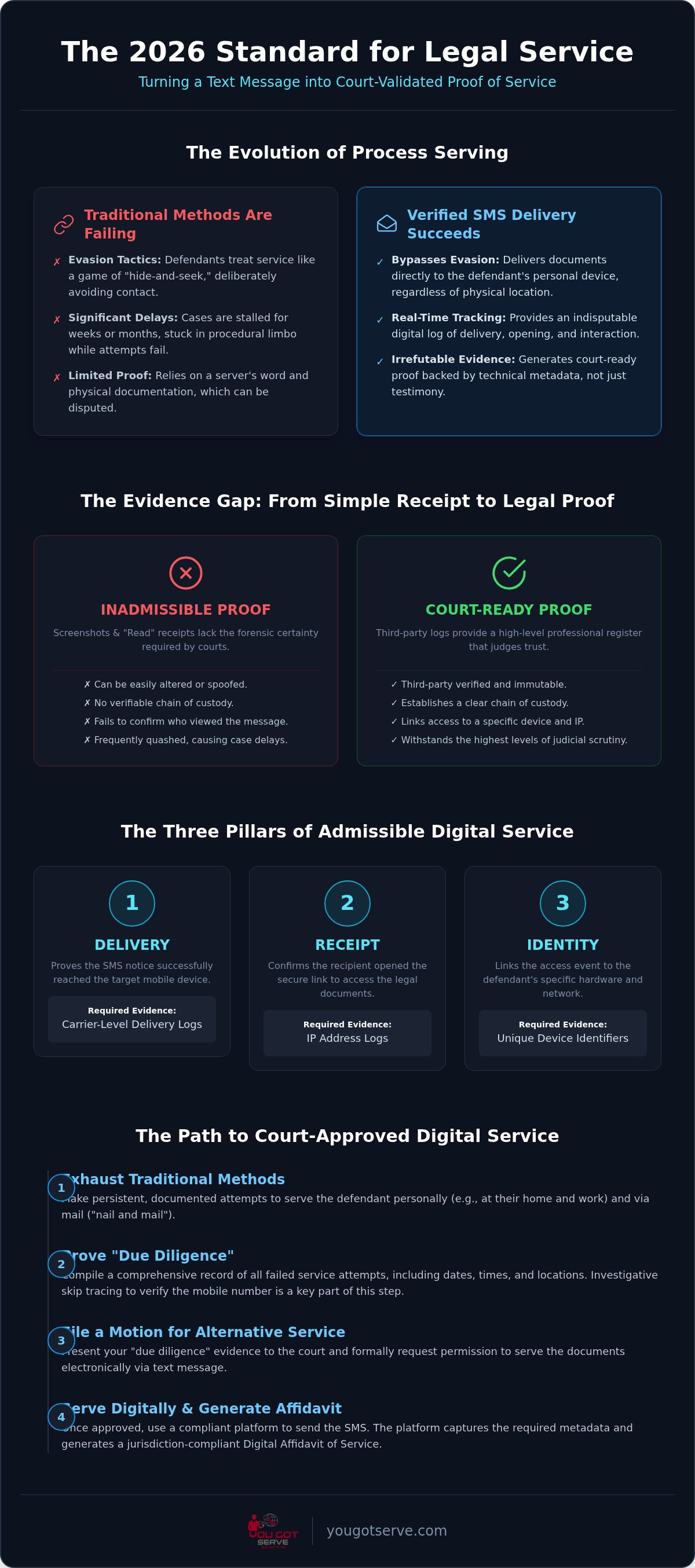
It's a common mistake to assume that a "Read" notification or a simple screenshot constitutes a valid proof of service for text message delivery. In a courtroom, these informal indicators are insufficient because they don't provide a verified chain of custody. A screenshot can be altered, and a read receipt doesn't confirm who actually viewed the message or which specific documents were attached. Legal proof requires a third-party verified log that captures specific technical data points. This log forms the core of a Digital Affidavit of Service, which is a sworn statement detailing the exact time, date, and device used to access the documents. By using a structured delivery platform, you move from anecdotal evidence to a high-level professional register that judges trust.
The Evidentiary Standard for SMS Service in 2026
In 2026, the threshold for digital evidence has shifted from visual representation to forensic verification. Metadata serves as the primary backbone for any court-ready digital document. It provides a layer of certainty that traditional methods struggle to replicate. To secure a valid proof of service for text message delivery, your documentation must satisfy the "Three Pillars" of digital proof: Delivery, Receipt, and Identity. These pillars ensure that the message was sent, that it was accessed by the correct party, and that the recipient's identity is technically linked to the event.
Carrier-level delivery confirmation is the first step, proving the SMS reached the target device. However, proving the recipient opened the document requires capturing IP addresses and device identifiers. These data points act as a digital fingerprint, showing the specific network and hardware used to interact with the legal papers. By documenting these technical details, you provide the court with a level of transparency that moves beyond mere speculation.
Why Screenshots Are Often Inadmissible
Relying on a basic smartphone screenshot is a common procedural pitfall. Defense attorneys frequently challenge unverified text messages by claiming digital manipulation or "spoofing." Because screenshots lack a formal chain of custody, they don't provide the forensic certainty required for litigation. According to The Evidentiary Standard for SMS Service, courts increasingly require independent, third-party logs to validate electronic notice. Without these logs, it's impossible to prove that a message wasn't deleted before being read or that the visual evidence hasn't been altered. This lack of reliability often leads to service being quashed, causing significant case delays.
Essential Data Points for Your Affidavit
A professional affidavit must be built on concrete, verifiable data. This starts with a unique URL click-track associated with each document. This tracking records the exact timestamp and duration of the access event. You must also verify the phone number's ownership through investigative skip tracing to confirm the defendant is the primary user of that device. Finally, the inclusion of automated delivery reminders demonstrates persistent effort to provide notice. Using a platform like YouGotServe automates this entire evidentiary trail, ensuring your affidavit is packed with the technical precision judges now expect.
SMS Delivery vs. Traditional Process Serving
While traditional process serving remains a cornerstone of the legal system, it often struggles to account for modern evasion tactics. Physical servers frequently encounter "dodging" behaviors where defendants refuse to answer doors or relocate without notice. In contrast, digital delivery bypasses these physical barriers by reaching the defendant directly on the device they use most. This transition is supported by the evolving legal standard for service, which increasingly recognizes that digital methods can be more effective at providing notice than leaving papers at a vacant doorstep.
The efficiency of digital delivery is most evident in its speed and documentation. Traditional service can take weeks if a defendant is elusive, often requiring multiple "stake-outs" that drive up costs and delay litigation. SMS delivery is instantaneous, providing an immediate path to the recipient. Beyond speed, digital logs offer a superior audit trail. While a physical server's notes might be subjective or incomplete, a digital log captures every interaction with forensic precision. This level of detail is essential when presenting a proof of service for text message delivery to a judge who requires technical certainty over anecdotal reports.
When Traditional Methods Fail
The modern "hard-to-reach" defendant isn't necessarily hiding; they're simply living in a digital-first environment where they don't answer the door for strangers. When traditional attempts at personal service prove futile, the legal strategy must pivot. This is where the industry transitions from "nail and mail" to "text and track." By utilizing electronic document delivery, you ensure that the legal documents aren't just left in a mailbox, but are actually placed in the defendant's hands via their mobile device. Identifying this pivot point early in the process prevents unnecessary delays and keeps the litigation moving forward.
Comparative Reliability and Court Acceptance
Courts are increasingly favoring methods that prioritize actual notice over procedural formality. Actual Notice is the 2026 gold standard for service, requiring verifiable proof that the defendant personally received and accessed the legal documentation. To achieve this, skip tracing plays a vital role in validating digital contact information before the message is even sent. By confirming the ownership of a phone number, you establish a direct link between the digital event and the individual. This verification ensures that when you submit your proof of service for text message delivery, the court can be confident the intended party was successfully notified.
Procedural Steps: Securing a Motion for Alternative Service
Transitioning from traditional methods to digital delivery isn't an automatic right; it's an earned procedural shift. Courts require a clear demonstration that you've exhausted standard options before they'll authorize alternative means. This process follows a structured five-step path designed to maintain judicial integrity while embracing modern efficiency. By following these steps, you build a foundation for a proof of service for text message delivery that survives challenges from opposing counsel.
- Step 1: Demonstrate due diligence through multiple, documented physical service attempts at various times of day.
- Step 2: Conduct investigative skip tracing to verify the recipient's active mobile number and digital profile.
- Step 3: Draft a motion for alternative service, specifically requesting permission to serve via SMS or email.
- Step 4: Execute the service through a secure digital platform that captures forensic metadata.
- Step 5: File the technical affidavit and delivery logs with the court to close the evidentiary loop.
Documenting Your Due Diligence
Judges typically look for at least three distinct attempts at personal service before considering a motion for alternative service. These attempts should occur on different days and at different times to prove a sincere effort to locate the defendant. A report from a licensed Private Investigator carries significant weight here, as it provides a professional third-party account of the evasion. You can also use tracking data from a secure delivery platform to show the court that while the defendant is dodging the front door, they remain active and reachable via their mobile device. This technical evidence proves that digital service is the method most reasonably calculated to provide actual notice.
Drafting the Motion Language
When drafting your motion, your language must emphasize technical reliability and security. Use phrases that highlight the use of advanced encryption, unique document access links, and real-time IP tracking. You aren't just asking to send a text; you're requesting "Substitute Service" through a verified digital channel. Citing the platform's ability to provide a comprehensive proof of service for text message delivery helps the judge feel confident in the process. This technical specificity differentiates your request from casual communication and aligns with the 2026 standards for digital evidence. To begin your skip tracing and secure your delivery logs, start your electronic document delivery with YouGotServe today.
YouGotServe: Streamlining Your Digital Proof of Service
The technical complexity of 2026 legal standards requires a platform that automates the evidentiary trail without sacrificing procedural rigor. YouGotServe serves as a comprehensive notification platform that transforms a standard SMS into a legally sound instrument of notice. By integrating recipient verification with real-time tracking, the platform ensures that every proof of service for text message delivery is backed by the forensic data judges demand. This automation eliminates the risk of human error in documentation, providing a steady and methodical flow of information from the initial send to the final affidavit.
One of the most critical components of successful digital service is ensuring the document reaches the correct individual. As licensed private investigators (FL #A1400196), YouGotServe provides integrated skip tracing and investigation services to verify phone number ownership before delivery. This investigative layer satisfies the court's requirement for due diligence, establishing a direct link between the recipient's identity and the mobile device. Once the link is accessed, the platform generates a jurisdiction-compliant digital affidavit with a single click, capturing all necessary metadata in a court-ready format.
The YouGotServe Advantage for Litigators
Litigators gain a significant tactical advantage through real-time notifications that signal exactly when a defendant views the documents. This transparency allows for immediate litigation progression rather than waiting days for a server's return of service. The platform also utilizes automated delivery reminders, which consistently prompt the recipient to access the legal papers. These reminders aren't just helpful; they're evidentiary tools that increase the probability of "Actual Notice" being recognized by the court. In cases involving "unservable" defendants who actively evade physical contact, this persistent digital presence often becomes the only viable path to successful service.
Getting Started with Electronic Service
The workflow for electronic document delivery is designed for streamlined efficiency. After a simple document upload, you can utilize our investigative skip tracing tools to identify and verify the most current contact information for the defendant. Once the documents are dispatched via SMS or email, the system begins logging every technical interaction, from carrier delivery to the final document open. This process culminates in a secure, encrypted evidentiary log that protects the integrity of your legal documents throughout the entire lifecycle. To ensure your litigation remains on track, secure your court-ready proof of service today with YouGotServe.
Advancing Your Litigation with Court-Ready Digital Evidence
The transition to digital-first litigation requires more than just a shift in tools; it demands a commitment to technical precision and forensic reliability. You've learned that a valid proof of service for text message delivery rests on the strength of your metadata and the thoroughness of your skip tracing efforts. By moving beyond simple screenshots and embracing verified delivery logs, you ensure your cases move forward without the delays caused by elusive defendants. Success in 2026 depends on your ability to provide actual notice that survives judicial scrutiny.
As licensed private investigators (FL #A1400196), we specialize in securing the evidentiary trail you need. Our platform automates the generation of court-ready digital affidavits while providing real-time recipient tracking and IP verification. This level of detail transforms a technical event into a legally sound instrument. Don't let traditional evasion tactics stall your litigation any longer. Take control of your document delivery process and ensure your service stands up in any courtroom. Start Serving Documents Digitally with YouGotServe today and experience the efficiency of a modern, compliant workflow.
Frequently Asked Questions
Is proof of service via text message legally binding in all states?
Digital service is not universally automatic. While national trends in 2026 show increased acceptance, it remains a secondary method in most jurisdictions. You typically need to prove traditional methods failed before a court recognizes proof of service for text message delivery as valid. The "Actual Notice" standard is the primary benchmark judges use to determine if the digital notification satisfied due process requirements.
Can I just take a photo of the "Delivered" status on my phone for court?
A simple photo or screenshot is generally inadmissible because it lacks a verified chain of custody. These visual records are easily manipulated and don't provide the forensic metadata necessary to confirm the recipient's identity. Courts require third-party logs that document the technical handshake between the server and the device. Without these logs, a defense attorney can easily challenge the evidence as unverified or spoofed.
What happens if the defendant claims they never saw the text message?
If a defendant claims they didn't see the message, the burden shifts to the technical evidence. A robust proof of service for text message delivery includes IP addresses and device identifiers that show exactly when the document was accessed. Automated delivery reminders also provide a record of persistent notice. This data makes it difficult for a party to claim ignorance when the logs show multiple interactions from their specific device.
Do I need a judge’s permission before serving someone via SMS?
You almost always need a court order for substitute or alternative service. Before granting this motion, a judge will require evidence of due diligence in attempting personal service. This usually involves documenting at least three attempts at different times and locations. Once the court is satisfied that the defendant is evading or unreachable, they may authorize SMS as the method most likely to provide actual notice.
How does YouGotServe verify that the right person received the text?
Verification begins with investigative skip tracing performed by our licensed private investigators. We identify the mobile number currently associated with the defendant's digital profile to ensure the message reaches the correct party. When the recipient clicks the secure link, our platform captures their unique device fingerprint and network location. This technical link between the verified number and the document access event provides the identity confirmation required for court.
What technical data is included in a YouGotServe proof of service report?
A YouGotServe report provides a comprehensive evidentiary trail. It includes carrier delivery receipts, the recipient's IP address, and specific device metadata such as browser type and operating system. Every interaction is timestamped with millisecond precision to create a forensic timeline. These jurisdiction-compliant digital affidavits move beyond anecdotal server notes, offering a technical certainty that satisfies the highest standards of modern litigation and judicial review.
Can I serve a subpoena via text message delivery?
The rules for subpoenas are often more rigid than those for a summons or complaint. Many jurisdictions still prioritize personal hand-delivery for subpoenas to ensure the witness is properly compelled. However, if a witness is actively evading service, you may be able to motion for alternative digital service. You should always verify the specific rules of the court where your case is filed before attempting digital subpoena delivery.
How much does it cost to get a digital affidavit of service?
We provide a transparent fee structure based on the specific services required for your case. Fees are typically assessed for the secure transmission and tracking of documents via SMS and email channels. If you need to locate an elusive defendant, additional investigative and skip tracing fees may apply to facilitate successful service. This approach ensures you only pay for the technical and investigative resources needed to secure a court-ready affidavit.


